
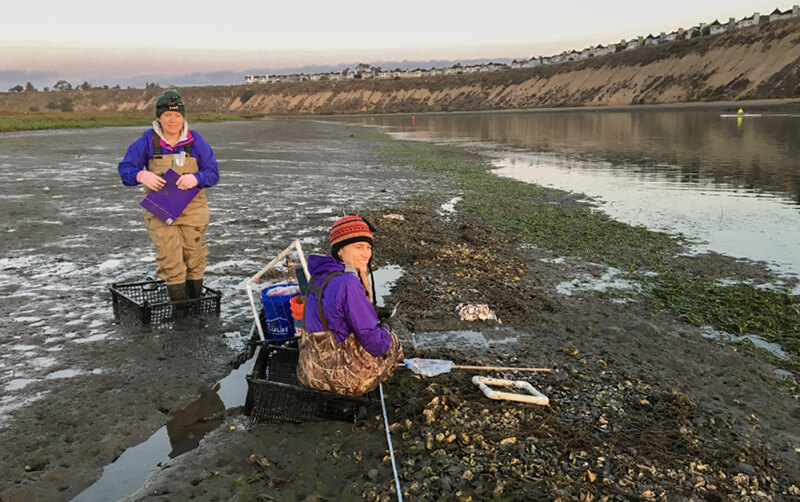
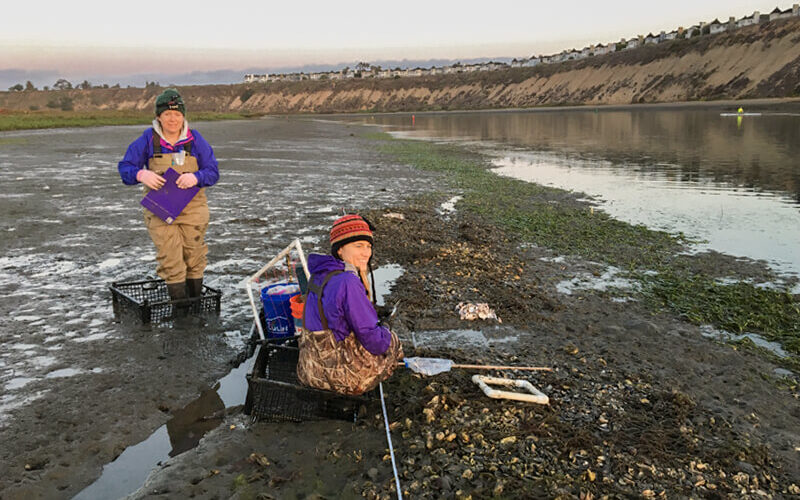
 CSUF biology alums Althea Marks, front, and Marissa Wu monitor restored oyster beds in Upper Newport Bay. (Courtesy of Orange County Coastkeeper)
Marine biologist Danielle Zacherl is teaming up with collaborators from Orange County Coastkeeper and Cal State Long Beach to use nonnative oyster shells discarded by restaurants to restore native Olympia oyster habitats and eroding Southern California shorelines.
For the past 20 years, Zacherl, her students and collaborators have researched ways to restore the dwindling population and habitat of Olympia oysters, the only oyster native to the West Coast.
“Due to a combination of overharvesting, pollution from paper pulp mills and extensive coastal bay development, the species has suffered significant losses since the early 1900s,” said Zacherl, Cal State Fullerton professor of biological science.
Zacherl’s research focuses on restoring Olympia oyster beds and using living plants and animals to stabilize eroding coastal areas, a technique known as living shorelines.
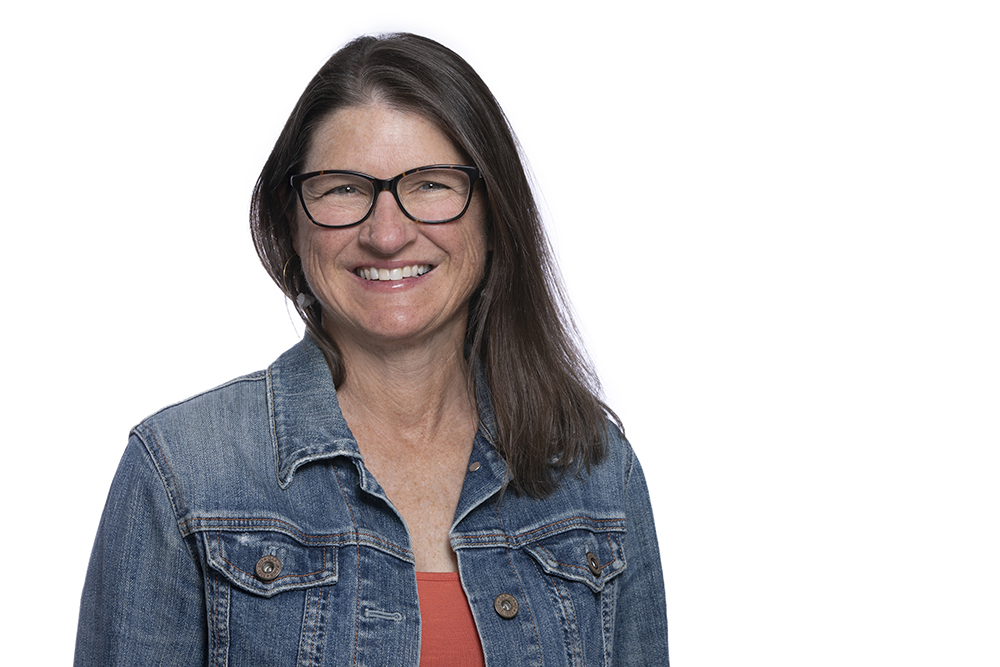 Danielle Zacherl, professor of biological science
“The oyster beds are key to healthy marine ecosystems and help protect the shoreline from erosion and rising sea levels,” she said.
Zacherl came up with the idea to adapt an East Coast method of deploying strings of dead oyster shells off public and private docks during the Olympia oyster’s reproductive season.
Locally produced oyster larvae settle on the shells, which are later harvested and placed onto the restored bed to jump-start the native population.
Zacherl’s former student Kaysha Kenney, marine restoration director at Orange County Coastkeeper, scaled up the effort.
Kenney, who earned her bachelor’s degree in biological science with a focus on marine biology in 2019, launched “Shells for Shorelines,” a program that recycles restaurant oyster shells. The program has since expanded to bays in Seal Beach, Newport Beach and Long Beach.
“Instead of buying oyster shells from aquafarms, the program intercepts shells from restaurants that are bound for the landfill,” Zacherl said.
Kenney said the program partners with 10 restaurants in Orange County and Long Beach. Since the program started in June 2024, over 14,000 pounds of oyster shells have been recycled.
“This initiative helps reduce food waste, lower program costs and engage the local community in marine science projects,” said Kenney, who holds a master’s degree in marine biology from James Cook University in Australia.
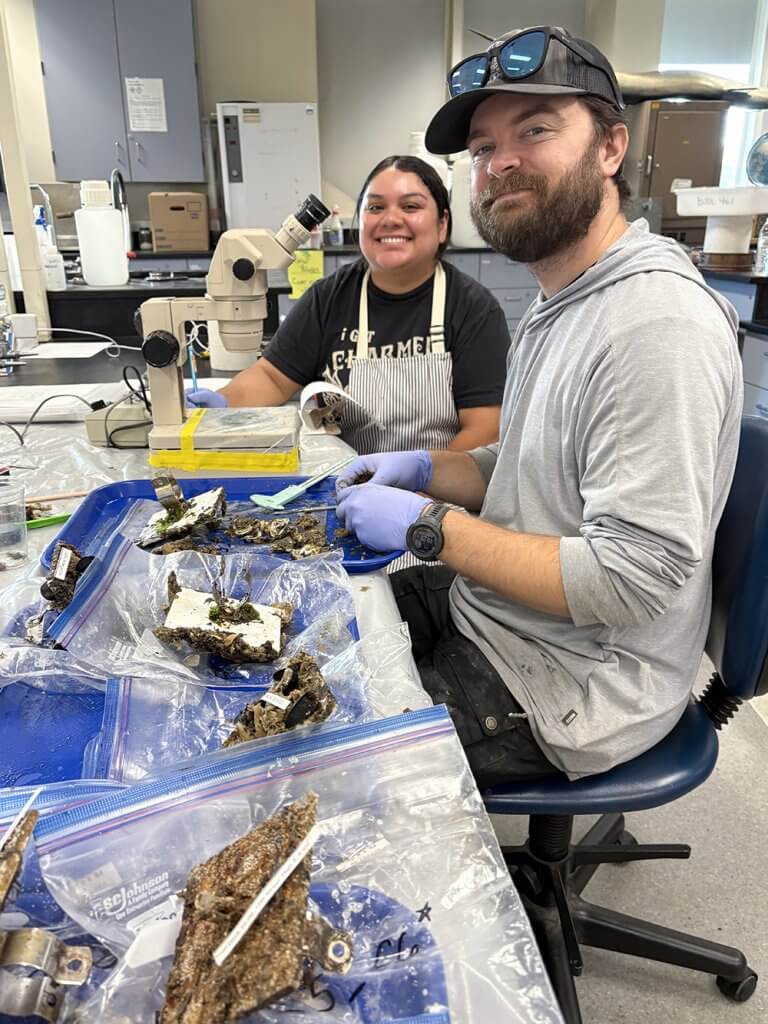 CSUF biology graduate student Leeza-Marie Rodriguez and environmental studies graduate student Dan Gifford work in the lab to assess oyster recruitment strength on retrieved oyster recruitment plates that were deployed last summer within Seal Beach National Wildlife Refuge. (Courtesy of Danielle Zacherl)
The collected shells are cured in the sun for at least six months to eliminate pathogens before being placed in the ocean to recruit new generations of oysters.
“Then we take those shell strings laden with baby oysters and move them to restoration sites to give the sites a boost of live oysters to help them establish their own self-sustaining populations,” Zacherl said.
The collaborative research team has received over $700,000 in funding from the National Fish and Wildlife Foundation’s National Coastal Resilience Fund for the living shorelines and oyster shell recycling programs.
The project aims to address coastal erosion at three locations within the Seal Beach National Wildlife Refuge and Anaheim Bay.
Of the funding, CSUF received $137,806 from Orange County Coastkeeper for the work being conducted by Zacherl and her students.
Five CSUF graduate student researchers, two undergraduate researchers and a postgraduate research technician, as well as Christine Whitcraft, professor and wetlands ecologist at Cal State Long Beach, are contributing to the project.
The grant supports the use of oyster shells to address coastal erosion that is threatening a U.S. Navy building and to construct a living shoreline.
“We’ve established that oysters recruit throughout the wildlife refuge, which means that when we lay out our restoration structures, the remnant oyster population — present but not forming oyster beds — can seed the oyster beds we build naturally in two of the three locations,” Zacherl said.
“The third location, where the shoreline is severely eroding and threatening a Navy building, will likely require subsidies from our shell strings program to establish the restored oyster population.”