
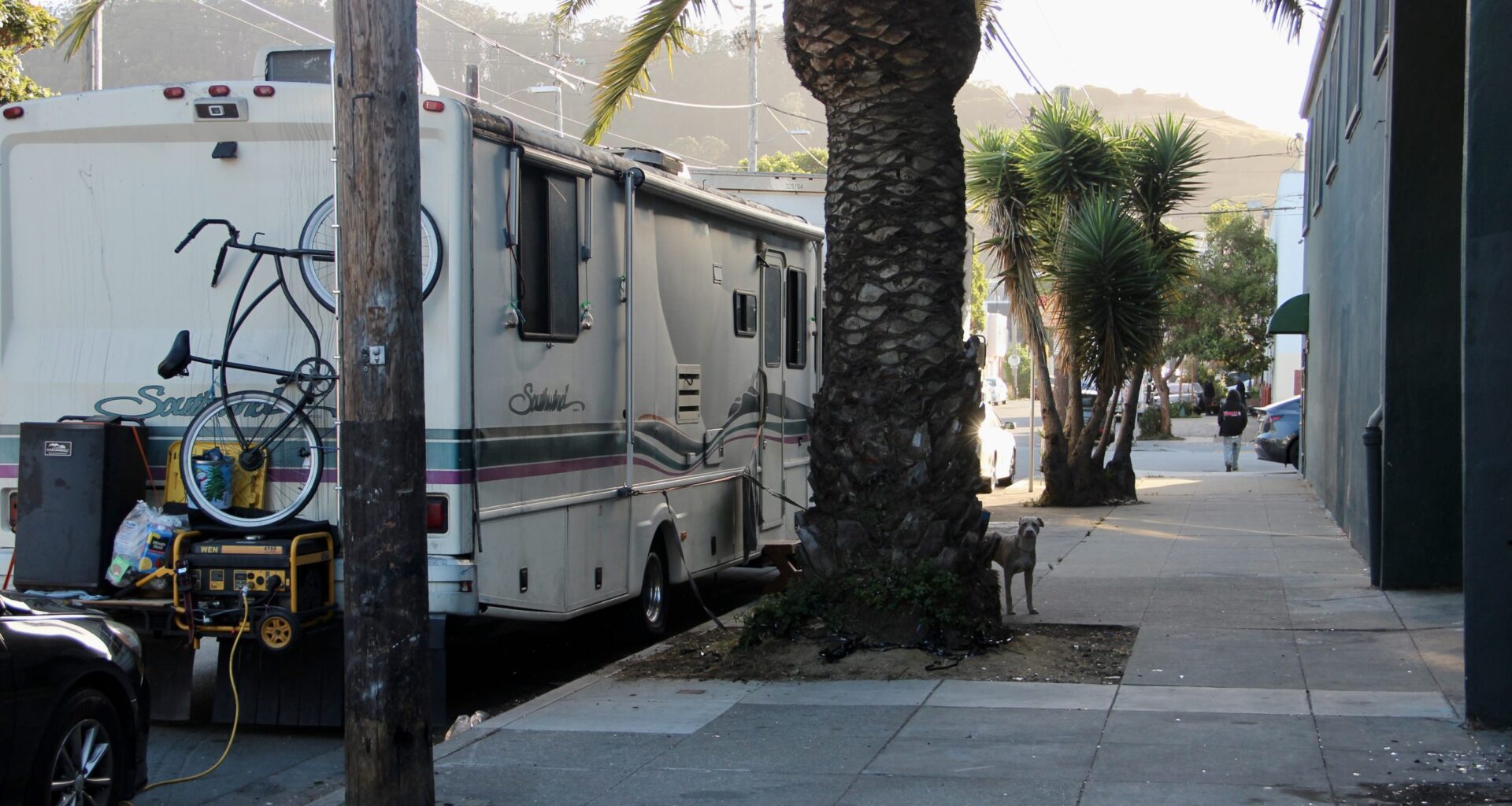
Four San Francisco RV dwellers say that a man dressed in a city worker’s outreach uniform has been going door to door selling temporary parking permits for up to $500 in cash, promising that RV dwellers will be able to stay parked on the streets during a citywide ban.
Emily Cohen, a representative from the Department of Homelessness and Supportive Housing, confirmed Wednesday evening the matter is “being investigated” by the city, and that permits would be audited to ensure authenticity. Cohen said the city will work to “pursue accountability” if the allegations are true.
Jesus and Kathia, two of the four, have been living in an RV parked in San Francisco’s Bayview for a year and a half. Kathia, who is expecting her first child in two weeks, is desperate to find more stable housing. At the very least, she wants a temporary permit, which offers a six-month grace period before their RV will be towed.
In mid-November, 19 days after the RV ban went into effect, a homeless outreach worker knocked on her RV window and offered to sell her the coveted permit — for $500 in cash, she said.
Two other RV dwellers reported the same, saying a man dressed in a Homelessness Outreach Team uniform offered a permit in exchange for hundreds in cash. One, concerned by the offer, called the Coalition on Homelessness, a local homelessness advocacy organization, and asked for advice.
Jennifer Friedenbach, the group’s director, reported the allegation to the city.
On Wednesday, Mission Local witnessed investigators from the city attorney’s office speaking with Jesus and Kathia in Spanish. The couple indicated that they had shared information with the investigators about the alleged permit-for-cash offer they received.
The alleged scam could result in RV dwellers losing their homes. Hours before her interaction with the investigators, tow truck operators and San Francisco police officers tried to take Kathia’s RV during a mass sweep in which at least three other RVs without permits were towed.
On Wednesday morning at 8:30 a.m., two San Francisco police officers “threw open” her door and warned her that she would be towed, she alleged. When a reporter began recording after she refused to leave her vehicle, she said, the officers let her off with a warning.
The Homelessness Outreach Team, colloquially referred to as the HOT team, has been deployed to mobile homes across the city to inform RV dwellers of the ban, which went into effect in November.
In July, Mayor Daniel Lurie and the Board of Supervisors signed a new law that banned RVs from parking in the city for more than two hours. For the nearly 500 San Franciscans who live in a mobile home on a city street, the law means they will need to find new housing or face street homelessness.
The city offered any RV dweller who could prove that they had been living in San Francisco on or before May of this year a six-month parking permit that would give them more time to find alternative housing. That is the permit RV dwellers allege was being sold.
Getting those permits — a roughly 3” by 3” blue sticker posted on the back of an RV’s exterior — has not been easy. The city has rejected applications frequently, asked for various forms of documentation proving an RV dweller’s residency in the city since May, and outsourced permitting questions to the city’s first AI chatbot.
Both Jesus and Kathia said they recognized the bearded, Latino man wearing a HOT team jacket who knocked on their door. They said he was a worker at a homeless shelter they had stayed at before they moved into their RV.
HOT team members are a mix of workers employed by the city and those contracted by the nonprofit Heluna Health. It is unclear whether the man clad in a HOT team jacket was a city employee or a contracted worker — or an out-and-out impostor.
Jesus and Kathia did not have enough money to pay the man $500 in cash up front and instead offered him $250, promising they would pay the rest later. The man agreed and gave them the permit, which they were desperate for — both had tried to get one before, but were told the application period had ended.
“He told us clearly, ‘If anyone asks, don’t tell them it was me,’” said Kathia, speaking in Spanish. “I knew the risk of [the city] taking [my vehicle] away from us,” said Kathia. “My baby is going to be born soon … I know these conditions aren’t ideal, but right now, this is all we have.”
After Jesus woke up the next morning and saw that his permit had been scratched off, leaving only the sticker’s residue, he tried getting his money back and texted the man using a number he had left for the couple.
“I need my money now,” texted Jesus, in Spanish. “Since you don’t want to come here, I’ll go where you are.” The man responded that he was at home in Antioch.
“Give me an exact date,” Jesus pleaded. “I need my money … You weren’t able to help me with anything.”
The man responded that he did not have the money, and then stopped replying.
Mission Local called and texted the same number but received no reply. Messages were marked “read” by the recipient.
Jesus and Kathia are not sure what to do now, or where they will sleep if their vehicle is towed. The options for family shelter are limited until her child is born, she said, and she does not want to leave her dog, who also lives in her RV, behind.
“I’m nervous and scared to go to the hospital only to find that my trailer won’t be there when I come back with my son,” said Kathia. “It’s my home, I know it’s an RV, but this is where I am.”
Additional reporting by Mariana Garcia.