
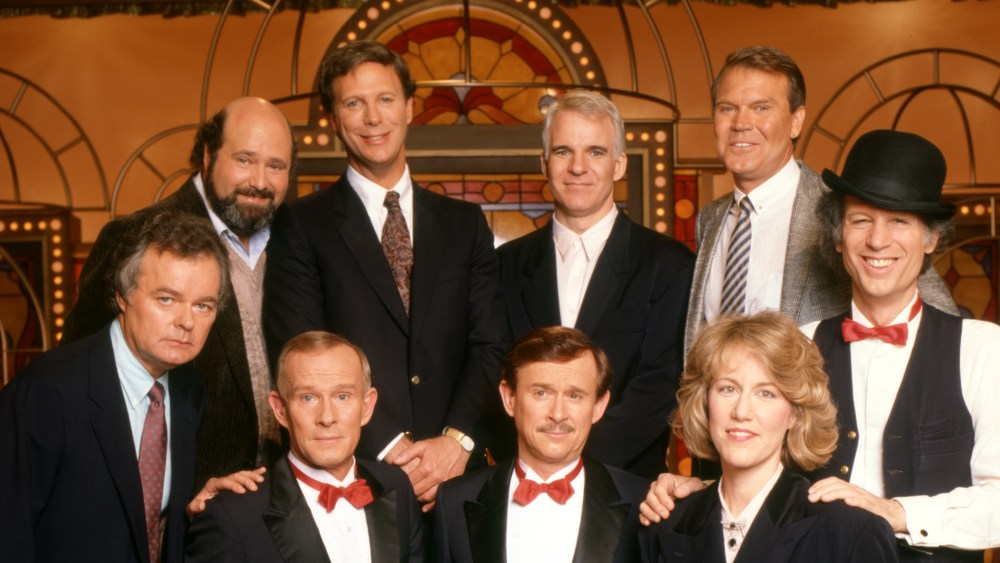
Rob Reiner has been showered with accolades for his work in film and TV in the days since he and his wife, Michele Singer Reiner, were found brutally slain in their Brentwood home.
Rob Reiner had a knack for intersecting with cutting-edge comedy forces just as they were on the cusp of breaking big. Reiner was born into a pedigreed showbiz family as the son of Carl Reiner, a pioneering star of “Your Show of Shows,” and singer Estelle Reiner. Rob Reiner grew up around Mel Brooks, Sid Caesar, Neil Simon and a slew of comedy legends who were close to his father.
But as he came of age in the late 1960s, Rob Reiner also had a good eye for talent and collaborators. He became involved with the out-there San Francisco improv troupe the Committee, whose members included future “The Bob Newhart Show” co-star Peter Bonerz and “Jaws” screenwriter Carl Gottlieb. Reiner and friends that included Richard Dreyfuss, writer Larry Bishop and writer-actor David Arkin would often drive up to San Francisco from Los Angeles to catch the Committee’s Sunday night shows.
Reiner and a handful of others eventually created an Los Angeles-based offshoot troupe that was dubbed the Session. The Committee had a residency in 1968 at the Tiffany Theater on the Sunset Strip that was a formative experience for all involved.
As an actor in improv, Reiner was “fearless,” Gottlieb recalls. “He would attempt any sketch. It didn’t matter what the content was. If it had the potential for humor, he’d try it.”
Even as a young man, Reiner had a presence and a charisma that drew people to him. “Rob was always kind of a spark plug. He’d do everything bigger and louder than everybody else. Not in furtherance of his ego. Always for the material, which made all the difference,” Gottlieb recalls. In those days, the Committee members were committed to social justice and anti-war protests. “For us it was an opportunity to find some deeper meaning in the improv work,” he says.
“We’d do a couple of anti-war pieces to provoke the audience. We had some arguments a couple of times. In San Francisco after we’d provoked the audience we’d bring the house lights up and have a teach-in session,” Gottlieb says.
After his time with the Committee and the Session, Reiner eventually found his way onto the writing staff of “The Smothers Brothers Comedy Hour.” That show became the stuff of TV legend as the stars famously battled CBS over content and censorship concerns. Reiner joined a murderer’s row of comedy talent in the “Smothers Brothers” writers room, which included Steve Martin, Mason Williams, Pat Paulson, Bob Einstein (aka Super Dave Osborne) and musician John Hartford.
“Smothers Brothers” was famously canceled in 1969 — and it went on to win the Emmy for best variety series two months later. The show was so respected in the creative community that all the writers went on to promising new projects. Within months of “Smothers Brothers” demise, Reiner had been cast as an actor on another edgy CBS series, Norman Lear’s “All in the Family.” That series made Reiner a household name — even if that name was “Meathead.”
Reiner was squarely at the center of Lear’s universe of shows. And through his marriage in the 1970s to Penny Marshall, Reiner was adjacent to the Garry Marshall universe of shows that included ABC’s “Happy Days” and “Laverne & Shirley” (which starred Penny Marshall). All of those connections would come into play in Reiner’s post-“All in the Family” years as he pursued his desire to make his mark as a writer and director. His first effort was a film that remains a landmark, oft-quoted comedy, 1984’s “This Is Spinal Tap.” And that was followed by smashes that include 1986’s “Stand by Me,” 1987’s “The Princess Bride” and 1989’s “When Harry Met Sally.”
Reiner’s close friends often marveled at how well he wore his success, especially when he made such a triumphant segue into helming.
“He was very cool about it. Having grown up as Carl Reiner’s son, he was no stranger to celebrity. His extended family was the ‘Laughter on the 23rd Floor’ crowd,” Gottlieb says, referring to Neil Simon’s play about his time writing for “Your Show of Shows.”
Gottlieb believes the spartan ethos of improv made a big mark on his former housemate.
“One of the key lessons of improvisation is that you never said ‘No but’ you always said ‘Yes and.’ Rob was really good at that. When he was doing a sketch, he would always stay in character. He took the work very seriously,” Gottlieb says. “And then he applied all the lessons he learned on stage and at his father’s knee to practical every day use.”
(Pictured: Top row: Mason Williams, Rob Reiner, Bob Einstein, Steve Martin, Glen Campbell and John Hartford at the 1988 “Smothers Brothers Comedy Hour” reunion. Bottom row: Tom Smothers, Dick Smothers and singer Jennifer Warnes.)