
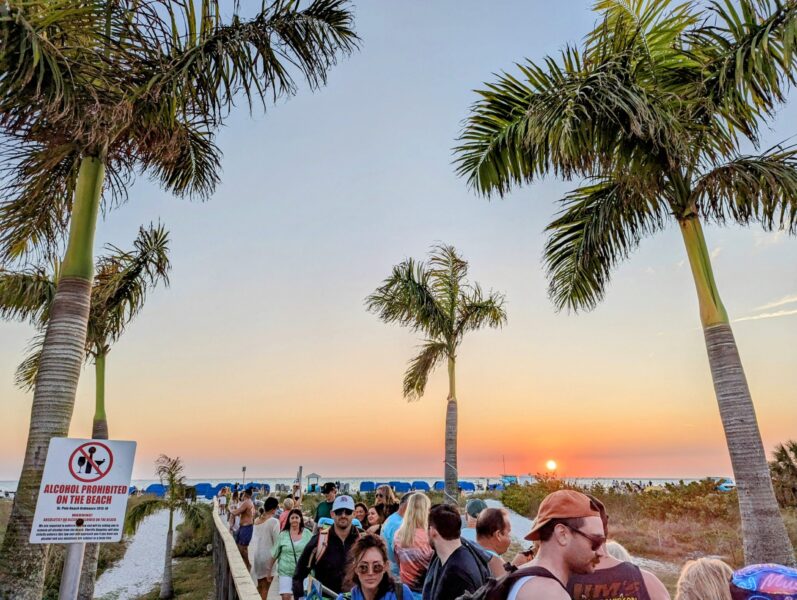
Pinellas County, widely known as a refuge for northern travelers seeking sandy beaches and warmer climates during the winter, has experienced a steep decline in Canadian tourism.
Local data from Visit St. Pete-Clearwater (VSPC) mirrors a national trend: Canadians spent 17% less in the area this year. The number of overnight stays decreased by 17.6%.
Those numbers could be worse. Canadian visits to the U.S. are down by 25.7%, and land crossings have plummeted by 30.1% in 2025.
While the county’s economy is heavily reliant on tourism, and Canada is, by far, the largest source of local international visitors, stakeholders remain optimistic. Brian Lowack, president of VSPC, sought to assuage any concerns at a Dec. 17 Tourist Development Council (TDC) meeting.
“We’re very bullish on our international markets and our investments in our international markets,” Lowack said. “Specifically, our key international markets.”
Data notably shows that visitors from Germany and the United Kingdom spent 11.4% and 6.8%, respectively, less in Pinellas over the past year. Brazil, with an 8.5% increase, provided a lone bright spot.
The downturn coincides with simmering international tensions. President Donald Trump expressed a desire to make Canada the 51st state earlier this year and applied several layers of tariffs to the nation’s northern neighbor.
Russ Kimball, vice-chair of the TDC, said the Toronto Blue Jays reaching the World Series in October could increase Canadian tourism in February. The team has held spring training in Dunedin since its inception in 1977.
Kimball, CEO of the Sheraton Sand Key Resort, also believes that “Europe is coming back a little bit … there is going to be a hemmed-up market.”
“People have not gone on vacation for the summer,” Kimball added. “And it’s cheaper to go to the beaches than it is to Epcot right now, or whatever for that.”
County Commission Chair Brian Scott, who also leads the TDC, recently helped highlight the area during a trip to Germany. He noted that “we all know international tourism is down.”
Scott said Europeans “don’t like the immigration posture of the United States right now.” He and his colleagues were surprised by the number of 24-hour news stations in Germany, and Scott said that those provided “zero context and the worst coverage you could possibly imagine.”
European views on domestic immigration policy are “really hurting demand right now,” Scott continued. He said increasing hotel rates and resort fees are also impacting international travel.
However, Scott also agreed with Kimball’s assessment. “I’ve seen this pendulum swing back and forth,” he said. “And when it comes back, it will come back pretty hard. The question is, when is that actually going to happen?”
According to VSPC’s report, the local tourism industry has started the new fiscal year on a sour note. An executive summary states that in November, county hotels “declined a noticeable” 21.3% year-over-year.
Hotel demand declined by 18.4%, while supply increased by 4.3%. Year-over-year occupancy rates dropped by 21.8% to 61% last month.
County hotels also “performed poorly” compared to peer markets, which were also “muted” and saw year-over-year declines. The summary notes that Pinellas had the largest increase in supply and the most significant decrease in demand and occupancy.
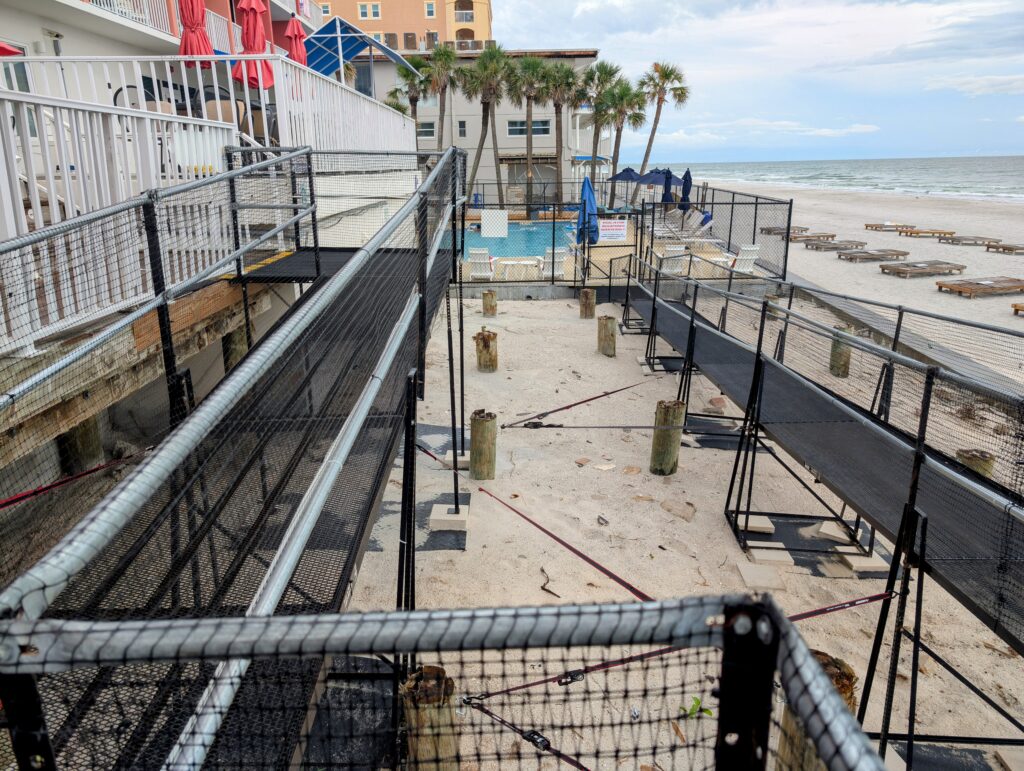
Redington Beach storm damage as of June 2025.
VSPC data also provides reasons for continued optimism in an area that withstood a devastating 2024 hurricane season. Pinellas still collected over $92 million in bed taxes, a 6% surcharge on overnight stays, for the fourth consecutive year.
In addition, nearly 15 million visitors in fiscal year 2025 generated an economic impact of over $10 billion, also for the fourth consecutive year. Clearwater Mayor Bruce Rector provided some much-needed context and credited Lowack and his team for their efforts.
Rector said, “I don’t think any of us would have believed this was possible” in November 2024. Visitation numbers are “not that far off, even after the damage to all of our tourism properties.”
“It is amazing what we have done collectively as a county,” Rector added. “And I mean not just the municipalities and county government, but all of our private property owners, to work together to achieve these results.
“Where we’re at now compared to where we could have been – is just amazing.”