
The aviation industry is facing a looming deadline, and it isn’t a flight departure. Leaders warn a workforce shortage could soon threaten safety and growth as air travel demand rebounds.
According to Boeing’s 2025 Pilot and Technician Outlook, the industry will need nearly 2.4 million new aviation professionals by 2044 to keep pace with rising air travel demand. That includes 660,000 new pilots, 710,000 maintenance technicians, and 1 million cabin crew members.
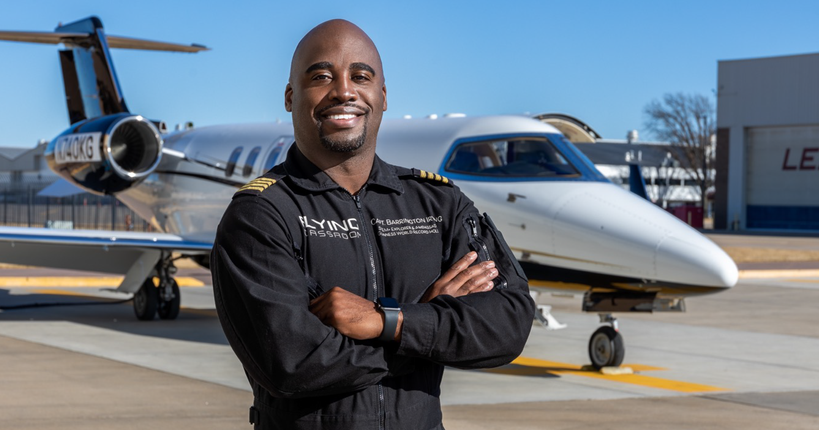
In South Florida, local organizations are moving beyond naming the problem to actively building a local and diverse workforce pipeline. Captain Barrington Irving — the first Black man to fly solo around the world and founder of the Barrington Irving Technical Training School (BITTS) — identifies two primary hurdles.

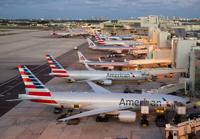
American Airlines Hangar at Miami International Airport.
(Miami International Airport)
“We have so many people retiring, and while we are doing better at getting more minorities involved, the bigger challenge is gaining greater attention to the opportunities that are out there and strengthening recruitment.”
Root causes
Industry leaders say the shortage stems from structural failures decades in the making.
“The air traffic control system has never fully recovered from the 1981 strike,” said Dr. Vena Symonette-Johnson, professor of aviation and safety at Florida Memorial University (FMU) and an alumna who has worked in the industry since 1989, referencing the Reagan-era mass firings.
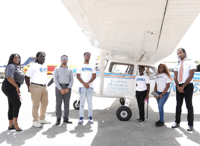
FMU staff and alumni in front of the Cessna 172S aircraft with Garmin G1000 cockpits.
(Courtesy of FMU Aviation and Safety Department)
“And the shortage in pilots has a lot to do with funding,” she added.
More recently, a 43-day federal government shutdown forced 13,000 air traffic controllers to work without pay, leading to burnout and mass sick calls. The Federal Aviation Administration (FAA) confirmed these staffing gaps caused hundreds of daily delays. Mandatory retirement rules have compounded the issue: pilots must retire at 65, and air traffic controllers at 56, with some being eligible earlier based on service years. During the shutdown,CNBCreported that retirement rates spiked to 15–20 controllers per day, up from the usual four.
Prior to that, the COVID-19 pandemic had already accelerated the crisis. Captain Clayton James, an American Airlines pilot and director of the Organization of Black Aerospace Professionals (OBAP) Miami ACE Academy, noted that mandatory retirements collided with hiring freezes.
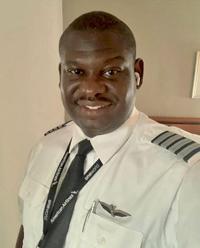
Clayton James, American Airlines pilot and OBAP Miami ACE Academy director.
(Courtesy of OBAP)
“A lot of companies decided to make cuts for their survival. There was no hiring during COVID, but people were still continuing to get older,” James said. “What companies are doing now are trying to catch up from that period.”
Training across the entire system
Located adjacent to Opa-locka Executive Airport, FMU offers majors in Aviation Management, Air Traffic Control, and Professional Flight. But Symonette-Johnson says cost remains the primary barrier for aspiring pilots.
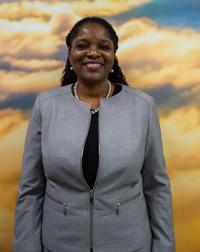
“We graduate about 20 to 25 students per year, and roughly 90% are placed in aviation roles.” -Dr. Vena Symonette-Johnson, FMU
(Amelia Orjuela Da Silva for The Miami Times)
“Students need money to fly because it’s very expensive. When you get a college degree, that doesn’t account for the flight time. Students need to build hours to fly for an airline, and all those licenses have to be paid for,” she said.
In the U.S., flight training in a basic aircraft like a Cessna 172 can cost$150–$200 per hour, with total licensing costs ranging from $8,000 to over $100,000.
To mitigate these barriers, Symonette-Johnson said FMU provides flight training through a partnership with Wayman Aviation Academy and allows students to use university-owned aircraft — Cessna 172s with Garmin G1000-type cockpits — at discounted rates. The university’s Air Traffic Control program includes a control tower and simulator lab designed to mirror FAA operations.
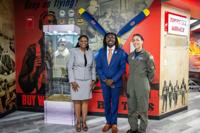
(L/R) FMU professor Dr. Vena Symonette-Johnson, aviation student Paladre Johnson, and FMU alumna Gabriella Deza, who is now a U.S. Coast Guard helicopter pilot.
(Amelia Orjuela Da Silva for The Miami Times)
The department is also pursuing FAA Part 141 certification, which would reduce the flight hours required for airline eligibility from 1,500 to 1,000, an adjustment Symonette-Johnson said makes a difference both “financially and psychologically.”
Unlike many other countries, the U.S. offers limited public subsidies for training. FMU offsets this through a partnership with University of Miami’s Air Force ROTC. Through this program, students can commission as Air Force officers, and those selected for pilot roles receive fully funded military flight training after graduation. A previous version allowed students to participate for two years and choose whether to commission, a flexibility Symonette-Johnson says significantly expanded access.

FMU Blacks In Aviation Museum.
(Amelia Orjuela Da Silva for The Miami Times)
“I myself was one of those people who were blessed to be on that program, and as a result, the industry saw a lot more pilots,” she said.
Additional support in the form of mentorship and scholarships comes from partners like American Airlines, Spirit Airlines, Miami International Airport, Fort Lauderdale–Hollywood International Airport, and nonprofits like OBAP.
“We graduate about 20 to 25 students per year, and roughly 90% are placed in aviation roles,” Symonette-Johnson said.
FMU alumna Gabriella Deza, now a U.S. Coast Guard helicopter pilot, said gaps are also felt in the military, leading to restructured training programs.
“We’re looking at different programs — maybe working with the army, shortening our training program, so that when we have people who are interested in helicopters, they start out in helicopters from the beginning.”
For Paladre Johnson, a current aviation student and intern at Miami International Airport, representation matters.
“Attending an HBCU with access to an aviation program is rare,” he said. “Walking the stage knowing you’re part of such a small percentage of people — it’s impactful.”
The missing middle
While pilots dominate the headlines, the system also relies heavily on maintenance and repair operations (MRO) and fixed-base operations (FBO). This is where BITTS focuses its efforts.
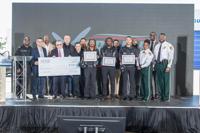
First cohort of graduates at BITTS.
(Courtesy of BITTS)
“I think so many kids are so focused on a career that they don’t pay attention to the actual industry,” Irving said. “How does money flow in and out? The different positions, the different ways in which you can grow.”
Irving views BITTS as the capstone of a pipeline that includes his nonprofit, Experience Aviation, and his STEM curriculum,Flying Classroom. Unlike traditional pathways, BITTS focuses on speed and workforce readiness. Programs run 12 to 16 weeks, providing hands-on technical training and micro-credentials, with the option to pursue further education later.
“A big challenge with aviation is the actual journey,” Irving said. “It’s not as straightforward as law school or medical school. You’re talking about careers and jobs that most people have never heard of. Navigating our industry can be a challenge, and BITTS helps with that.”
BITTS partners with United Way Miami, which provides funding and wraparound services such as stipends, transportation assistance, and résumé training. For 25-year-old student Deion Kingcade, the program offers stability often missing in minority communities. Black Americans made up just 3.6% of pilots and flight engineers in 2023, according to the Bureau of Labor Statistics.
“Because of the cost and having lack of experience, you have to go through a program that’s partnered with aviation,” he said. “This right here is a blessing.”
The program boasts graduation rates in the high 80s to low 90s, with alumni landing jobs at Miami International Airport and private aviation hubs. Some alumni, including Tremaine Johnson, have returned as instructors.
“I feel like this school and training is huge for people that don’t know too much about the industry and want to dive in,” he said. “I was in class, and we learned in depth about marshaling as a skill to signal the planes to make left and right turns and how to park them.”
Irving believes long-term success requires restoring dignity to skilled trades.
“The first time someone should be able to use a tool shouldn’t be when they’re in high school or college,” he said. “We’ve abandoned embracing the idea that there is dignity in skilled trades. Yes, you work hard, might be outside in the sun or in the cold, but we need individuals to do those things.”
Starting the pipeline earlier
OBAP’s Miami ACE Academy reaches students early, exposing middle and high schoolers to aviation STEM careers before college.
“We had students who were exposed to being air traffic controllers, and they fell in love with that,” said Antonio Thomas, National ACE Academy director. “Even talent acquisition and HR, people who go find the talent needed for the aerospace industry. They get exposed to a lot of things they would never think about, from designing planes to designing flight attendants’ uniforms, even how the seats look inside the aircraft.”
OBAP operates 47 FAA-endorsed ACE Academies nationwide, including in Puerto Rico, the U.S. Virgin Islands, and Hawaii. Last year, they served a total of 861 students.
Students tour airline operations, maintenance facilities, military aviation units, and airport logistics centers. The program culminates in a Discovery Flight, where students take the controls.
“That plants the seed,” Thomas said. “Once they have the bug to fly, they’re all in.”
Graduates receive a year-long OBAP student membership and access to scholarships, mentorship, and advanced programs like Solo Flight Academy,a two-week program which provides up to 10 hours of flight time.