
As we near the start of the New Year, it appears college football’s head coaching carousel has closed its doors for business.
Kyle Whittingham filled the opening at Michigan this week, and Marcus Freeman looks like he’s passing on the NFL this cycle to stay at Notre Dame. That means we’ve had 32 head coaching changes, including 17 at Power 4 programs.
Which one will turn out to be the best hire? Probably Lane Kiffin at LSU because it won’t be long before the Tigers are in the College Football Playoff and well-positioned to win a national title.
But don’t sleep on Whittingham at Michigan. He’s got Bryce Underwood, a healthy NIL budget, and he’s proven he can win at Utah playing the kind of football Wolverines fans love. The game is still won at the line of scrimmage, and Whittingham has a stronger record doing that than Kiffin.
Which teams in the current playoff field are strongest on the offensive and defensive lines?
Miami, Oregon, Texas Tech and Ohio State rank first, third, seventh and 10th in lowest pressure rate per dropback with the Buckeyes and Hurricanes both in the top-10 in fewest sacks per dropback allowed.
Defensively, Indiana, Miami, Ohio State and Texas Tech rank third, seventh, ninth and 10th in pressure rate with the Buckeyes, Hoosiers and Hurricanes ranked in the top 10 in sack rate.
Oregon, meanwhile, is the only Playoff team ranked in the top-30 in rushing, coming in second, averaging 5.9 per carry. Texas Tech, Ohio State, Georgia, Miami and Indiana all allow fewer than three yards per rush and rank in the top-10 in rush defense.
Will any of this mean anything when our next national champion is crowned in Miami in three weeks? I think so. But what do I know?
I went 4-0 picking straight-up winners to open the Playoff and improved to 84-57 on the season. All that probably means I’m due for a setback in this week’s quarterfinal round.
College Football PlayoffNo. 5 Oregon (-2.5) vs. No. 4 Texas Tech
Dan Lanning’s team gave up 28 points in the second half to James Madison after leading 34-6 at halftime in its 51-34 opening round victory over the Dukes at home. The big question heading into this Orange Bowl matchup is whether the Red Raiders have enough offense to beat the Ducks. The answer: Yes.
Texas Tech averaged better than 30 points per game against the FBS-winning teams it faced and 32.3 points per game in its three wins over ranked opponents. The better question here might be, will Oregon’s defense show up? The Ducks allowed 30 points to Indiana, 27 to USC and had arguably their best day holding Washington to 14 points. This will be Oregon’s fifth game against a top-20 scoring offense.
Texas Tech? The Red Raiders have only faced one top-40 scoring offense all season: Utah. Shiel Wood’s unit limited the Utes to 101 rushing yards and 263 yards of total offense in a 34-10 win on the road. Dante Moore and the Ducks, however, are a different animal. Utah and BYU were also the only top-40 scoring defenses the Red Raiders faced. Oregon’s defense is stingier than both of those.
Prediction: I was going to go with Texas Tech, but Moore has been the better quarterback than Behren Morton against FBS-winning teams and ranked opponents. Moore also has the better running game backing him. In the end, Moore finds Kenyon Sadiq in the fourth quarter to break a 13-all tie and sends the Ducks to the Peach Bowl.
No. 9 Alabama vs. No. 1 Indiana (-7)
Kalen DeBoer’s 18-3 record against AP Top-25 opponents is more impressive than Curt Cignetti’s 3-2 mark. Cignetti, though, just beat the No. 1-ranked team in the country in the Big Ten championship game heading into the Rose Bowl.
Both teams’ offenses are battle-tested. This will be Alabama’s eighth game against a top-40 scoring defense and Indiana’s seventh. Both teams’ defenses are also battle-tested. Alabama is the fourth top-40 scoring offense Indiana has faced. The Hoosiers are the best of the top-25 scoring offenses the Crimson Tide have faced (Bama played Georgia twice).
The obvious difference between these teams is Indiana’s success on the ground versus Alabama’s lack of success. The Crimson Tide rank 125th in yards per attempt (3.43 yards per carry); the Hoosiers rank 13th (5.49 per carry). Oklahoma held the Crimson Tide to 28 yards, but blew a 17-0 lead and lost its first-round playoff matchup because it dropped passes, punts, and John Mateer threw a pick-six.
Cignetti’s team hasn’t had many miscues like Oklahoma had against the Crimson Tide. That said, Heisman winner Fernando Mendoza has looked a lot better against unranked teams this season (31 touchdowns, four interceptions) than ranked opponents (2 touchdowns, two interceptions).
Prediction: Mendoza will make mistakes, but the Hoosiers’ running game will be the difference. A Kaelon Black fourth-quarter touchdown run lifts Indiana to a four-point win.
No. 6 Ole Miss vs. No. 3 Georgia (-6.5)
The first time these teams played in mid-October, Georgia outscored the Rebels 17-0 in the fourth quarter for a 43-35 come-from-behind win in Athens. Gunner Stockton threw for 289 yards and four touchdowns, and the Bulldogs shut down Ole Miss’ running game, limiting the Rebels to a season-low 88 rushing yards.
Georgia’s defense has gotten progressively stingier since. The Bulldogs played six games against top-40 scoring offenses and allowed only nine points (Georgia Tech) and seven points (Alabama) in those last two contests. On the other hand, the Rebels faced three top-40 scoring offenses — Arkansas, Georgia and Mississippi State — and allowed 35, 43 and 19 points in those games.
Could Pete Golding’s team find a way to tighten up? If they can, they can win.
Prediction: The problem is Georgia is really starting to play well defensively, and Kirby Smart is 4-0 in in-season rematches. The Bulldogs force two turnovers, hold the Rebels under 100 yards rushing and win the game by 10 points.
Upset alertNo. 10 Miami vs. No. 2 Ohio State (-9.5)
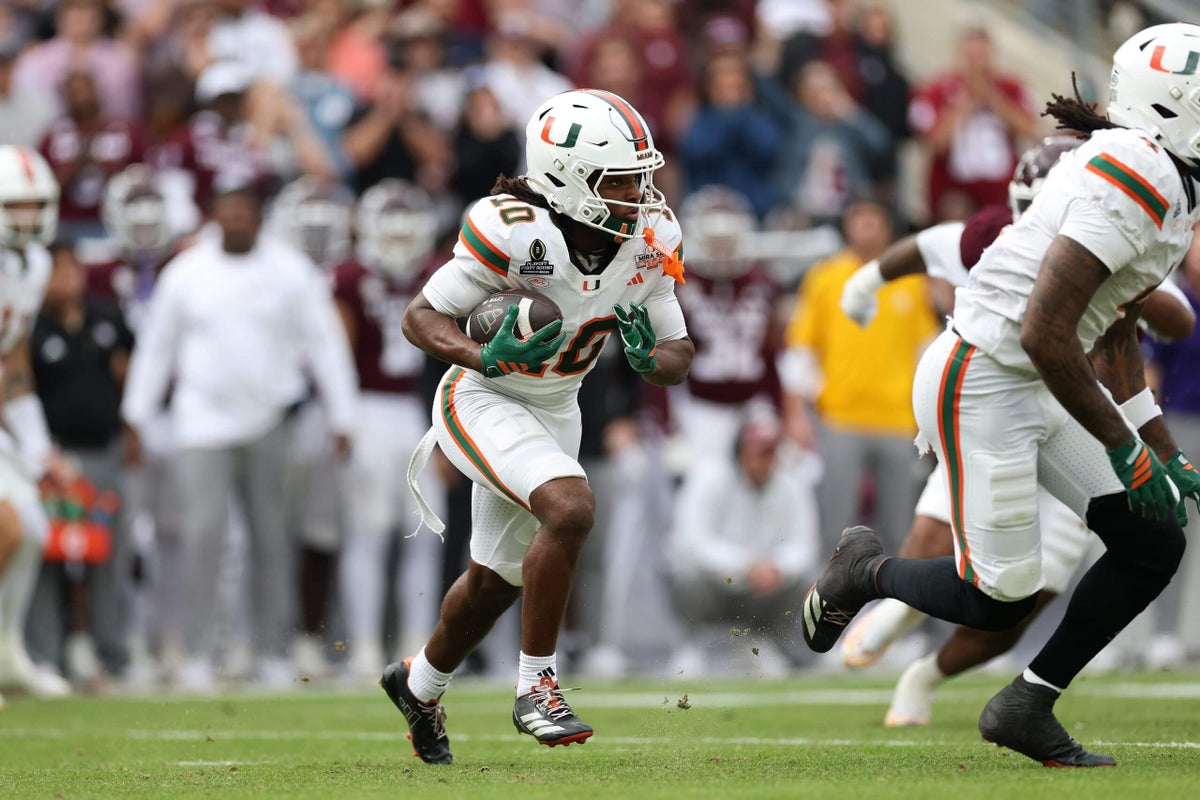
The Hurricanes opened the postseason by surviving a 10-3 defensive struggle in heavy winds at Texas A&M — Miami’s most meaningful postseason win since the 2001 national championship. The Buckeyes, meanwhile, are set to play their 12th Playoff game since the format expanded to four teams with the No. 1 defense in college football.
Ohio State hasn’t allowed an opponent to score more than 16 points in a game this season, which doesn’t bode well for Miami. The Hurricanes are playing their fifth game against a top-40 scoring defense. The most the Hurricanes managed to score in any of those four previous games was 27 in the season-opener against Notre Dame.
Ohio State, meanwhile, is playing its seventh game against a top-40 scoring defense — the Hurricanes rank fourth in fewest points allowed. Throw out the 10-point performance against Indiana and the 14 against Texas, and the Buckeyes managed to score at least 24 points in each of the other four games.
Prediction: The problem for Ohio State here is that Miami has the best defensive front they’ve faced all season, with Rueben Bain and Akheem Mesidor, and the Buckeyes allowed five sacks in their loss to Indiana. Corey Hetherman’s defense racks up six sacks, forces two turnovers to give the offense a short field, and Miami wins a New Year’s field goal-fest by three.
CFP Round 1 report card
The good: I went 4-0, including calling Miami’s upset at Texas A&M.
The bad: I said Oregon would cover the 21.5-point spread against James Madison, but was wrong when the Dukes scored a couple of late touchdowns to prevent that.