
The Athletic has live coverage of Oregon vs. Texas Tech in the 2025 College Football Playoff.
ARLINGTON, Texas — Ohio State walked off the field at Michigan Stadium on Nov. 29 with all the confidence in the world.
The Buckeyes had just beaten their rival for the first time since 2019, and their offensive line had put together its best performance of the season: 419 total yards without allowing a sack. They were 12-0, widely regarded as the best team in the country and poised to make another national championship run.
A month later, that same team walked off the field against Miami after a 24-14 loss in the College Football Playoff quarterfinal at the Cotton Bowl, its season over due to back-to-back losses in which it gave up five sacks to the defense of a fellow title hopeful.
The bottom completely fell out for the Buckeyes, and not because their favorable regular-season schedule left them untested or oblivious to their weaknesses. Ohio State had a plan for handling Miami’s elite defensive line with a reshuffled O-line, just like it had a plan against Indiana in the Big Ten title game with the CFP’s top seed at stake, but neither worked and the Buckeyes took too long to make adjustments.
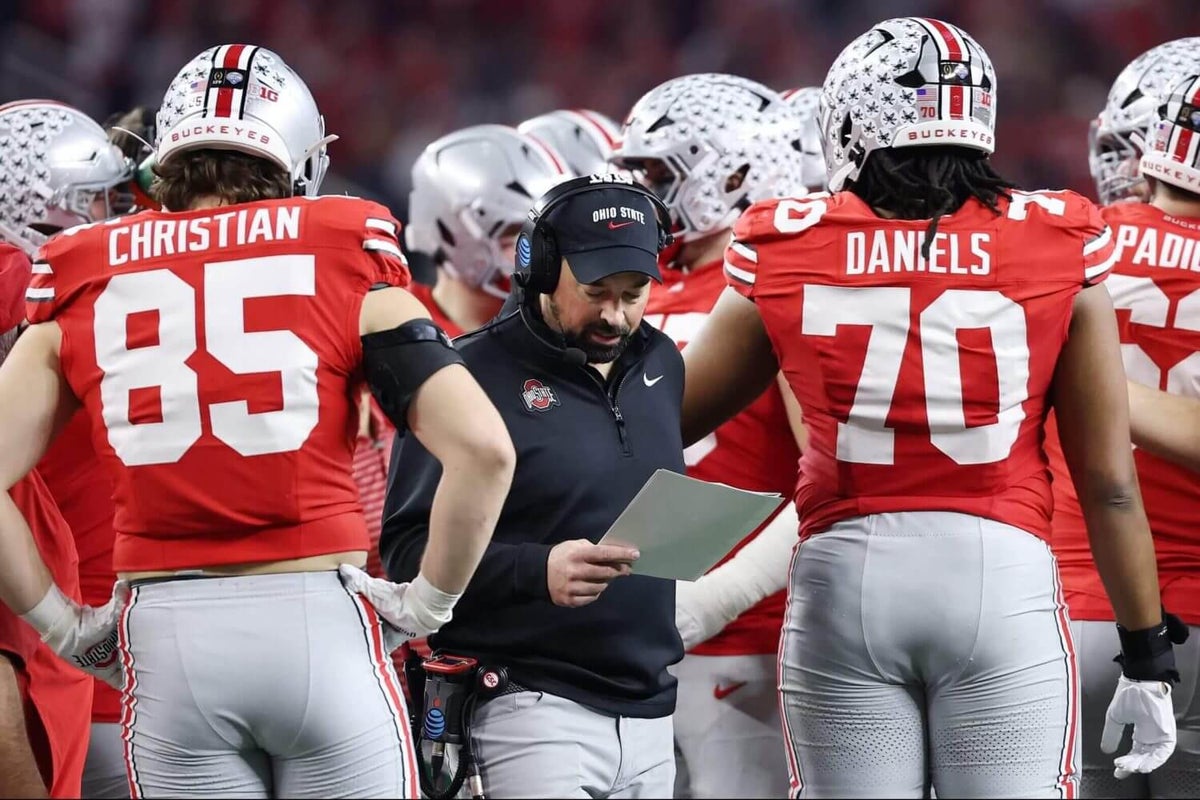
“We put ourselves behind the eight ball,” head coach Ryan Day said. “We worked really hard during the last three weeks leading up to this game to come out of the gates and win the first quarter, win the first half, be ready to go. I thought we had an excellent plan. … I think the guys bought into it, but at the end of the day, we didn’t get it done, and that starts with me and goes down from there.”
Ohio State wasn’t without some in-house adversity in the last month. Three days before the Big Ten title game, news broke that offensive coordinator and play caller Brian Hartline was taking the head coaching position at South Florida. That sent Ohio State into a frenzy, and after Hartline’s unit sputtered in the 13-10 loss to Indiana, Day reclaimed play-calling duties for the first time since the 2023 Cotton Bowl loss to Missouri.
Despite all of that, Day is right; the blame for Ohio State’s December drop-off falls squarely on him. Against Indiana and Miami, Ohio State had 11 first-half drives and tallied 301 yards and just 10 points. In the second halves, Ohio State had 361 yards and 14 points on just six drives. His coaching staff has to look itself in the mirror and figure out why it took so long to adjust.
Ohio State is running Day’s offense. He made the decision to promote Hartline to play caller after Chip Kelly left for the NFL last winter. Now, after taking back play-calling duties and losing, everything that follows goes back to the head coach who won a national championship not even a year ago, but will still feel the heat from a fan base that expects perfection. These two losses, and the entire season, emphasize the importance of his next offensive coordinator hire.
Day’s time as a play caller has come and gone. Ohio State is at its best with him as a CEO and with an offensive play caller he trusts completely, as was the case with Kelly. But to make sure he gets this hire right, he has to evaluate everything.
“Whatever it takes to get better, we’ll do,” Day said.
Ohio State’s third offensive play of the game should’ve been a sign of things to come. Facing a third-and-7, quarterback Julian Sayin dropped back to pass, and before he could even make a read, he was being put into the turf by Miami defensive lineman Akheem Mesidor, who has terrorized opponents all season in tandem with future first-round pick Rueben Bain. Right guard Gabe VanSickle didn’t get off the ball, and Mesidor went right by him, nearly untouched, for the easiest of his two sacks on the night.
While at first look it just seemed like VanSickle was beat, it was also an error in gameplan and execution. The Buckeyes went into Wednesday’s game with a silent snap count plan. Sayin’s job was to diagnose the pressure that was coming, and then left guard Luke Montgomery would look back at Sayin and tap center Carson Hinzman when Sayin was ready to receive the ball. Day was hoping to minimize the noise from inside AT&T Stadium.
“I mean, indoors here, we’ve played here before, and it doesn’t take a lot to really echo inside here,” Day said.
But the system led to a bad start for the sophomore guard making his first career start, and everything snowballed from there.
Even when Sayin did have time to throw, he couldn’t diagnose the coverage he was seeing and held onto the ball too long. That’s what led to the sack when Ohio State got to the Miami 16-yard line in the second quarter, one play before Sayin’s crushing 72-yard pick six on a screen to Brandon Inniss, in which poor blocking by receiver Jeremiah Smith allowed Keionte Scott to spring free and jump in front of the pass.
“We knew we were going to get the ball out of our hand quick,” Sayin said. “There were times today where I held on to the football, and they were able to get after me and get some sacks.”
That was the 11:49 mark of the second quarter. By then, Miami had two sacks and was looking, and feeling, unstoppable. Things got worse before they got better.
After kicker Jayden Fielding missed a 49-yard field goal before the buzzer, Ohio State went into halftime scoreless for the first time since its 2016 Fiesta Bowl loss to Clemson. A two-score lead isn’t an insurmountable deficit in a high-level Playoff game — Arizona State was down 17-3 in last year’s Peach Bowl before taking Texas into double overtime — but for Ohio State, it put a major limit on what it could do.
The Buckeyes have played all season slowly, entering the Cotton Bowl ranked 84th nationally in total plays. And though Day said during the season that they would turn up the pace when needed, he didn’t. Ohio State continued huddling in the second half and put together touchdown drives of 82 and 75 yards, keeping the Miami D-line at bay and allowing just one sack. But the problem with playing at that pace is that when one thing goes wrong, it can derail an entire game. Ohio State had been able to overcome minor versions of that problem because it was more talented than the rest of its schedule. That was not the case on New Year’s Eve.
“When you have a start the way that we did, you put yourself at risk of having to be really darn near perfect in the second half to go win the game,” Day said.
Ohio State wasn’t perfect.
In the fourth quarter, the Buckeyes bounced back from another sack by converting a third-and-15 on what was shaping up to be a game-tying or go-ahead drive. But with 7:25 to play, right tackle Phillip Daniels was called for holding that forced the offense into a second-and-20. They ran four offensive plays the rest of the game, watching the season come to an end as Miami coach Mario Cristobal and quarterback Carson Beck put on a game-icing clinic with a 10-play, five-minute touchdown drive.
While the team was boarding the buses, greeting family and finishing up final tasks in the stadium, Day stood outside the locker room talking with defensive coordinator Matt Patricia and offensive staffers Hartline and Keenan Bailey.
Harder conversations are coming this offseason. As Hartline leaves for USF, Day will be tasked with finding not only a new offensive coordinator but a new ace recruiter. And that decision, which he said he has not given much thought to yet, will be the biggest of the next phase of Day’s coaching career.
Yes, he won a national championship, but now he must show he can adapt like Nick Saban once did, losing coordinators almost yearly from championship-level Alabama teams and replacing them with winners. And he must start with somebody who can right the ship for an offense that scored a total of just 24 points in the season’s two biggest games.
“I’ve got to look at it all and figure out what that was and what that is because it’s not good enough,” Day said. “So we’ll look at it all. We’ve got to do better. We’ve got to do better.”