
Citrus County elected officials once weighed public input, long-range planning and local conditions when making decisions that shaped their communities. Increasingly, they must now ask a different question first: Will this survive a lawsuit?

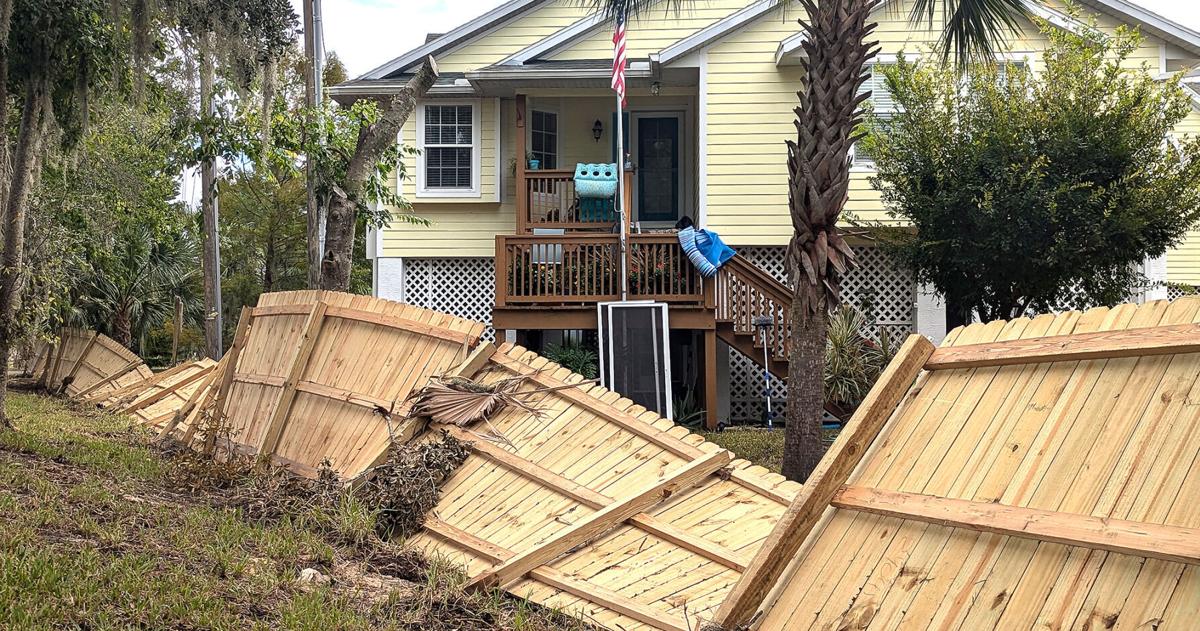
A large fence separating homes adjacent to the Fort Island Trail Park were pushed to the ground by Hurricane Helene in 2024. The Florida Legislature has already passed a law to make it easier to rebuild without following more restrictive local rules to ensure future resiliency.
Matthew Beck / Chronicle photo editor
Over the past several years, a steady stream of state laws has narrowed the authority of cities and counties, shifting power over growth, zoning, enforcement and disaster recovery away from local governments and into Tallahassee — or, just as often, into courtrooms.

Supporters say the changes bring uniformity and efficiency. Critics argue they have replaced locally tailored governance with cookie-cutter rules that ignore the fact that Florida’s communities, from the densely urban centers to rural counties like Citrus — are not created equal.
To some, these intrusions undermine the very principles of local control and individualism on which the state, and the country, were founded.
For Citrus County, Crystal River and Inverness, the stakes are less about ideology than practicality. Here they manage myriad growth pressures along first-magnitude springs and flood-prone coastlines and a development landscape that ranges from rural farmland to fast-changing waterfront corridors. State laws that limit zoning discretion, suspend local ordinances, or expose counties and cities to costly lawsuits reduce their ability to tailor decisions to those conditions.
Case in point
The City of Crystal River in December 2024 unanimously passed its new form-based code, which promotes livability through the encouragement of mixed use. It was a plan that evolved from a public charette and took five years to complete.
Fast forward to August 2025 when Crystal River City Councilman Robert Holmes raised concerns over Senate Bill 180, which limits how cities and counties can regulate land use in the wake of hurricanes.
Crystal River City Attorney Rob Batsel Jr. told council the law prohibits local governments from enacting land development rules “more restrictive or burdensome” than what existed before August 2023 — and applies retroactively, which put parts of the city’s new form-based development code at risk.
“Anything in our new code that’s more restrictive … is void,” Batsel said, and if challenged, “we are obligated to pay attorney’s fees.”
In a county without the legal budgets or planning staff of larger urban areas, the erosion of local control matters not because Citrus is fighting Tallahassee today, but because it may have fewer tools tomorrow when the next development proposal, storm or infrastructure failure arrives.
Quick Bill Guide
Recent and proposed Florida laws are limiting local control in Citrus County. SB 180 (2025) freezes local land-use rules after disasters. SB 218 (2026) lets citizens or businesses sue local governments that violate these rules. SB 208 (2026) speeds up approvals for new housing and limits local fees, reducing community input. HB 105 (2026) allows lawsuits if local enforcement of rules like building codes or safety laws is deemed “unreasonable.” Critics warn these laws hinder local decision-making; supporters say they bring consistency and fairness across the state.
The legal pressure point
SB 180, in conjunction with the “Local Ordinance Preemption” companion bills passed in 2023 have created a legal minefield for local government. The local preemption bill allows courts to suspend local ordinances immediately when challenged, requires local governments to prepare business-impact statements before passing certain ordinances and allows challengers to recover attorney fees and damages (up to $50,000) if a court finds a local ordinance “arbitrary” or “unreasonable.”
Smaller governments with tight budgets, like Crystal River, may be deterred from passing innovative local laws because of the risk of costly litigation.
Citrus County and its cities now face a higher burden when proposing rules that affect development, environment, property or business — even when those rules are tailored to local conditions. The risk of early suspension and legal costs can freeze local initiatives without state involvement.
SB 180 under challenge
Shortly after Gov. Ron Desantis signed SB 180, also referred to as the “Emergencies Bill,” several legal challenges were filed. Separate lawsuits by the 1000 Friends of Florida and 25 individual city and county governments were filed, then merged.
A key early milestone to the case came in December 2025 as a Leon County circuit judge refused to block SB 180 while litigation moved forward. The judge’s ruling allows the legal challenge itself to proceed, but it does not stop enforcement of SB 180 for now.
The consolidated lawsuits will proceed through the judicial process while legislative and political efforts seek remedy. Advocacy groups like 1000 Friends are pushing the Legislature to address or reform the law during the upcoming session.
Citrus County’s comprehensive plan guides everything from affordable housing capacity to conservation. A statewide freeze hampers the county’s ability to adapt planning policies to local needs — especially critical in a region with springs protection, flood risks, and rural character concerns.
A need for change
Earlier this year, State Rep. J.J. Grow (R-Inverness), who supported SB180, told the Chronicle Editorial Board the law is less about politics and more about practical oversight in counties that are already struggling.
“I’m never one that wants to take away from local rule, but I do think… there’s got to be oversight of what’s going on in a lot of these counties,” Grow said. “All counties aren’t created equally… a lot of the other state reps I talked to, their counties are messes, especially… up into the Panhandle in some of those areas where there’s not a lot of money.”
Grow said it’s about stopping a cycle of unsustainable rebuilding in areas with repeated damage and little accountability.
County Commissioner Rebecca Bays told the Chronicle shortly after it was enacted that she understood its intent, but questioned whether it was the right move.
“I understand their intent,” she said, “but limiting local governments and their ability to impose stricter standards in certain cases is not really the right choice … Florida should have stronger building codes… But I’m just not sure that the state telling us what we should or shouldn’t be doing is how it should work.”
On the horizon
Three bills introduced for the 2026 session (Jan. 13 to March 13, 2026) would effectively tie local government’s hands when it comes to regulating growth and enforcing code violations.
SB 218: This follow-on to SB 180 clarifies and expands enforcement mechanisms, giving private citizens and businesses a cause of action against local governments that violate the statutory limitations. Retroactively applies those limitations back to Aug. 1, 2024.
Critics see it as another layer of state control over local land-use authority, especially in areas affected by disaster declarations.
Supporters suggest the bill clarifies exemptions or relieves certain counties not affected by specific disasters from the broad freeze.
SB 208: This bill would take away some of the power local governments have to slow down, block or add conditions to new housing projects. It would make it easier for certain types of residential development — especially smaller projects in already-developed areas — to get approved quickly, and it would limit some of the fees that local governments can charge developers when reviewing these projects.
Critics argue compatibility decisions are essential tools for responsibly managing growth and SB 208 would ignore community input and lead to near automatic OKs of planning decisions.
Supporters say the bill strengthens property rights and improves housing affordability by removing restrictive zoning barriers.
HB 105: This bill would change how local governments enforce their own rules (like building codes, safety standards, or nuisance ordinances). Under the bill, if someone thinks a county or city enforcement action was “arbitrary or unreasonable,” they could sue the local government in court — and if they win, they could collect attorney’s fees and damages.
Critics warn that the bill’s vague definitions of “arbitrary or unreasonable” enforcement could stop routine enforcement of its rules.
Supporters say the measure would ensure fair, consistent and transparent enforcement across the state.
In Citrus County, decisions that once reflected local priorities, long-term planning, and public input are increasingly shaped by legal risk and state law. With SB 180 still in effect, and bills like SB 218, SB 208, and HB 105 poised to further restrict local authority, city and county leaders must weigh whether their policies can survive court challenges before asking whether they make sense for the community.