
By Paul Guzzo, University Communications and Marketing
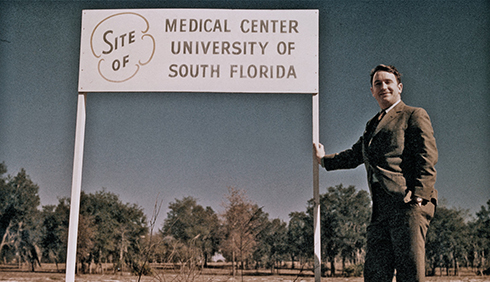
The image is central to the stories of Dr. Douglas Barrett and the University of South
Florida — a photo taken on campus more than five decades ago.
It shows USF’s campus in the early 1970s as seen from the neighboring James A. Haley
Veterans’ Hospital — scrub pines, sand and USF Department of Psychiatry founder Walter
Afield posing next to a simple hand-painted wooden sign that reads, “Site of Medical
Center, University of South Florida,” noting where the building would soon be constructed.
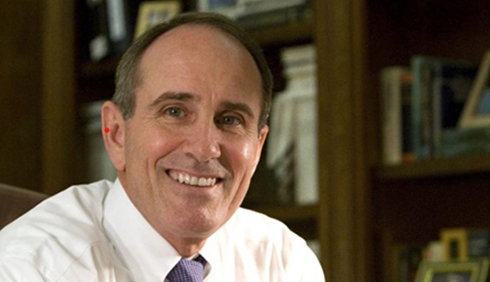
Dr. Douglas Barrett was a
The site of the original USF Medical Center
“It’s a picture I carry with me and use whenever I give a presentation,” said Barrett,
a member of the charter class of the USF College of Medicine, which was later renamed
after Frank and Carol Morsani following their historic $20 million gift in 2011. “It
shows what is possible despite simple beginnings.”
Barrett went on to become a nationally respected pediatrician and academic leader,
ultimately serving as senior vice president for the University of Florida’s J. Hillis
Miller Health Science Center and chair of the UF Department of Pediatrics.
As for the USF Health Morsani College of Medicine:
USF celebrates its 70th anniversary this year, marking Dec. 18, 1956, when state officials
approved the university. The campus opened in 1960, and the first medical class arrived
in 1971.
Today, the USF Health Morsani College of Medicine is the state’s top-ranked medical
school and among the highest ranked in the nation – a cornerstone of USF and Tampa
Bay region.
“We’re training the next generation of physicians,” said Dr. Charles Lockwood, executive
vice president of USF Health and dean of the USF Health Morsani College of Medicine.
“They will be truly world class, will improve the quality of care that patients received.
When you think about where we’ve come, it’s pretty unprecedented. We’ve come further,
faster and with more enthusiasm than almost any other school in the country.”
A Medical Legacy
USF’s medical school began as a dream. It then morphed into a reality with a charter
class that had no building to call their own — only a sign promising that one was
on the horizon.
In 1974, USF’s four-story Medical Center — with student and faculty laboratories,
a library, cafeteria and other support services — was completed on the same patch
of sand pictured in that old photo.
Today, the medical school is located on bustling Water Street in downtown Tampa.
Completed in January 2020, the USF Health Morsani College of Medicine’s state-of-the-art,
13-story facility hosts more than 1,450 students, 2,300 full-time faculty and over
800 residents and fellows. It houses high-tech classrooms, research and clinical labs,
a 400-seat auditorium and leased space for USF’s teaching hospital, Tampa General
Hospital.
In a way, it symbolizes the college’s rise.
The USF Health Morsani College of Medicine’s total annual research funding exceeds
$380 million, and it is home to world-class institutes and centers, including the
Byrd Alzheimer’s Center and Research Institute, Neuroscience Institute, Heart Institute,
Virology Institute and the Center for Aging and Brain Repair. The college also partners
with Moffitt Cancer Center and Tampa General Cancer Institute. Additionally, USF serves
as the international headquarters for the Global Virus Network.
“USF has arrived,” said third-year medical student Sarah McCrackin. “A lot of people
are recognizing it. We’re getting a lot of national recognition. I think it’s really
fascinating to watch how it’s evolved.”
Founding a Medical School
As far back as 1947, there was a desire to place a state medical school in Tampa.
Since there was no state university in the area at the time, the state instead established
its first medical school at the University of Florida in 1956.
By the 1960s, with the state’s population growing and USF established, the Florida
Legislature saw the need for another state medical school, again suggesting Tampa
as the site. In 1971, the legislature formally approved the establishment of the USF
School of Medicine.
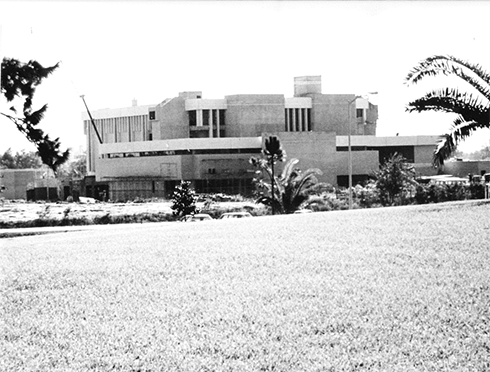
The first USF Medical Center, which was located on the main campus [Photo courtesy
of USF Tampa Library]
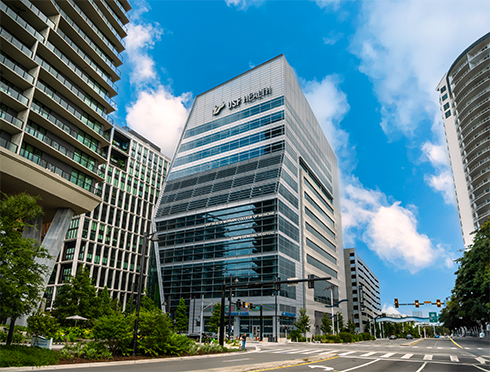
The USF Health Morsani College of Medicine facility in downtown Tampa [Photo by Fredrick
Coleman, USF Health]
Barrett was already a USF undergraduate student, having enrolled in 1968 to pursue
a bachelor’s degree in chemistry.
“During that time, I worked in the Morton Plant Hospital’s laboratory in Clearwater,”
he said. “There, I got a sense for what the medical field was like and decided that
medicine would be an exciting career for me.”
Staying at USF to become a charter member of its medical college was risky, Barrett
admitted. The University of Florida and University of Miami’s medical schools were
established, so some pressured him to choose one of those over the unknown.
Ultimately, his USF professors won him over.
“I did some cancer research while a chemistry student, which provided me the opportunity
to work with some exciting and charismatic professors who would be part of the charter
class of professors too,” Barrett said. “And then getting to be a part of creating
something new was exciting. And, lastly, I knew that everything we used would be new
— new microscopes, lab coats and so on, rather than using somebody else’s from a past
class.”
He was sort of right.
The Pioneers
The charter class’s 24 students — chosen from more than 400 applicants — did indeed
have new equipment, but they were taught out of borrowed space.
Since the first medical school building was not yet constructed, the charter class
was primarily housed in what newspapers at the time referred to as a “one-room schoolhouse,”
the corner of a lab on the fourth floor of the then-Science Center building. Students
listened to lectures on folding chairs, then stacked them against a wall for lab periods.
But Barrett never had second thoughts about choosing USF.
“There was a real sense of enthusiasm among us,” he said. “We felt like pioneers,
and a family. There were only 24 of us students in the charter class and about the
same number of professors. So, we also knew that we were getting a lot of personal
attention, ensuring the quality of our education and our ultimate success.”
They also played hard, which added to the camaraderie.
During class breaks, the students taped tongue depressors to the end of beaker poles,
used a petri dish as a puck and played floor hockey in their small room.
“We did everything together,” Barrett said. “We played football together. We played
handball together. Even our dean and associate dean played handball with us a few
times. Those relationships contributed to our success.”
On one occasion, former Tampa Mayor Dick Greco and civil rights activist Moses White
took the charter class on a tour of the city’s less fortunate neighborhoods.
“They wanted to remind us of how privileged we were to have the opportunity to go
to medical school and that we should not forget about those patients from different
tiers of society,” Barrett said. “It was such a unique experience, one only possible
at USF at that time.”
The Building Blocks
Construction began in March 1972 on the site where that grainy photo was taken.
The charter class never did occupy the building, but at their graduation in December
1974, each of the 24 students received a piece of its history.
“They handed each of us a brick — a real brick — from its foundation, with a little
plaque on it with our name,” Barrett said. “I still have mine.”
The symbolism wasn’t lost on anyone. The first 24 graduates weren’t just earning degrees;
they were part of the literal and figurative foundation of USF’s medical future.
USF Health now fills skylines, not sand lots. But that grainy picture — just a sign
stuck in the dirt — still lingers in Barrett’s mind.
“We were proud of what we’d done,” Barrett said. “I’m still proud.”