
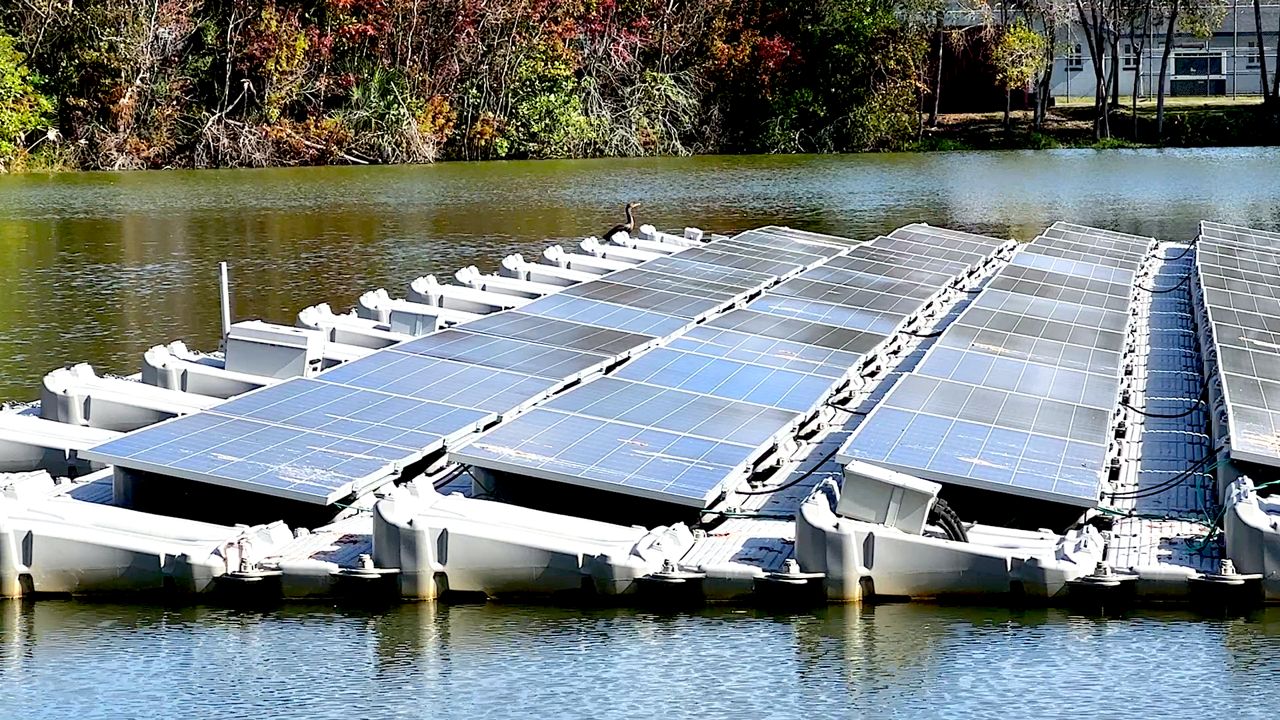
ORLANDO, Fla. — Central Florida is experiencing a boom in massive solar farms, promising cleaner energy and a greener future.
What You Need To Know
Massive solar farms are expanding across Central Florida, producing clean energy but not lowering consumer electricity bills.
Orlando Utilities Commission (OUC) operates four large solar arrays around Orlando, generating enough power for thousands of homes.
Homeowners can save money by installing their own solar panels, with systems paying for themselves over several years.
Florida ranks third in the nation for installed solar capacity, with clean energy expected to become more cost-effective over time.
Utility-scale solar is growing, yet consumers say monthly energy costs keep climbing.
Solar farms are expanding around Central Florida, turning sunlight into electricity.
“If you think about it, all the power for our entire planet comes from the sun,” said Justin Kramer, director of emerging technologies for the Orlando Utilities Commission (OUC).
The utility has built four large solar arrays around Orlando, producing about 74.5 megawatts — roughly enough to power 16,000 homes for a year.
“You know, we’re in the winter months, so the days are shorter. We’re getting less solar every day. But we still need to power your homes every day, 24/7,” Kramer said. “But all of that technology has cost considerations. It has integration technology considerations. My team really works to figure out how to bring all of that together for our customers.”
Solar experts say the only way homeowners can directly benefit from the sun’s energy is by installing panels themselves.
At an Orlando home being prepped for solar, panels will produce enough electricity to power everything, including air conditioning, 24/7.
Homeowner Rafael Ferrer said, “So, looking at the numbers and what can I do to fight this? You know, solar was my option. And that’s what I took.”
Unused electricity can be sold back to the utility.
Nathan Traynor, owner of Castaways Energy, explained how.
“For example, this homeowner is paying around $400 a month for his power bill. He’s only going to pay about $30 now. So that $300, $370 a month that he’s saving is going to pay for this system in seven years.”
Florida is the third-largest state for installed solar capacity.
“You know, everybody thinks about Florida as the Sunshine State,” Kramer said. “But in all reality, we’re the partly cloudy state 277 days a year; we are partly cloudy or mostly cloudy. Every time that cloud rolls over the solar array, it adjusts the production of that solar array.”
Clean energy production is expected to become more cost-effective in the years ahead.