
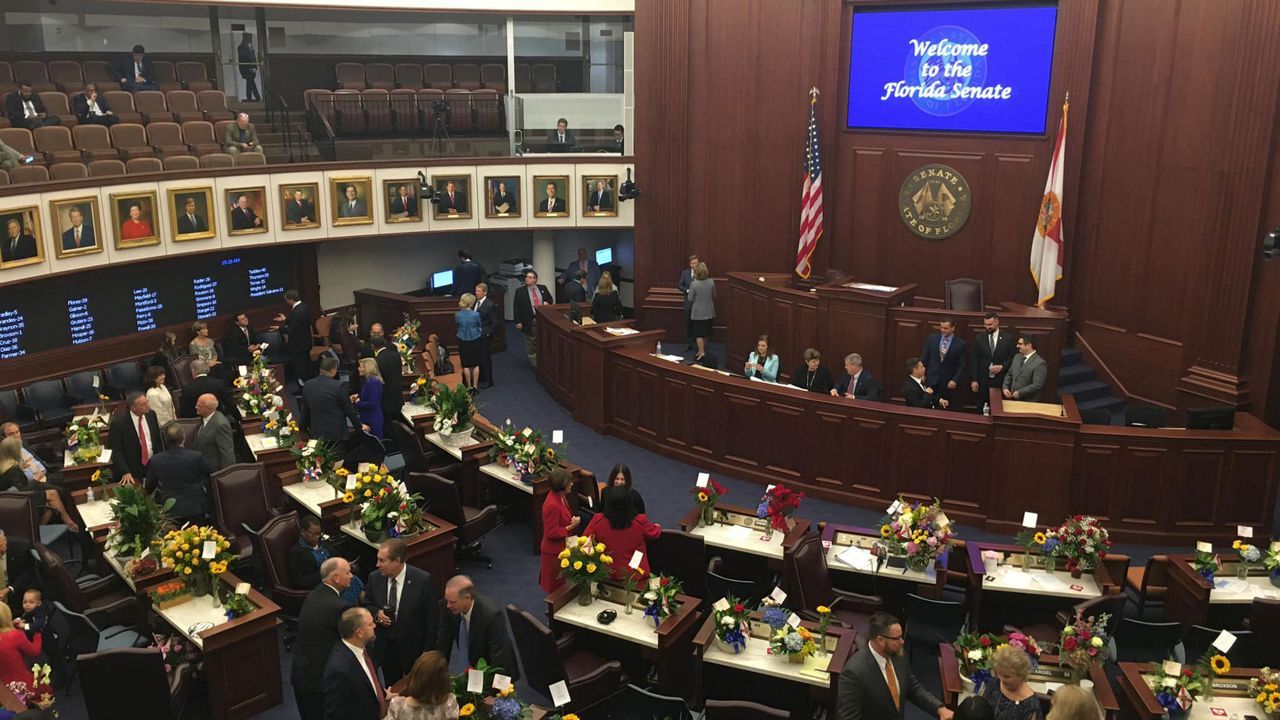
TALLAHASSEE, Fla. — Florida lawmakers are set to converge on Tallahassee next Tuesday, where they will begin to tackle issues like Gov. Ron DeSantis’ proposed $117 billion budget, a reduction in statewide property taxes, and a possible redistricting push, among other things.
Florida Gov. Ron DeSantis is set to deliver his annual State of the State address shortly after 11 a.m. Tuesday, during which he will outline his agenda for the upcoming legislative session.
Similar to the president’s State of the Union address, the governor is tasked each year with providing a message at the start of the regular legislative session. This message should include information about the condition of the state, any proposals to reorganize the executive branch, and to recommend measures in the public interest, according to Article IV, Section 1, Subsection e in the Florida Constitution.
DeSantis has a history of using the speech to outline the successes of his administration in the state of Florida.
Lawmakers and the governor have each released key details about their proposals.
The State Budget
DeSantis announced the details of his last budget proposal last month. The proposal calls for $117 billion in spending, an increase of $2.2 billion from last year’s $115.6 billion in proposals.
The governor highlighted expenditures for education, including $1.56 billion for teacher pay increases across the state, which is up slightly from the $1.5 billion DeSantis proposal for the 2025-2026 fiscal year budget.
Other educational line items included $30.6 billion for the overall K-12 budget — up from $29.7 billion in the previous budget proposal — with an additional $1.7 billion earmarked for early childhood education, which is down slightly from the 2025-2026 proposal of $1.76 billion.
DeSantis also announced a plan to spend $4 billion on the state’s university system, which is up slightly from his $3.9 billion proposal for 2025-2026.
Additionally, he highlighted planned pay increases for state law enforcement, and said he hopes to extend the current recruitment bonus program, which pays out $5,000 for new recruits.
DeSantis is proposing $118 million for pay increases for law enforcement and firefighters, which is slightly less than the $118.3 he proposed last year.
For Transportation, DeSantis outlined $15.4 billion for the Department of Transportation, as well as $14.3 billion for the state transportation work program.
DeSantis also outlined spending for health care across the state. The governor is seeking to spend $8.6 million for improvements to the State Veteran’s Nursing Homes, and $36.6 million for child welfare system funding that will help foster parents, caregivers, and community-based services.
Additionally, DeSantis is seeking to provide $159 million for behavioral health services, including preadmission diversion and discharge services.
DeSantis’ first budget proposal in 2019 was $90.98 billion.
Property Tax Reform
The Florida House advanced a series of proposals designed to cut non-school property taxes through its first committees this past fall, a move that could change how local governments fund services and manage local finances.
The proposals include a measure to eliminate the taxes immediately, and another to phase them out over 10 years.
“This is about returning money to hard-working Floridians,” said Coral Gables Republican Rep. Demi Busatta Cabrera.
Another proposal would eliminate non-school property taxes exclusively for homeowners 65 and older.
“This is a targeted approach to help those who need it the most,” said Miami Republican Rep. Juan Porras. “Our most vulnerable communities, those who have built the cities and counties, the areas that we all represent.”
The proposals include a police mandate that would require local governments to leave law enforcement budgets untouched.
“I did not support defunding the police in 2020, and I am not going to support it today,” said Coconut Creek Democratic Rep. Christine Hunschofsky.
It would require a constitutional amendment to alter the state’s property taxes. If passed by the Legislature, the proposal will go to voters in 2026 and would require at least 60% approval.
“We should not be afraid to let the voters of this state, the same voters who elected each and every one of us, make the decisions for themselves, for their communities and for the state,” said Stuart Republican Rep. Toby Overdorf.
Democratic lawmakers on Thursday voiced concern over the effort to slash property taxes, which are the primary revenue source for local governments. The Florida Policy Institute estimates $43 billion would be needed to maintain current services if the House proposals are enacted.
“We should not be putting our local governments in a situation where we’re taking away tools, only to have them shift that burden in some other way. That is actually going to have the most adverse impacts on the people who need our help the most,” said House Democratic Leader Fentrice Driskell, a Tampa lawmaker.
The Senate has not filed any companion legislation, leaving the House to move forward alone.
DeSantis has criticized the idea of putting multiple tax proposals on the 2026 ballot, calling it a poor approach.
Congressional Redistricting
The Florida House Committee on Congressional Redistricting met in December for the first time to consider redrawing congressional maps before the next census.
On the board is Orlando Democratic Rep. Johanna Lopez, who represents District 43.
There have been mixed reactions after DeSantis announced his plan to call a special session next year, as early as March, so lawmakers can redraw Florida’s map.
In order for a redistricting to happen, though, he still needs approval from the House and Senate, as the timing of his announcement would allow the Sunshine State to watch the U.S. Supreme Court, which is reconsidering parts of the Voting Rights Act of 1965.
Voting rights advocates from the American Civil Liberties Union worry that this move could unlawfully benefit one party over another. Civil‑rights groups and voting‑rights advocates warn that a new round of redistricting could collide with Florida’s own constitutional limits.
“To be perfectly clear, in Florida, it’s illegal and unconstitutional to draw districts to benefit one party over another,” said Abdelilah Skhir of the ACLU during a press conference at the Florida Capitol in early December.
Meanwhile, some Republican leaders frame the push as part of a broader national battle over the congressional map. At least six other states are already revisiting their lines, and allies of President Donald Trump are urging Republican‑controlled legislatures to follow suit. Trump first made the call over the summer.
“It will end in two very partisan draws in red and blue states, I would imagine,” said Florida GOP Chair Evan Power. “But that’s what they’re trying to do in California. That’s what they’ve done in Massachusetts. That’s what they’ve done in New York. That’s what they’ve done in Illinois.”
Critics in Florida describe the governor’s plan as political, discriminatory, and potentially unlawful. They point to the state’s “Fair Districts” amendments, which ban maps that favor a party or an incumbent.
“To the Legislature: Your constitutional duty could not be more clear,” said Jonathan Webber of Southern Poverty Law Center. “You can obey the Constitution or bow to political pressure, but you cannot do both.”
Meanwhile, the Florida Senate has yet to formally publish an opinion, and unlike the House, Senate President Ben Albritton has not assembled a panel to brainstorm redistricting.
DeSantis and Albritton met to discuss the plan, according to Florida Senate spokeswoman Katie Betta.
“The Governor reiterated to the President what he has stated publicly — that the timeline for addressing redistricting should be next Spring,” Betta wrote.