
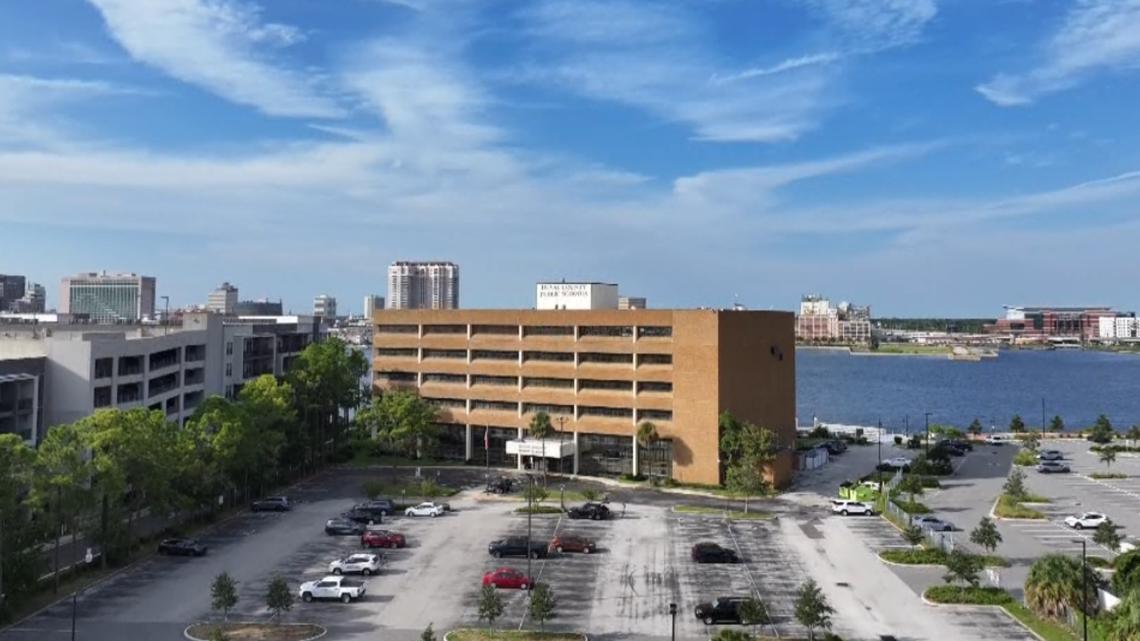
The Duval County School Board debated over the contentious Schools of Hope program, narrowly passing an amendment to challenge charter school policies.
DUVAL COUNTY, Fla. — The future of charter school locations in Duval County was back front and center at the Duval County School Board’s first meeting of 2026.
The Schools of Hope program sparked passionate debate Tuesday night, with parents, community members and board members pushing to pass an amendment that would go before legislators in Tallahassee.
School Board member Cindy Pearson introduced the addition to the school board’s legislative agenda, saying it will serve as their voice to the community, as well as a unified statement to lawmakers.
However, not everyone was in agreement. School Board Chair Charlotte Joyce was one of three no votes, calling this “premature.”
“You’re putting a lot of emphasis on something that is probably going to be a nonissue when we have six items on our legislative platform that we need to walk in and really talk about,” Joyce said.
“We need to do anything we can to fight back against the Schools of Hope,” said Gloria Einstein, community member.
The Schools of Hope program allows charter school operators to move into vacant schools or co-locate in underperforming public schools.
Under state law, school districts must provide Schools of Hope charters the same services given to district-run schools.
It’s an ongoing issue that dominated public comment during Tuesday night’s school board meeting.
“I believe what began as an effort to intervene and provide support for struggling public schools has become a full embrace of the privatization of public education,” said Brian Amerling, another community member.
“Our community needs you as a school board to speak with us in a unified voice against Schools of Hope,” said Kelly Sharkey, community member.
School board members accepted that challenge.
In a 4-3 vote, they approved an addition to their legislative agenda, adding a Schools of Hope amendment. Its language was approved by the Florida School Board Association advocacy committee and school board members in all 67 counties in the state.
It outlines the district’s advocacy priorities for the upcoming legislative session, including protecting district resources, preserving local control and refining how underperforming schools are identified.
“If 67 counties across our whole state have said, ‘Hey, this is what we need to do,’ I don’t think it’s premature,” said School Board member Darryl Willie. “I think it’s giving the rules-making group, as well as our legislature an opportunity to understand where we stand as a group, where we stand as a community.”
“I feel like putting something on a piece of paper just to say something isn’t really doing the work that we all know we’re going to be doing anyway,” said Vice Chair April Carney.
The Schools of Hope amendment aims to:
Ensure co-location requirements neither jeopardize safety and security nor create unfunded operational or administrative burdens for school districts.
Refine eligibility criteria so they accurately identify underperforming schools;
Update facility utilization metrics to reflect current classroom and building use, instructional models, and student enrollment patterns;
Preserve the authority of locally elected school boards to manage district property and resources in fulfilling their constitutional responsibilities;
Clarify statutory definitions to provide consistent guidance for both districts and charter operators.
The three school board members who voted no Tuesday night were Chair Charlotte Joyce, Vice Chair April Carney and board member Tony Ricardo.
Florida Senate Bill 424, introduced in November, would take out the provision in current law that allows Schools of Hope to co-locate in a public school facility. If addressed and passed in the upcoming session, it would go into effect on July 1, 2026.
Schools of Hope will not go into effect until 2027.