
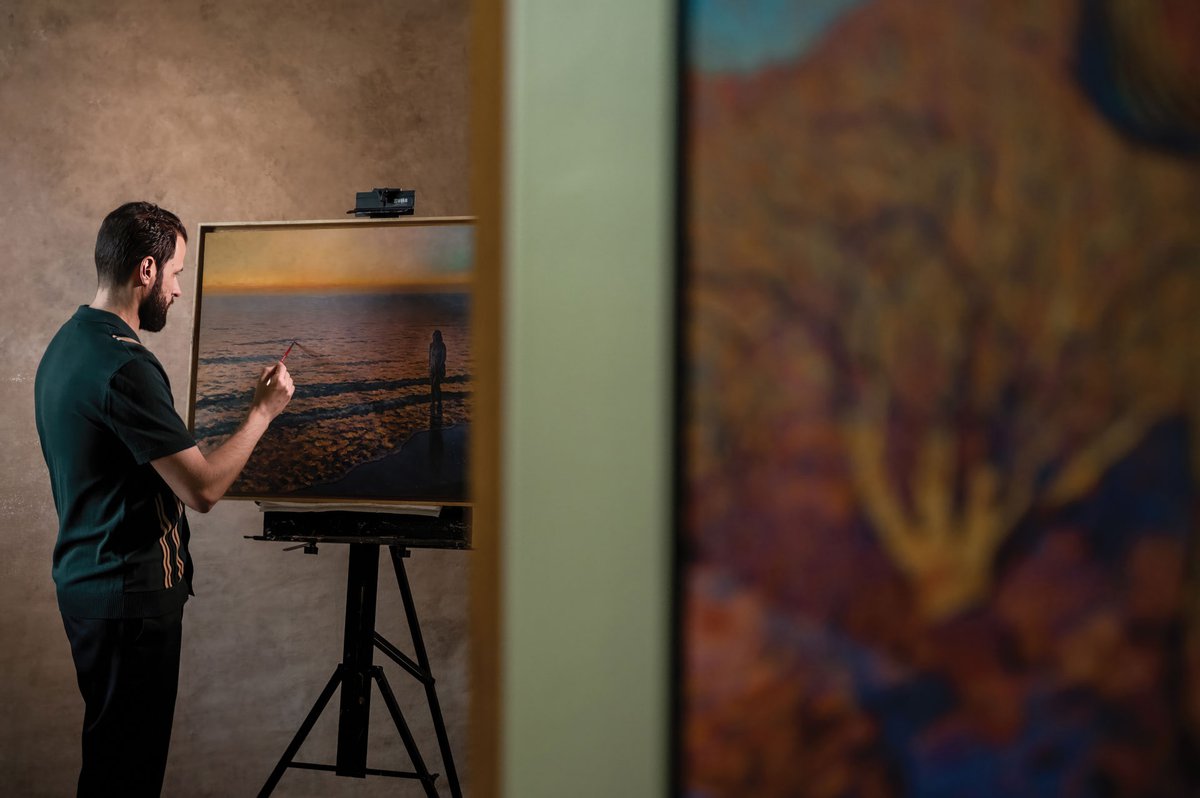
Miguel Saludes has spent much of his artistic career traveling through America in search of connection. The Cuban landscape painter made a name for himself capturing the nation’s diverse reaches: Appalachian mountain vistas, the gloom of coastal Maine, tornadoes traversing fields of grain, cactus blossoms in Western desert canyons and the cypress swamps near his Southwest Florida home.
But one scene stands apart. On a 2016 visit to his wife’s Pennsylvania hometown, Miguel saw something he had never seen before: a cornfield. The sight struck him, waves of gold and green stretching as far as the eye could see. He decided to paint the scene en plein air, working over two days despite blistering heat and considering the sight’s significance. “I was painting a crop that’s fed Americans from the very beginning, from the Native Americans that grew it to the Europeans to today,” he says of the piece, Pennsylvania Cornfield.
In the midst of the field, watching stalks ripple in the wind, the act of painting became meditative, grounding him in the place and moment. Miguel came to a sudden revelation about his place in the American story. “I had been struggling, like I think a lot of immigrants struggle, with finding a new sense of home,” Miguel says. But there, he felt a sense of participation he hadn’t experienced before. In depicting this distinctly American scene, he was practicing a genre with a long, revered place in Cuban art. His approach was Cuban, the subject unmistakably American, and for the first time, those two identities didn’t feel at odds. “I felt like America was really embracing me, and that I was a part of her,” he says. “That’s when I really felt that I belonged in this country.”
Landscape paintings have always held interest for Miguel. Born and raised in Cojímar, a fishing suburb of Havana, Miguel remembers middle school visits to the Museum of Fine Arts in Havana and being introduced to the work of Esteban Chartrand and Tomás Sánchez, landscape painters from the 19th and 20th centuries, respectively. He dreamed of joining their ranks, carrying forward the island’s tradition. But, Cuba was facing economic strain and scarcity, placing fine art materials firmly out of reach. He’d sketch in graphite and crayons at school, and at home, he found that a rubber knife would make markings on the wall if he pressed hard enough. “I drew all over the house, much to the dismay of my mother,” Miguel says with a laugh. “You always find a way to make art.” When the family moved to Miami in 2005 after receiving political asylum, he was 16. One of his first acts in America was to buy art supplies freely.
The move came after years of escalating danger. Miguel’s parents were dissidents against the Castro regime, active organizers who pushed for freedom of speech, press and assembly. When the state began to crack down, many of the Saludes family’s friends were swept up by the authorities and sent to jail. “We were pestered for many years, secretly followed, harassed by the Cuban secret police, until we finally were able to get political refugee status and leave the country,” he says. “Things kept getting more and more dangerous for us.”
Art has been the constant for Miguel, an escape from the strange and uncertain—first at home, then in a foreign land. Once in the U.S., he could pursue his craft without fear or scarcity. He studied painting at Florida International University before earning an MFA at the University of Florida, where he met his wife, Carrie. Together, the pair traveled the country, and in each new vista, Miguel found moments of wonder, snapped photos and rendered them on canvas. “She wanted to share her homeland with me,” he says. After graduation, they moved to Fort Myers to work as teachers and made Southwest Florida their home, with Miguel finding representation with Naples’ Harmon-Meek Gallery.
His paintings traverse the landscape with a contemplative gaze, paying close attention to how light settles over distance, how a balance of saturated and muted hues creates poetry, and how atmosphere lends a place its character. “Lighting and color are essential,” he says. “It’s not just realism, but something that is more real than real.” It’s all about freezing a moment of time; he likens his oeuvre to that of photographer Ansel Adams—a chronicle of experiences in the land that gave him a new life.
In his home studio, the artist sifts through photos from his family’s travels, searching for images that feel cinematic and personal. At times, he renders them with fidelity; others he infuses with richer light or sharper shadows, elements that reflect his feelings or memories of a place. The process is slow, methodical. “I have to be present in every aspect of the work,” he says. The ethos extends from subject matter to materials. Miguel handles every part of the process—from gessoing canvases to making the frames. Paintings often begin as ideas that sit with him for years before he’s ready to realize them.
Where misty mountains and red rocks instill wonder, Southwest Florida offers familiarity, connection. He finds inspiration in the glinting coastlines of Lovers Key, Naples shores and in the tangles of the swamp. His son was born here, he’s built a life here, and when the light hits just right, he could mistake the scene for one from his childhood. “If you want a poetic sunset, go no farther than the west coast,” he says, seeing echoes of the skies he grew up with. “Even though I’ve changed to a completely new country, it’s the same meridian.”
In recent years, portraiture has found its way into his practice. These works tend toward warm, narrative-driven family moments: a grandfather dozing with a baby in his arms, his toddler examining a corn stalk at a fall fair, moments between mother and child. Last January, his Portrait of the Artist’s Wife With Sunflowers (2021) was added to the Figurative American Art Collection at the Ashley Gibson Barnett Museum of Art in Lakeland, Florida.
An art history teacher and lifelong student, Miguel will spend hours mentally deconstructing works he admires. His studies often shape how he approaches a scene. “Sometimes I look at something and think, ‘Wow, this is so Georgia O’Keeffe.’ So when I’m working on the painting, I look for simple shapes, more minimalism,” he says. Another of his paintings may recall Andrew Wyeth’s deliberate detail or the foggy atmosphere of Caspar David Friedrich. “I’m pulling from the timeline of art history and channeling my heroes, because each one has their own way of conveying the beauty of the sublime,” he adds.
Cuban artists still guide his ethos, particularly Tomás Sánchez, who channels his Buddhist practice into his paintings. “[His landscapes are] windows into his inner self,” Miguel says. As Miguel immerses himself in a place, he works through questions of location, identity and belonging. Horizonless compositions let him retreat into the familiar patterns of nature. Wide vistas prompt him to consider the sweep of land before him and his place within it.
For him, painting American landscapes is a way of connecting with a homeland not chosen, but discovered. “Historically, Cuban artists are prone to painting the Cuban landscape as a sense of patriotism,” he says. “I think of myself as continuing that tradition, but here in America.”