
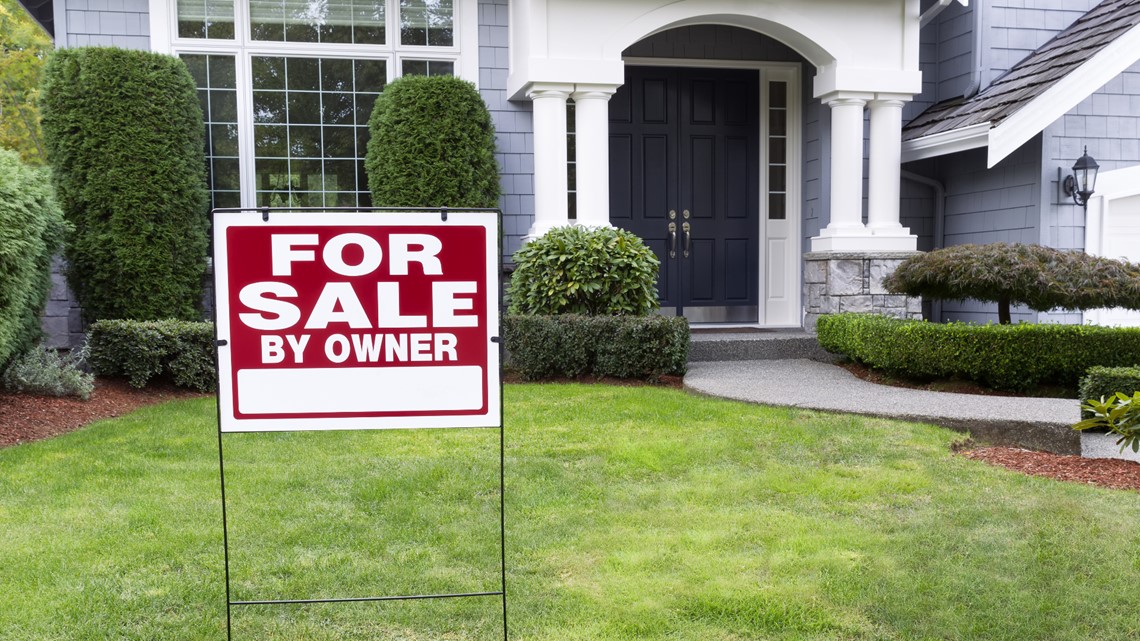
President Trump’s proposal comes as institutional investors continue to play an outsized role in Tampa Bay’s housing market.
TAMPA, Fla. — President Donald Trump says he is considering limits on corporate investors buying up single-family homes, arguing the move could help lower prices and make homeownership more attainable for families.
“People live in homes, not corporations,” Trump wrote this week on social media.
The proposal comes as institutional investors continue to play an outsized role in Tampa Bay’s housing market, particularly in the wake of the 2008 real estate crash and another wave of investor purchases following the region’s historic 2024 hurricane season.
Nationally, institutional investors own about 450,000 single-family homes, roughly 3% of the market, according to the U.S. Government Accountability Office. Locally, their presence is more pronounced.
Some local realtors estimate corporate investors own about 6% of single-family homes in Pinellas County and nearly 8% in Hillsborough County.
“That’s happening all the time around Tampa,” homeowner Brian Gallardo said. “You see it all the time.”
Real estate analysts estimate Wall Street-backed firms control more than 27,000 homes across the Tampa Bay region, many acquired after foreclosures surged following the Great Recession, then during Covid, and again after hurricanes Helene and Milton left thousands of properties damaged or distressed.
Critics argue that corporate buyers reduce available inventory for individual buyers and drive up prices by converting homes into rentals and reducing supply.
“They’re just kind of destroying houses, rebuilding it, renting it out — and then a lot of people are just left looking for more,” Gallardo said.
Renters say the ripple effects are being felt just as sharply.
“I think it would be fair to give single families — normal people — more of an opportunity versus the big companies,” renter Olivia Coppinger said. “Yeah — and then it’s not affordable for anybody.”
Still, local real estate professionals caution that limiting corporate purchases alone may not significantly move the needle.
“I don’t know that it’s going to have a massive impact on homeownership,” Cristan Fadal, a Tampa real estate broker, said. “It could have a blip. But the bigger problem is the lack of available housing stock that we have out there.”
Fadal points to high interest rates, rising insurance costs, labor shortages and long permitting timelines as larger drivers of affordability issues. He also notes that institutional investors have, at times, helped stabilize neighborhoods, particularly after disasters.
“You had all these zombie homes out there,” Fadal said. “They came in, bought them up, fixed them up, rented them out and actually provided housing for folks.”
After last year’s hurricanes, large investors were often better positioned to take on the financial risk of repairing or rebuilding damaged homes.
“It’s all about risk,” Fadal said. “Homeowners don’t want to take risks. Smaller investors might not want to take the risk. Larger institutions have that timeline and the ability to take those risks.”
Even so, Fadal acknowledges that Tampa Bay could feel more of an impact from any federal limits than other parts of the country.
“We’re larger than the national average,” he said. “So, we would obviously see a little bit more of an impact than maybe some other areas.”
At minimum, he says, any increase in available homes could help ease pressure in a market where prices continue to outpace wages.
“Look, at this point, any inventory,” Fadal said, “any inventory increase would help our market.”
Trump has said he wants Congress to codify the proposal into law, an idea that could draw bipartisan support. Democrats introduced similar legislation in 2023, though it failed to advance.