
GLENDALE, Arizona — I used to be one of those people who said college football didn’t need to expand the College Football Playoff because there aren’t more than four teams worthy of playing for the national championship.
Boy, was I wrong.
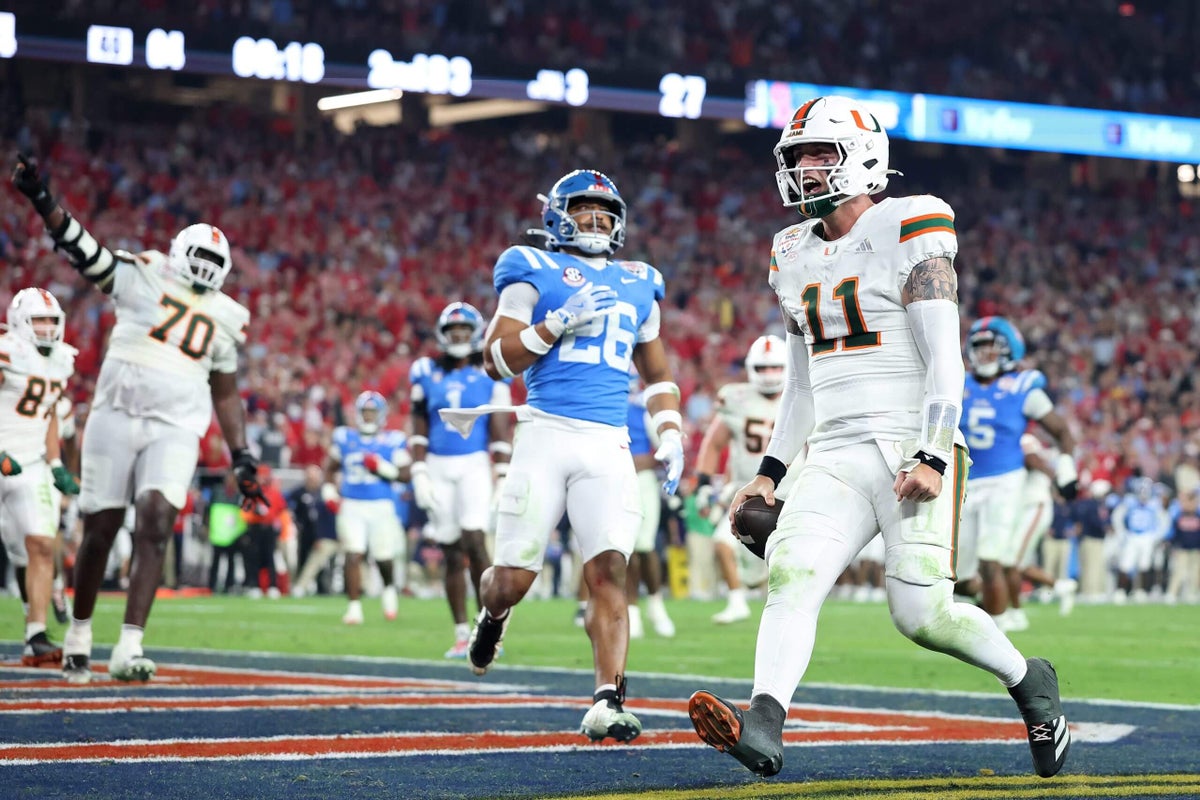
For the second straight year, a team that wouldn’t have sniffed the four-team CFP — No. 8 seed Ohio State in 2024, No. 10 seed Miami in 2025 — is heading to the national championship. Standing on the State Farm Stadium field watching Mario Cristobal, Carson Beck, Mark Fletcher and the rest of the Canes celebrate their dramatic 31-27 semifinal win over No. 6 seed Ole Miss here Thursday, I couldn’t help thinking, I can’t believe we almost left these guys out.
And also, who were we to think we ever knew who the four best teams were? When teams play such wildly imbalanced schedules, and the conferences play so few crossover games?
Then I saw some Miami players doing confetti snow angels and snapped out of it.
No one would have claimed the ‘Canes were a national title contender on Nov. 1, when they lost for the second time in three games, in overtime at SMU. But after the run Miami has made over the past three games — beating 11-1 SEC foe Texas A&M on its home field, while allowing just three points; knocking off a 12-1 Ohio State team that spent nearly the entire season at No. 1; and scoring two touchdowns in the last five minutes to survive 13-1 Ole Miss — who could possibly argue with a straight face the Hurricanes didn’t belong?
Still-bitter Notre Dame fans notwithstanding.
“It’s a reflection of how awesome this sport is,” Cristobal said at his postgame news conference. “Teams have the opportunity to get better as the year goes on. How young players get to develop, better players have a chance to get better, and all of a sudden you have a different dynamic and it carries you into the Playoff.
“You can get hot at the right time, and things could be pretty interesting in a hurry.”
The Playoff semifinals have certainly gotten interesting since we started making teams earn their way into them rather than the committee slotting them in early December. In Year 1, No. 7 seed Notre Dame beat No. 6 seed Penn State on a last-second field goal in the Orange Bowl and No. 8 seed Ohio State put away No. 5 seed Texas in the Cotton Bowl on Jack Sawyer’s 83-yard scoop-and-score.
And the first semifinal of Year 2 at the Fiesta Bowl managed to top them both.
The first three quarters were admittedly ugly, thanks in large part to an astounding array of Miami’s own penalties and dropped interceptions. Ole Miss, whose coach ditched them the night before the wedding, seemed to have all the momentum when it went ahead 19-17 with 7 minutes left.
What ensued from there was seven straight minutes of peak college football. Miami’s stud freshman receiver Malachi Toney weaving his way to a go-ahead touchdown, followed by Ole Miss star Trinidad Chambliss springing to life and throwing his own go-ahead TD, followed by Beck leading his team back down the field and running in a go-ahead TD, followed by Chambliss’s Hail Mary falling just incomplete.
That was followed by Miami’s current players celebrating on a stage while a who’s who of its early 2000s players — Andre Johnson, Edgerrin James, Jonathan Vilma, Calais Campbell and many more — stood on the field basking in Miami’s accomplishment.
Johnson, a Pro Football Hall of Fame receiver who starred on the school’s last national championship team in 2001 and played in its last title game the following year, chuckled while recalling the days when the BCS computers determined which two teams made it. You had to be perfect most years; his 10-1 team in 2000 got left out for an 11-1 Florida State team the Canes beat.
But if you did, you had to win only one more game. Not four.
And yet, “I would have loved to have this (system) when I was playing,” Johnson said. “It makes it more interesting when you have a Playoff.”
It makes you wonder how different our list of national champions might be today had the field not been so limited.
To be clear, all those Alabama/Clemson/Georgia teams of the four-team era were really good teams and worthy champions. But a lot of other really good teams with similar records never got to take them on — because their conference wasn’t respected enough, their quarterback got hurt or they just plain lost the wrong game at the wrong time.
If we still had a four-team Playoff this season, this Miami-Ole Miss Fiesta Bowl would have been an undercard New Year’s Six bowl. Beck, Fletcher and others might not have bothered to play. And of course, all of Lane Kiffin’s assistants would have moved on to LSU weeks ago.
Meanwhile, that 12-1 Texas Tech team that got shut out by Oregon in the quarterfinals would have qualified for one of the semis, no questions asked. And you better believe SEC champion Georgia would be in, too, because, SEC.
Instead, we’re about to have our third straight national championship game with zero SEC teams.
But Miami will be there — playing in its home stadium, no less, against the winner of Friday night’s Indiana-Oregon semifinal. Its run may well end there. But no one will be able to say the Canes didn’t earn their appearance.
“Football is about settling it on the field, right?” said Cristobal. “The more we can give teams an opportunity to do that, it makes the sport better.”
Early returns suggest he’s correct. Sorry it took some of us a few years … er, decades … to come around.