
Federal immigration officers shoot two people in Portland, Oregon, and Florida lawmakers to take up restrictions for foreign students.

Federal immigration agents shot and wounded two people in a vehicle outside a hospital in Portland on Thursday, a day after an officer fatally shot a woman in Minnesota, authorities said.
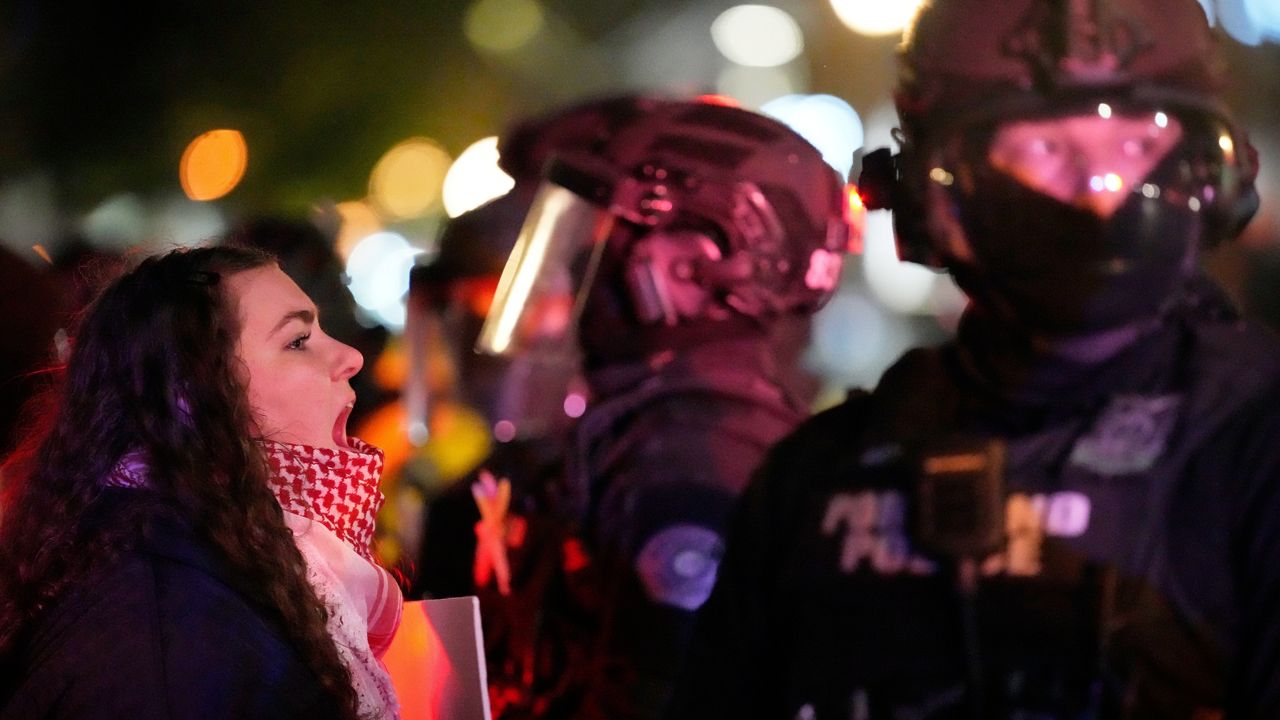
The shooting drew hundreds of protesters to the U.S. Immigration and Customs Enforcement building at night, and Oregon Attorney General Dan Rayfield vowed to investigate “whether any federal officer acted outside the scope of their lawful authority” and refer criminal charges to the prosecutor’s office if warranted.
The Department of Homeland Security said the vehicle’s passenger was “a Venezuelan illegal alien affiliated with the transnational Tren de Aragua prostitution ring” who was involved in a recent shooting in the city. When agents identified themselves to the occupants during a “targeted vehicle stop” in the afternoon, the driver tried to run them over, the department said in a statement.
“Fearing for his life and safety, an agent fired a defensive shot,” it said. “The driver drove off with the passenger, fleeing the scene.”
There was no immediate independent corroboration of that account or of any gang affiliation of the vehicle’s occupants. During prior shootings involving agents from President Donald Trump’s immigration crackdowns in U.S. cities, including the fatal one Wednesday in Minneapolis, video evidence has cast doubt on the administration’s characterizations of what prompted the shootings.
Trump and his allies have consistently blamed the Tren de Aragua gang for being at the root of violence and drug dealing in some U.S. cities.
The Portland shooting escalates tensions in a city that has long had a contentious relationship with Trump, including due to his recent failed effort to deploy National Guard troops there. The city saw long-running nightly protests outside the ICE building.
Trump announces he called off more Venezuela strikes
President Donald Trump says he has called off a second wave of strikes on Venezuela because of the country’s cooperation with the United States.
In a post online, the president says Washington and Caracas are “working well together.”
Trump also announced that Venezuela will release a large number of political prisoners in what he is calling a sign of seeking peace.
The U.S. will invest at least $100 billion in Venezuela’s oil infrastructure. Trump will welcome Venezuelan opposition leader María Corina Machado to the White House next week.
The president called the Nobel Peace Prize winner a “very nice woman,” but doesn’t feel she has enough support in Venezuela to lead the country.
Trump says he plans on the U.S. controlling the government there for years to come.
This morning, the U.S. seized another oil tanker in the Caribbean.
According to the Pentagon, U.S. Marines and sailors completed the operation in coordination with the Department of Homeland Security.
The tanker named Olina was apprehended “without incident.”
Florida lawmakers are considering measures that would restrict college admissions to non-U.S. citizens and immigrants who are “lawfully present” in the country.
One GOP-sponsored proposal would effectively block undocumented students from enrolling in Florida’s public colleges and universities.
A separate GOP-sponsored proposal would cap foreign student enrollment at public colleges and universities, limiting non-U.S. citizens to no more than 10% of a school’s total student body.
Florida GOP Chairman Evan Power said the proposals reflect the priorities of Republican voters.
“Our country has been invaded by illegal immigrants,” said Power. “We want those people out. You also have the fact that there’s legal immigration that some people think are being abused and we need to get control of that.”
Meanwhile, Democrats argue that the legislation is politically driven and does little to address the state’s real challenges.
“President Trump campaigned on unregulated immigration and going after criminals,” said Orlando Democratic State Rep. Anna Eskamani. “These bills don’t do any of that.”
According to the Higher Ed Immigration Portal, only three states currently ban undocumented students from public colleges and universities — Georgia, Alabama, and South Carolina
The 2026 legislative session kicks off Tuesday.