
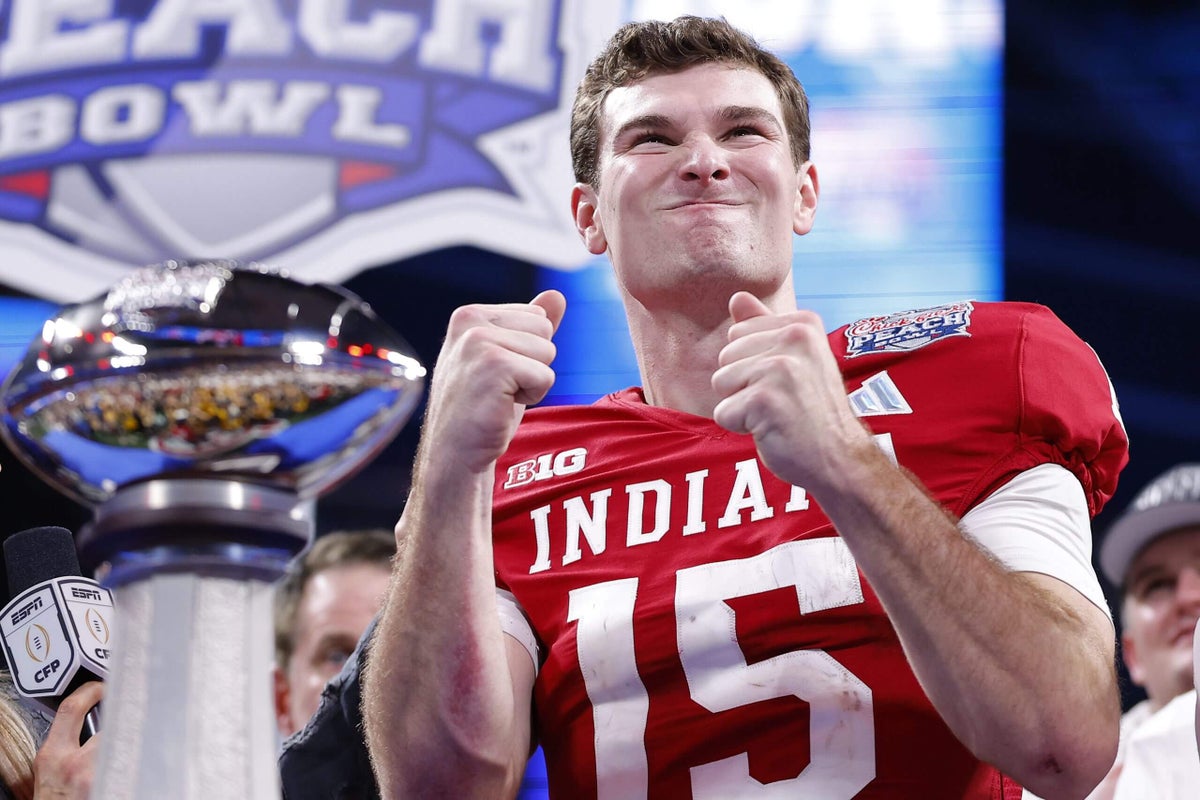
For only the second time of the College Football Playoff era, the national championship will take place without at least one of four usual suspects: Alabama, Georgia, Ohio State and Clemson. Instead, the Jan. 19 CFP final at Hard Rock Stadium will feature two less likely teams: undefeated, No. 1 Indiana and 10th-seeded Miami, which will play on its home field.
Given the (relatively) new faces squaring off for the title in the second year of the 12-team format, here’s a quick look at the histories of both contenders, how they got here and why this is such an unlikely matchup.
A brief history of Miami football
The Hurricanes finished ranked only five times from 1936-78 and were on life support when Howard Schnellenberger arrived in ’79. He quickly started a dynasty; Schnellenberger’s Hurricanes won the state of Florida’s first national championship in 1983 with an upset against Nebraska, and The U added four more (’87, ’89, ’91 and 2001) over the next 18 years. Miami produced a pair of Heisman Trophy-winning quarterbacks (Vinny Testaverde and Gino Torretta) and built an empire on retaining elite local talent and a whole lot of swag. The 2001 title team is regarded as one of the most talented rosters ever assembled with Hall of Famers Ed Reed and Andre Johnson among its astounding 38 future NFL Draft picks.
A brief history of Indiana football
The Hoosiers have been bad (or worse) for almost their entire existence. They never recorded a 10-win season until last year and entered this season with more all-time losses than any other FBS program (Northwestern has since “passed” them). Before this Playoff run, Indiana hadn’t won a bowl game since 1991 and had appeared in only 13 postseason games ever. Indiana played in the Rose Bowl in 1967, finished No. 4 nationally in 1945 and once had Lee Corso as its head coach. Those are pretty much the only highlights until head coach Curt Cignetti arrived two years ago.
Tale of the tape
Indiana HoosiersMiami Hurricanes
15-0
2025 record
13-2
No. 1
CFP seed
No. 10
Big Ten
Conference
ACC
0
National championships
5
3
AP top-10 finishes
17
1
Heisman winners
2
1
Pro Football Hall of Famers
9
Why Miami’s run is so surprising
Since those two decades of glory, Miami has been so mired in mediocrity that “Is The U back?” has become a semi-annual question. Since joining the ACC in 2004, the Hurricanes have not won the conference championship and lost 38-3 to Clemson in their lone ACC title game appearance (2017). Before this year, Miami had not won a major bowl game or finished in the top 10 in two decades. The Canes built a recent reputation as a team that routinely squandered good talent with undisciplined play, penalties and underwhelming quarterbacks.
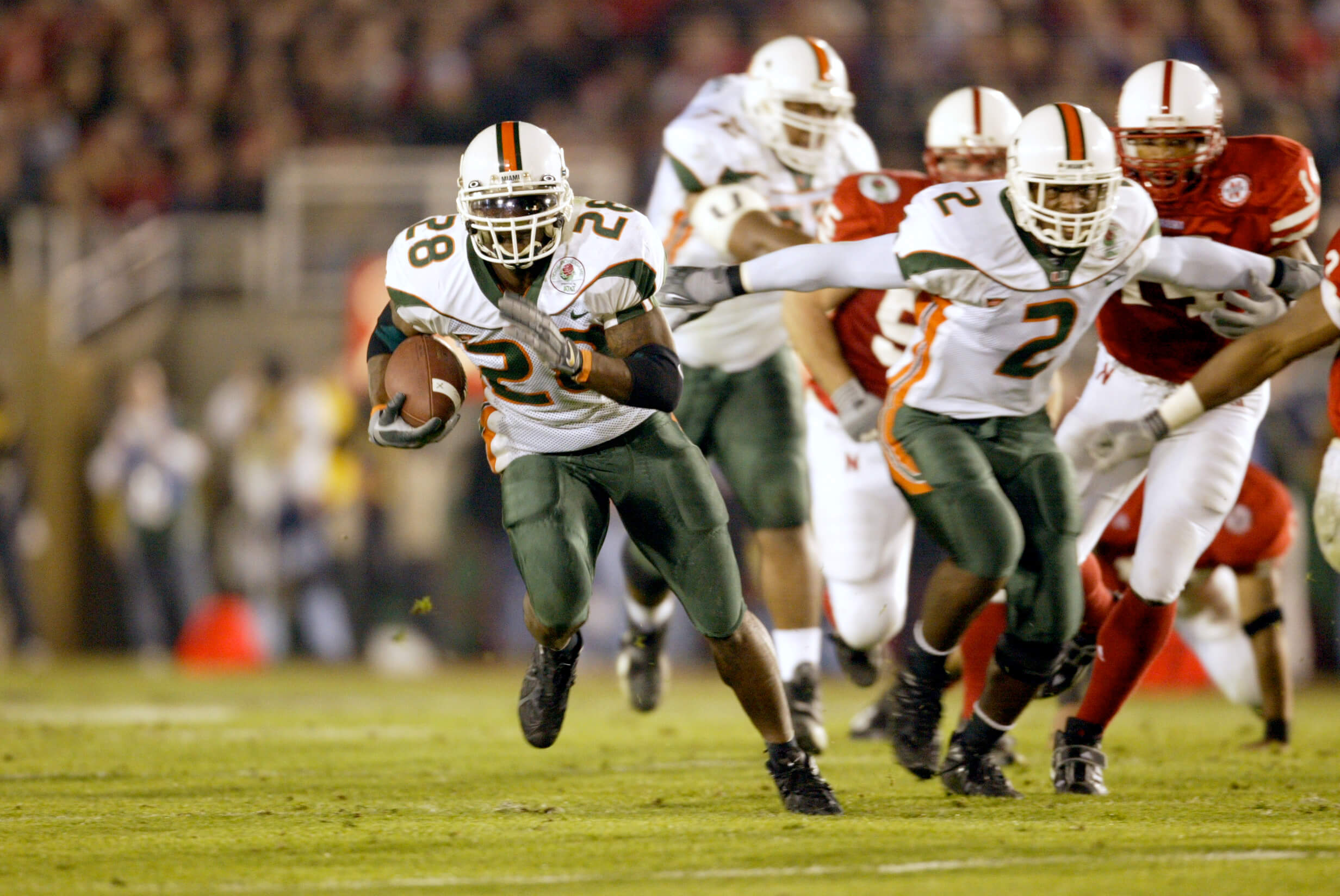
Miami won its fifth and most recent national championship in 2001. (Brian Bahr / Getty Images)
Why Indiana’s run is so surprising
To repeat: The Hoosiers have been bad (or worse) for almost their entire existence and entered this season with the most all-time losses of any program. Indiana had zero top-10 finishes in the five decades before Cignetti. He inherited a 3-9 team but made the Playoff in Year 1 and has rolled into the title game in Year 2. Despite last year’s success, Indiana started the season only 20th in the AP poll, showing the lingering skepticism. It’s one of the most remarkable turnarounds in the history of college sports, period.
How Miami got here
Head coach Mario Cristobal signed top-seven recruiting classes in his first two full cycles and built dominant lines on both sides of the ball. The Hurricanes balanced a foundation of blue-chip high school talent with key transfers like starting quarterback Carson Beck from Georgia.
Miami did not even play for the ACC championship because of two regular-season losses (to Louisville after Beck threw four interceptions and at SMU) and a convoluted five-way tiebreaker. The Hurricanes’ CFP hopes looked grim in early rankings, but their season-opening 27-24 victory over Notre Dame became a trump card that gave them the final at-large spot in the field over the Fighting Irish.
Miami smothered Texas A&M (10-3) and toppled reigning national champion Ohio State (24-14) in the first two rounds with great defense, then withstood a late back-and-forth frenzy to outlast Ole Miss 31-27 in the Fiesta Bowl semifinal.
How Indiana got here
Cignetti was at James Madison before taking over the Hoosiers, and he brought a chunk of JMU’s roster with him to IU. He built on last year’s 11-2 run by adding quarterback Fernando Mendoza from Cal; Mendoza became the first Indiana player to win the Heisman Trophy. The Hoosiers rank No. 2 in the FBS in scoring offense and scoring defense, and they’re also in the top two in turnover margin and penalties per game. That means they do everything well and don’t beat themselves. Only three of Indiana’s 15 wins were by one score.
IU is on the verge of becoming the first major college football team to go 16-0 since 1894 Yale. Its past three games: a 13-10 triumph over Ohio State in the Big Ten championship, a 38-3 rout of Alabama in the Rose Bowl and a 56-22 obliteration of Oregon in the Peach Bowl semifinal.
About Miami head coach Mario Cristobal
The 55-year-old Miami native was an offensive lineman on two of the Hurricanes’ national title teams. He was the head coach at FIU and Oregon (where he won two Pac-12 titles), with a spell on Nick Saban’s Alabama staff in between, and he took Miami from 5-7 in his first year to 7-6, 10-3 and now 13-2. Cristobal is regarded as an excellent recruiter but iffy game manager; he infamously dropped a game to Georgia Tech in 2023 after his team lost a fumble instead of kneeling out a win. He has, however, amassed a top-tier roster and kept his team together after its two losses. Previous Miami teams have cratered in similar situations.
About Indiana head coach Curt Cignetti
As the 64-year-old Pennsylvania native said when he got the job: He wins. Google him. Before taking over IU, he went 52-9 at James Madison while navigating its jump to college football’s top level (Football Bowl Subdivision) and made five playoff appearances in eight combined years at Elon and Indiana University of Pennsylvania (IUP). His father, Frank, was a Hall of Fame coach at IUP who appeared in two Division II national championship games. Cignetti didn’t become a household name until recently, but he was a key staffer under Saban at Alabama and developed Philip Rivers at NC State. He’s 26-2 at IU.
Miami names to know
Carson Beck won two national titles as a backup at Georgia, starred in ’23 and was shaky last year before injuring his elbow in the SEC championship. He transferred to Miami as one of the highest-paid players in the transfer portal and has remained a lightning rod. His CFP numbers: four touchdown passes, one interception and the game-winning touchdown rush against Ole Miss.
Wide receiver Malachi Toney is arguably the nation’s top freshman and scored the game-winner at Texas A&M. Nicknamed “Baby Jesus,” the 18-year-old recorded the eighth 1,000-yard season in program history.
The excellent lines are led by a pair of first-round NFL Draft talents, offensive tackle Francis Mauigoa and defensive lineman Rueben Bain Jr., plus all-ACC defensive end Akheem Mesidor.
Running back Mark Fletcher Jr. has rushed for 395 yards in three Playoff games, including a pivotal 56-yard breakaway against the Aggies.
Because Miami’s rich history is never far away, you’ll often see legendary alumni like Michael Irvin and Ray Lewis on the sidelines.
Indiana names to know
Fernando Mendoza has been one of the country’s most accurate passers and will likely be in the discussion as the No. 1 pick in the NFL Draft. In two Playoff wins, he has thrown more touchdown passes (eight) than incompletions (five).
Left tackle Carter Smith was named the Big Ten’s offensive lineman of the year and is another top-50 prospect. He anchors a unit that was regarded as one of the nation’s best.
D’Angelo Ponds and Louis Moore are both all-conference defensive backs. Ponds returned an interception for a touchdown on the first snap of the Peach Bowl, and Moore’s six picks were tied for second nationally. Linebacker Aiden Fisher was an All-Big Ten honoree for the second consecutive year after following Cignetti from JMU.
Running backs Roman Hemby and Kaelon Black have both topped 900 rushing yards, while Elijah Sarratt and Omar Cooper Jr. (who made the catch of the year to beat Penn State) are the only teammates with at least 10 touchdown catches each. Charlie Becker has broken out down the stretch alongside them.
Mark Cuban, who became famous as the Dallas Mavericks’ owner and on the TV show “Shark Tank,” is an IU alum and benefactor to the Hoosiers’ NIL war chest.
Game details
Date: Monday, Jan. 19
Time: 7:30 p.m. ET
TV: ESPN
Location: Hard Rock Stadium, Miami Gardens, Fla.
Series history: A 1-1 split in two games in the 1960s
Odds to win: Indiana has a 71 percent chance, according to our model