
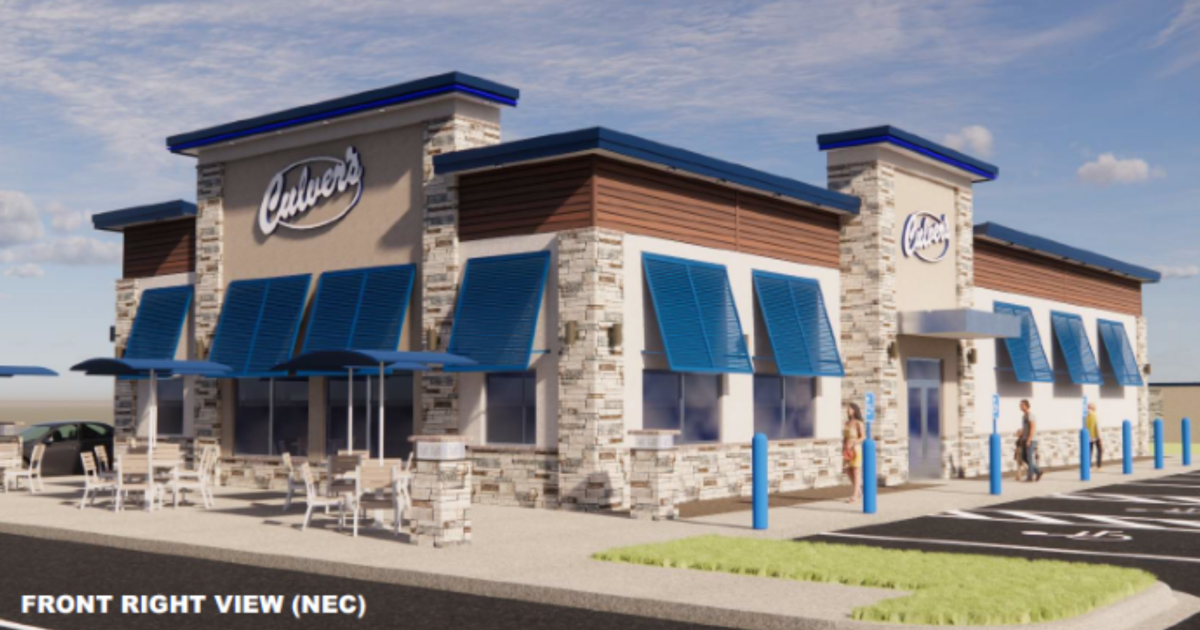
TEMPLE TERRACE — It took the Temple Terrace City Council a little more than five minutes Jan. 6 to unanimously approve the final site plan for the city’s first Culver’s, a popular fast-casual restaurant known for its burgers and custard.
The 4,413-square-foot restaurant will be located on Fowler Avenue and will be constructed after the Wells Fargo bank on the 1.73-acre site is demolished. It will consist of indoor seating, 20 outdoor patio seats and a drive through.
One of the conditions is that the builders will be required to widen 60th Street adjacent to the building to 24 feet.
Culver’s, which was founded in 1984 in Wisconsin, is considered one of the most successful burger chains in the country.
Council approves density increase for property
In other action, the City Council approved a comprehensive plan amendment that could double the allowable housing density on a three-acre parcel near North 78th Street and Harney Road, despite objections from leaders of a nearby homeowners association and some of its residents.
The amendment changes the property’s future land-use designation from Residential-9, which allows up to nine homes per acre, to Residential-18.
If fully built out, the change could permit as many as 54 dwelling units, compared to 27 under the previous designation.
The parcel is surrounded by other R-9 and R-18 property.
The Hillsborough County City-County Planning Commission determined in 2020 that the map amendment was consistent with the city’s Imagine 2040 Comprehensive Plan, though the property owners, K and W Property Group LLC, did not bring the request before the city council until five years later.
Asked why the delay, a representative of the landowner said they were busy with other things.
Renee Mincin, president of the Meadowood Homeowner’s Association, urged the council to reject the higher density, citing flooding, traffic and safety concerns. She had previously described the parcel as resembling wetlands and said the entire area surrounding the parcel was prone to flooding.
Mincin noted that several nearby homes took on water following Hurricane Milton in 2024 and said the property’s proximity to a lift station raises additional stormwater concerns.
She also pointed to increased traffic along 78th Street, driven by recent development including an Amazon fulfillment center, a VA clinic and a self-storage facility, as well as a lack of sidewalks in the area.
“It’s very dangerous right now,” Mincin said. “These are a lot of things to take into consideration before allowing an increase in volume.”
Some nearby residents echoed many of Mincin’s concerns, particularly those about flooding.
Temple Terrace resident and environmental advocate Karen Michalski, however, spoke in favor of the denser development near the city’s primary HART bus route.
She said she also supported the approval back in 2020.
“This is really a great location for somebody that can’t drive,” Michalski said, ticking off nearby amenities and job opportunities like the VA hospital, Moffitt Cancer Center, Publix and Amazon. “We are in the urban core, and this is where we want to have development.”
City attorney Ernest Mueller emphasized that the council’s vote addressed only future land use, not a specific development proposal. Any eventual site plan, he said, would have to go through full review for compliance with zoning, engineering and environmental requirements, with issues such as traffic, stormwater management and setbacks evaluated at that stage.
As for what the developers might have in mind, they weren’t saying. That drew pointed questioning from Councilmember Erik Kravets, who pressed the applicant’s representative on what they might build and why it took five years to come to the council.
After some back and forth, Kravets asked if the intention was to pursue the upzoning solely to increase the property’s value for resale.
The representative said there were no plans to sell the property, and said the developers did not have any firm plans on what they intended to build, but “we want the have the R-18 density to potentially build what we want.”
Kravets made a motion to table the amendment until the applicant could bring forward a business plan outlining potential uses for the property. The motion failed for lack of a second.
Kravets, who supported the amendment on its first reading in December, cast the lone dissenting vote at the final hearing.