
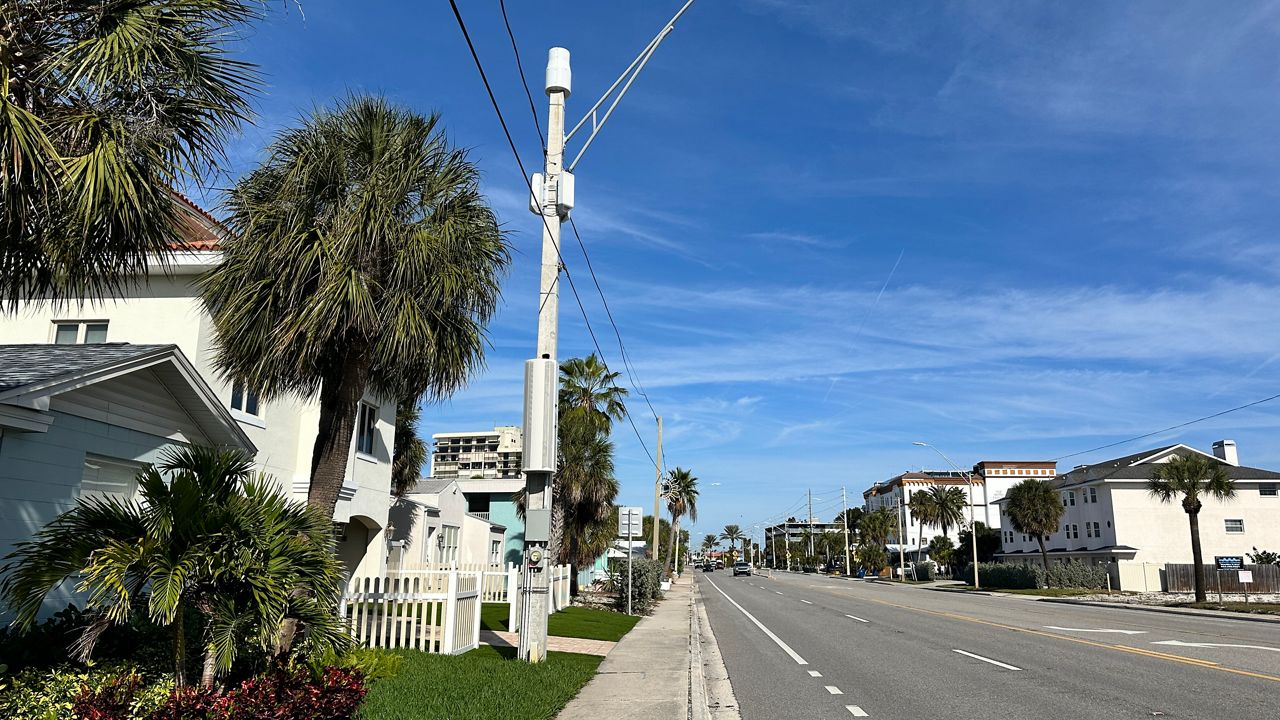
ST. PETE BEACH, Fla. — St. Pete Beach commissioners will take a second and final vote on Tuesday to add new restrictions to the city’s cell tower ordinance in response to residents’ concerns.
What You Need To Know
St. Pete Beach commissioners unanimously passed the revised ordinance during a first reading last month
The amendments are expected to pass a second and final vote on Tuesday
St. Pete beach will be the first city in Florida to implement the most protective ordinance possible
The Florida Coalition For Safe Technology which raised money to hire an attorney who specializes in telecom law to help the city toughen up the ordinance
“We’re confident that our city is going to stand behind us,” said resident Lauren Mones. “I’m proud of my city.”
Residents have been concerned about 5G cell tower equipment installed close to homes, parks and schools. Mones founded the Florida Coalition For Safe Technology which raised money to hire attorney W. Scott McCollough, who is based out of Texas and specializes in telecom law, to help the city toughen up the law.
“What we want is a collaborative effort,” she said. “We want residents and our elected officials and telecom to come together when these cell towers have to be sited somewhere.”
Resident KellyLee McFrederick joined forces with Mones last summer after 5G equipment was being installed on a pole directly across the street from her house in the historic Don CeSar neighborhood without any notice.
“So definitely was helping raise funds for the coalition,” she said. “So that we could have the first protective updated ordinance for wireless. That’s what we’re so, so excited about.”
As Spectrum News first reported, McFrederick fought back and managed to get the cell tower equipment moved away last September. Attorney McCollough called that relocation “rare” and pointed out the measures McFrederick took were key to her success.
“What’s most important is to figure out that this is a bad thing that’s happening to you early in the process, get friends and allies. Get involved with the local leaders,” he said. “Then try to find somebody like our group that can kind of help them, help you, navigate through the process. There are things that can be done.”
McCollough said federal and state laws regulating 5G cell towers are very restrictive but locals can take some measures within those limits which St. Pete Beach has done.
“One of the most important things that we did was we really, really increased the amount of information that is required to be disclosed to the local jurisdiction in the permit application,” he said. “Then as much as we could, required that the people who are affected by the proposed project get notice and an opportunity to participate in the process.”
Other revisions to the St. Pete Beach communication and small wireless facilities code include increased setbacks from residential neighborhoods and environmentally-sensitive areas. Limiting the height of most facilities in residential areas, outside of city-owned rights-of-way, to the maximum height permitted in the zoning district.
Increase application requirements for facilities that could adversely affect sightlines for existing developments. Require compliance verification with environmental reviews and historic preservation consideration when facilities could adversely affect these sites and limit equipment on towers to the extent viable.
St. Pete Beach commissioners unanimously passed the revised ordinance during a first reading last month. The measure is expected to pass a second reading and become law.
“I feel like it’s a heroic effort,” said Mones. “For not only the residents to stand up to telecom but also our elected officials to stand up to a very big, very influential industry.”
McCullough said while other communities have worked on the issue, St. Pete beach will be the first city in Florida to implement the most protective ordinance possible. The FCC and the state of Florida pre-empted local authority to address unnecessary regulatory barriers to wireless infrastructure deployment which could affect the speed and cost of the projects.
Mones and McFrederick said they will lobby state and federal lawmakers to make changes to those laws too.