
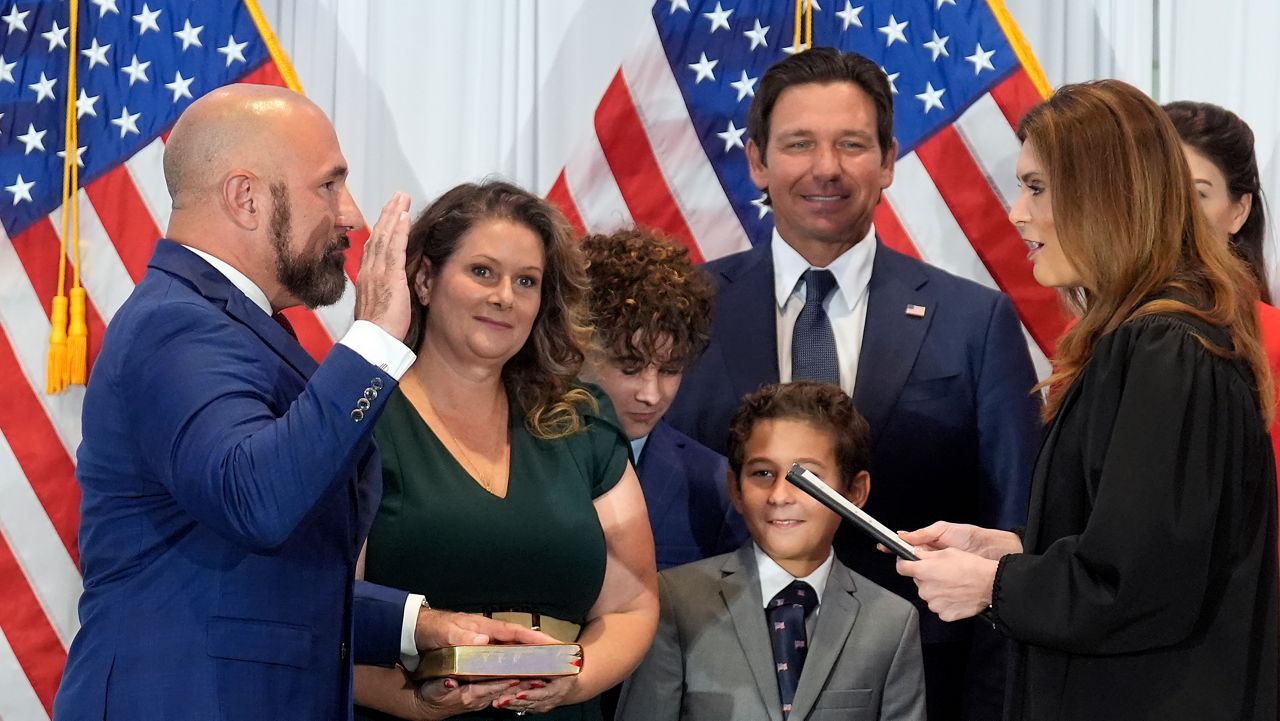
Florida Lt. Gov. Jay Collins announces his new bid for Florida governor, and lawmakers in Tallahassee prepare for this year’s upcoming legislative session.

Florida Lt. Gov. Jay Collins announced he has joined the crowded Republican field to succeed Gov. Ron DeSantis.
“I’m running for Governor because leadership is forged under pressure, not in soundbites. I served over 23 years in the United States military, mainly as a Green Beret, where accountability is real, decisions have consequences, and service comes before self. That experience shaped how I lead and why I believe public office is a public trust,” he wrote in a post on X.
He now joins a crowded Republican field that includes Florida House Speaker Paul Renner, Orange County Mayor Jerry Demings, former Republican congressman David Jolly, investor James Fishback and Congressman Byron Donalds.
Although he recently announced his entry into the race, the campaign for Donalds was quick to react.
“Trump-endorsed Byron Donalds is the only proven conservative fighter who can unite Republicans, deliver on the President’s America First agenda, crush the Democrats, and make Florida more affordable. Anyone running against Byron is an anti-Trump RINO and will be soundly defeated in the Republican primary,” Chief Strategist for the Byron Donalds for Governor Campaign Ryan Smith said.
Collins was appointed as lieutenant governor in August 2025. | Read story
He replaced Jeanette Nunez, who left office to become president of Florida International University.
Collins was first elected to office in November 2022 to represent Tampa and East Hillsborough County, defeating incumbent Democrat Janet Cruz.
In August, DeSantis called him the “Chuck Norris of Florida politics,” drawing a round of applause. He was referencing the action film star who is also famous for his work in martial arts.
In the Florida Legislature, Collins was chairman of the Senate’s transportation committee, vice chair of the military and veterans affairs, space, and domestic security committee, has served on multiple appropriations committee and was on the pre-K education and ethics and elections committees.
Collins served in the Army Special Forces, earning the Purple Heart for his service in combat during his 23-year military career. He is a former Green Beret and had a leg amputated years after sustaining a serious injury but re-qualified to return to active duty.
After retiring from the military, Collins founded a nonprofit organization supporting veterans, first responders and Floridians in need.
DeSantis cannot seek reelection because of term limits.
With just one day left before the start of the legislative session in Tallahassee, Florida lawmakers are gearing up to tackle various issues that have been garnering a lot of attention in past months.
Proposed elimination of property taxes and congressional redistricting are expected to take center stage, all while Gov. Ron DeSantis gears up for his final year in office.
DeSantis has already laid out some of his biggest priorities.
Top of the list is the conversation surrounding the elimination of non-school property taxes, which includes four proposals that would either cut them out entirely or phase them out over 10 years.
Another proposal would eliminate non-school property taxes exclusively for homeowners 65 and older.
The proposals include a police mandate that would require local governments to leave law enforcement budgets untouched.
But many lawmakers from both parties have voiced concern about this idea, since it could significantly change how local governments fund essential services like police, fire and schools, especially in rural areas.
Property taxes are the primary source of revenue for local governments.
The Florida Policy Institute estimates $43 billion would be needed to maintain current services if the House proposals are enacted.
When it comes to introducing big pieces of legislation like this during his final session, University of Central Florida political science professor Aubrey Jewett said he looks at it through a policy and political lens.
In the case of eliminating property taxes, Jewett said it’s a policy issue, especially as it relates to taxing and spending, which could have major impacts for local governments.
But, he said it is also a political issue.
“It’s pretty clear that (DeSantis) still has political aspirations and political ambitions,” Jewett said. “This is his last year as governor. He’s term limited out — he’s a lame duck. But he wants to go out with some big political and policy victories. And so, if he can be considered the architect of the first state to totally eliminate property taxes for primary homeowners, that would be something that he could brag about.”
By the same token, Jewett said this also applies to mid-decade redistricting, which he believes is being used as a tactic to maintain a strong Republican presence in Congress.
As the midterm elections inch closer, DeSantis has called a special session in April to address congressional redistricting to potentially redraw the state’s congressional districts.
This comes months after President Donald Trump urged Republican-led states to redraw their maps to expand GOP majority in congress.
“The Florida Constitution says that when the legislature draws district lines, that they can’t do so with the intent of helping or hurting a political party,” Jewett said. “And so, all the legislative leaders and the governor are sort of winding themselves in circles coming up with all these reasons why they want they want to do mid-decade redistricting.”
But before he can move forward with this, DeSantis needs the approval from both the Florida House and Senate.