
St. Petersburg is launching a holistic, collaborative and innovation-focused workforce development program designed to prepare underserved residents for high-wage careers in target industries.
Mayor Ken Welch’s administration selected St. Petersburg College to administer the initiative, dubbed St. Pete Works: Employment & Development for a Growing Economy (EDGE). City council members unanimously approved a three-year, $6 million contract with the nearly century-old college Jan. 8.
The EDGE initiative represents a reboot of the original St. Pete Works program, which abruptly ended in June 2025 after 5 years. A significantly enhanced version prioritizes connecting South St. Petersburg Community Redevelopment Area (CRA) residents with careers in the marine and life sciences, financial services, specialized manufacturing, data analytics and the creative art and design industries.
“Developing and maintaining a qualified and robust workforce is a top priority for my administration, and I thank the city council for supporting a program that will benefit hundreds of St. Pete residents,” Welch said in a prepared statement.
“This program was intentionally designed to connect participants with the right resources, education, and support so they can fully focus on further developing their skills and completing their training. When we invest in our workforce, the whole community thrives.”
The overarching goal is to increase family-sustaining employment among underserved residents through accelerated training in high-demand industries. A request for proposals issued in August 2025 resulted in five applicants.
St. Petersburg College (SPC) emerged from a competitive process. Belinthia Berry, dean of workforce development, noted the school’s previous success with the initial St. Pete Works program.
SPC recruited 2,737 residents, with 1,307 attending employability training. Another 570 participated in career training, and the college placed 556 people in jobs. “So, we exceeded our metrics,” Berry said.
The city’s contribution to the previous program was less than $1 million over five years, and officials are now providing $2 million annually. “So, it wouldn’t be apples to apples, what we’re expecting,” said Economic Development Manager Andrea Falvey.
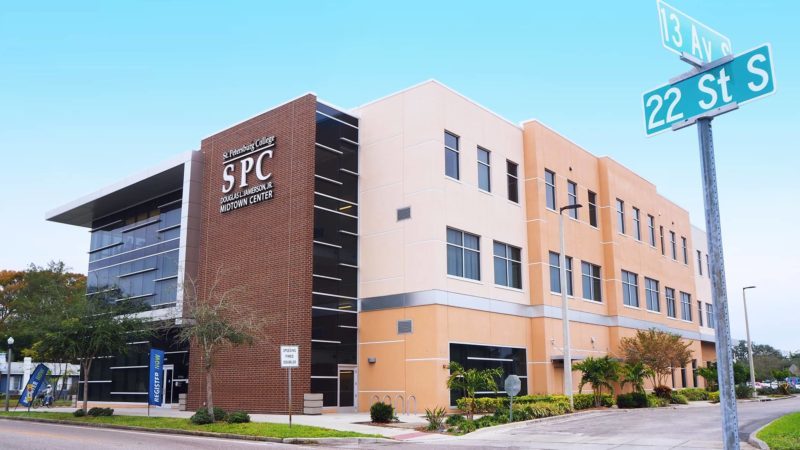
Councilmember Corey Givens Jr. credited SPC for uplifting the South St. Pete community through a diverse array of career training opportunities at its Midtown Campus. He called those efforts an ideal use of CRA tax dollars.
“We talked about 556 people who were placed in jobs in five years – you really can’t put a dollar value on the impact that you all are making on the lives of people who need it the most,” Givens added.
SPC has formalized new program partnerships with Pinellas Technical College, Corporation to Develop Communities of Tampa, Inc., PERC (Pinellas Ex-offender Re-entry Coalition), CareerSource Tampa Bay, the St. Petersburg Area Chamber of Commerce, Pinellas County Urban League and multiple other community organizations.
“I’m really impressed with the partners you have … it just really strengthens the whole program based on what everyone’s individual superpower is,” said Councilmember Gina Driscoll. “It’s like you’ve got a whole Justice League of workforce development.”
Driscoll suggested allowing participants to explore the Maritime and Defense Technology Hub and ARK Innovation Center, two facilities with multiple employers who “fit into these target industries.” Berry said she is already working with both organizations.
City documents state that SPC maintains a database of 938 active partners, which will help place EDGE participants in jobs. Dr. Tonjua Williams, president of the college, noted that “workforce readiness looks different for everyone,” and the importance of “meeting people where they are and supporting them in every aspect of their journey.”
“By combining education with wraparound support services, such as transportation assistance, technology access, digital and AI literacy, food security and mental health resources, we are helping individuals remove barriers, build confidence and achieve long-term economic mobility,” Williams said.
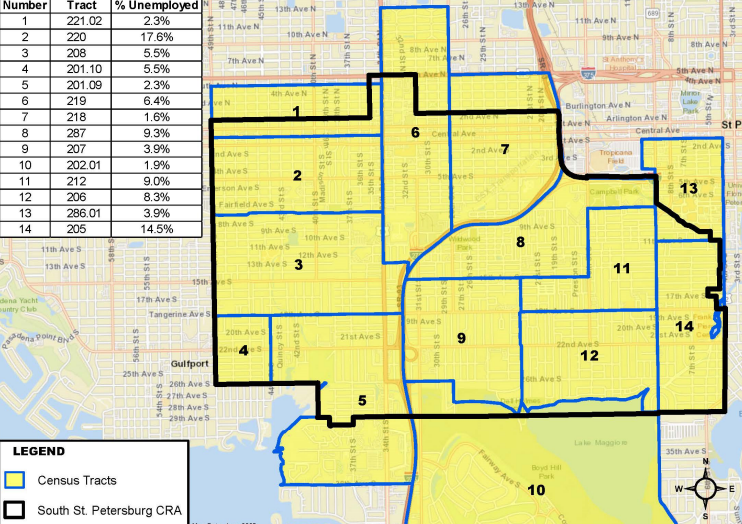
A map highlighting unemployment rates within the South St. Petersburg Community Redevelopment Area (CRA). Taxes collected within the CRA are funding the initiative. Image: City documents.
The EDGE initiative has six operational pillars: Community discovery and access; career navigation and blueprinting; immersive learning labs; work-integrated training; launch and celebration; and career momentum.
Berry said SPC will offer soft skills, including time management and how to “dress for success,” in addition to technical training. Councilmember Brandi Gabbard urged Berry to incorporate resiliency-focused construction training into the program.
“If we don’t have it, we can build it,” Berry said. “That’s what I do – customized training and working with industry partners to scale up and build courses. Within, I say, three to six months, we can get it built and get people in jobs.”
The EDGE initiative will continuously evolve to align with new target industries and technological advancements. SPC and administrators will provide the council with quarterly and annual progress reports.
Chris Steinocher called EDGE a “major commitment by our city” that was “thoughtfully designed.” Councilmember Deborah Figgs-Sanders said the “greatest part of the whole proposal” is that SPC and program partners will “meet all of the participants where they are.”
She said the new initiative is “five times better” than the previous iteration of St. Pete Works, due to technical advancements, new collaborations and a focus on individual needs. Figgs Sanders expects completion rates to soar “because you relate to each of the participants uniquely.”