
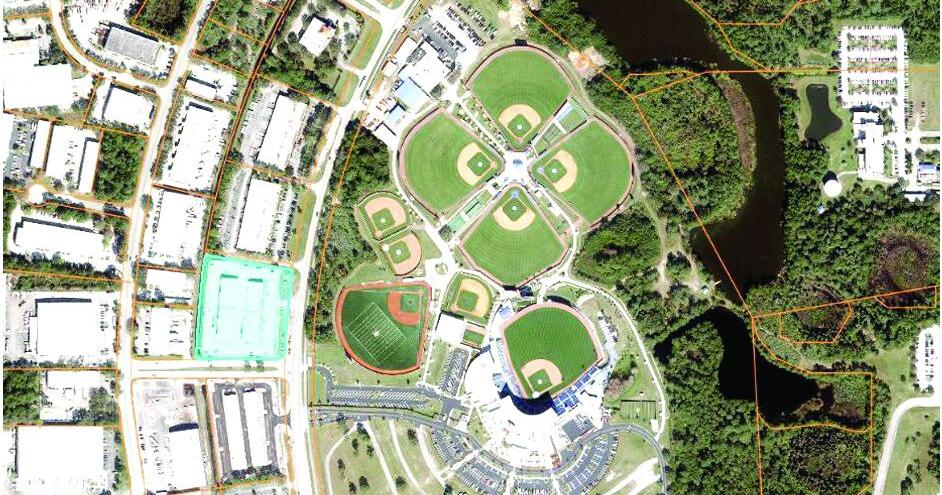
PORT ST. LUCIE – The Planning & Zoning Board approved three separate parking variances Jan. 6 for the property at 510 N.W. Peacock Blvd., allowing new tenants to lease space in an office/warehouse development originally designed for different uses.
Planner Cody Sisk presented the requests on behalf of the property owner, explaining that the proposed tenants require more parking than originally anticipated when the 3.36-acre site was developed. The Board approved a three-space variance for a Jump Start fitness studio and a five-space variance for a private fitness coach with little discussion, citing their limited hours of operation and minimal overlap with existing businesses.
The third request — a four-space variance for a Fyzical physical therapy clinic — generated more debate because its proposed 9 a.m. to 5 p.m. hours would coincide with other tenants’ peak business times.
“This is a request to allow a reduction of four parking spaces required for a physical therapy office,” Sisk said. “The zoning code requires one parking space per 200 square feet of medical use. The proposed clinic will lease two units in Building 2 totaling 2,080 square feet.”
Sisk explained that the site currently provides parking at a ratio of one space per 365 square feet of building area and that a Parking Demand Analysis was submitted using data from the Institute of Transportation Engineers Parking Generation Manual, Sixth Edition. The study compared peak hours for each business to show that adequate parking would remain available.
Sisk outlined the Board’s options, including approval with a condition limiting the variance to the current tenant only.
“This variance shall be granted exclusively to the current applicant and shall terminate automatically upon cessation of the approved business operation,” he said. “Any change in ownership or business entity would render the variance null and void.”
Board Member Peter Previte questioned whether that condition was typical for parking variances. Planning & Zoning Director Mary Savage-Dunham said similar language has been used for shared parking arrangements and had been modified for this request.
Board Member Eric Reikenis, a physical therapist assistant, led much of the discussion, directing questions to the property owner’s representative, Vania Pedraja-Castro, and Fyzical franchise owner Marvin Mora.
Pedraja-Castro clarified she was representing the landlord, not operating the businesses. Mora then described Fyzical’s operating model, which he said differs from traditional high-volume outpatient clinics.
“Our model goes against the traditional 25 patients per day per clinician,” Mora said. “Balance therapy can take an hour. We’re not running multiple therapists back-to-back. There may be two clinicians and staff total at any given time.”
Reikenis pressed Mora on operating hours and patient volume, expressing concern that parking could spill over during peak times.
“My only concern is this is the one business that could impact parking for the rest of the plaza,” Reikenis said. “I’d hate to see people parking on the grass along Peacock Boulevard.”
Mora responded that the parking study assumed a higher patient load than he anticipated.
Chairwoman Jim Norton summarized Mora’s testimony, confirming that the clinic’s model emphasizes appointment-based care rather than volume-driven operations.
“Yes,” Mora said when asked if that approach would prevent additional parking demand.
Board Member Joe Rosen questioned parking consultant Luke Lambert, who confirmed that the study projected a peak usage of 74 out of 96 parking spaces, leaving 22 available.
“That includes the entire parking lot and all uses identified in the study,” Lambert said, adding that some patients are dropped off via ride-sharing.
Alternate Board Member Douglas Harvey was the only member of the public to speak. Appearing as a private citizen, he supported adaptive reuse of the building but raised a concern about accessibility requirements.
“The Florida Accessibility Code requires 20 percent of parking spaces for a physical therapy facility to be accessible,” Harvey said. “That could be an issue.”
Savage-Dunham responded by noting staff had advised the property manager to seek tenants consistent with the site’s original design.
“These sites were developed as office/warehouse and cannot be expanded for additional parking,” she said. “We’ve encouraged them to be mindful as they lease additional units so this doesn’t become an ongoing issue.”
Pedraja-Castro assured the Board that parking would be actively managed.
“I work onsite and would not allow parking on the grass,” she said. “We want to make sure the plaza is managed appropriately.”
Following discussion, the Planning & Zoning Board unanimously approved all three parking variances, including the conditional approval for the physical therapy clinic.