
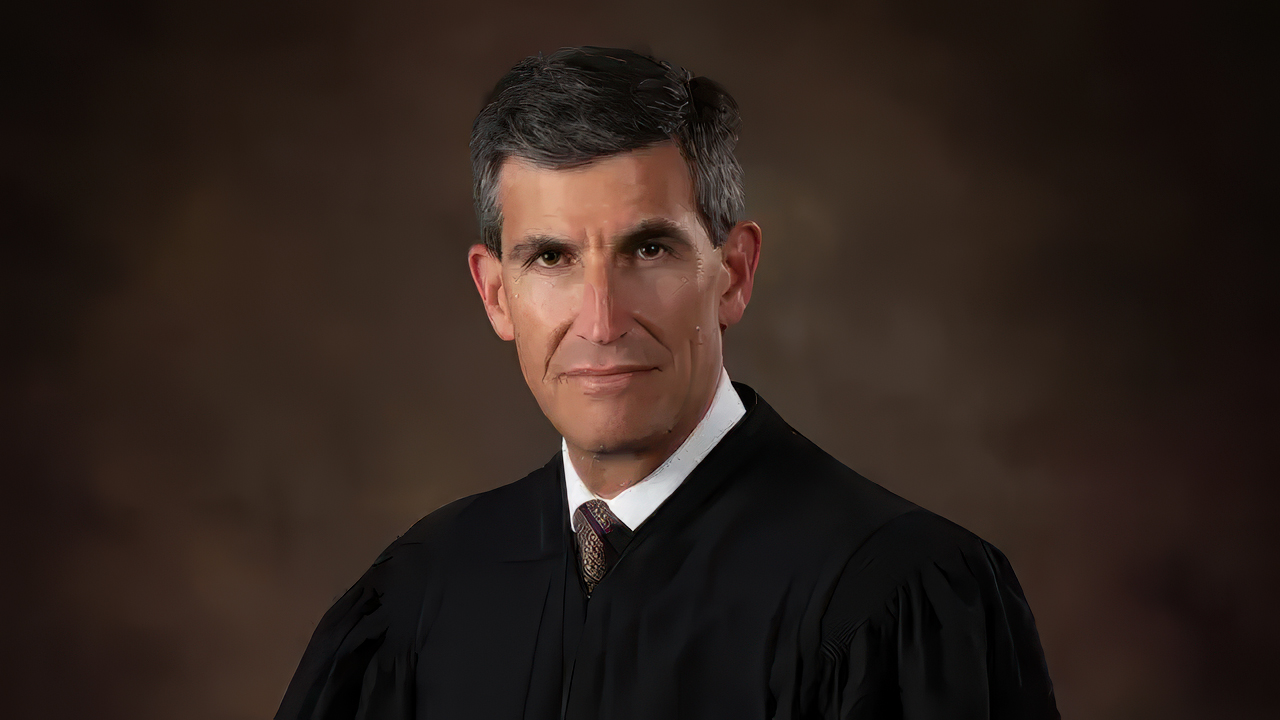
Gov. Ron DeSantis continues to put his stamp on the Florida Supreme Court, appointing Adam Tanenbaum to fill the opening left last year by recently retired Justice Charles Canady.
DeSantis made the announcement at Seminole High School, Tanenbaum’s alma mater, where the jurist was student body president and graduated as valedictorian.
DeSantis appointed Tanenbaum to the 1st District Court of Appeal in October 2019 and clearly liked what he has seen since, elevating the jurist from a crowded field of qualified applicants.
DeSantis said he was particularly impressed with Tanenbaum’s knowledge of state government and “strong background,” saying the newest Supreme Court Justice understands the executive branch better than the Governor himself.
“I was talking to some of my guys after I interviewed the Judge. It’s like, we’ve got 23-plus million people, you know, in the state of Florida. And I would guarantee you, you will not find 10 people out of that 23 million who know more about Florida government — not just law, and the Supreme Court and courts, but the agencies, the legislative branch, all that — than Judge Tanenbaum. He knows this stuff very, very well,” DeSantis said.

Prior to becoming a Judge, Tanenbaum worked in commercial litigation and served as a state and federal public defender, General Counsel for the Florida Department of State, and chief deputy solicitor general at the Florida Department of Legal Affairs.
“He’s had a really distinguished legal career,” DeSantis said.
Tanenbaum graduated from the University of Florida as a co-valedictorian, was a member of Florida Blue Key, and later earned his law degree from Georgetown.
He is DeSantis’ sixth pick for the high court and will ensure the Governor’s conservative judicial philosophy prevails long after he leaves office in November.
“Someone could be on the court for 20, 30 years,” DeSantis said, going on to express confidence that Tanenbaum had the “courage” and “warrior spirit” to make tough rulings “when it may not be as popular to do so.”

“I wholeheartedly embrace your vision, Governor, and I am honored and humbled that you would entrust me with what likely is your capstone appointment to our state’s high court,” Tanenbaum said, before offering some autobiographical context as to why the setting of the announcement was so important to him.
“I graduated in 1989. The same year the ‘Stranger Things’ kids did, as a matter of fact. And the same year that Taylor Swift was born. I gave a valedictorian speech and crossed the stage on a football field, not far away from this room, about 37 years ago. Never did I expect that I would be back here, in this building, with the Governor of the state of Florida, doing this.”
Tanenbaum discussed how his parents fostered his independent spirit, then fought back tears as he paid tribute to his deceased grandparents. He also offered an emotional testimonial to his wife on the day before their wedding anniversary.
He also grounded his judicial philosophy in that of DeSantis’ favorite living judge, Clarence Thomas, saying he’d be an originalist and wouldn’t be afraid to overrule erroneous precedent when necessary.
“Sometimes, the circumstances require boldness to restore our jurisprudence to its historical roots. Choosing not to do this is not judicial restraint. Judicial restraint describes how the court should approach the work of the other two branches. With respect for separation of powers, and for the limited scope of the judicial power, basically to conclusively adjudicate one dispute at a time by ascertaining and correctly applying the originally fixed meaning of the law. Restraint does not, and should not, describe the court’s approach to correcting demonstrably erroneous lines of decision that only it has the power to correct,” Tanenbaum said.
He also pledged to look at “wrong and inefficient” practices in administrative law.
“The court should continue to exercise its constitutional authority, to look at the different administrative components that the court supervises and make any necessary changes to ensure. those components are efficiently pursuing the court’s established values and vision. Steps already have been taken on this front by my soon to be colleagues, and I look forward to joining them in the ongoing endeavor.”