
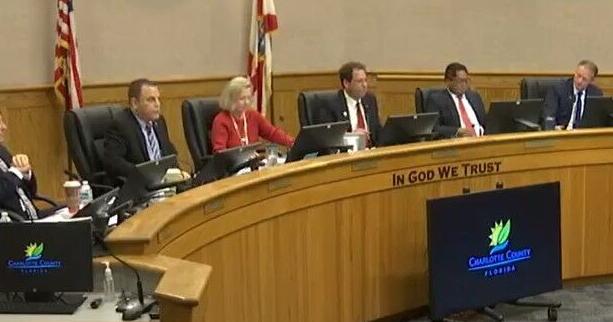
Builders in Charlotte County will face a sharp increase in water and wastewater connection fees for new construction beginning April 1, while residential ratepayers will see a more modest utility rate hike, following a contentious debate over how the county should fund expanded infrastructure needed to support rapid growth.
Under the approved changes, water and wastewater connection fees for new construction will rise by about 33%, while residential utility rates will increase by 3.5%. The Board of County Commissioners voted 4-1 to approve the increases during its Jan. 13 meeting, with Commissioner Stephen R. Deutsch casting the lone dissenting vote.

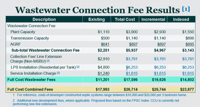
A Charlotte County Utilities chart details the combined cost of proposed water and wastewater connection fees, which will total $26,714 for new construction beginning April 1.
Charlotte County government
The decision came after hours of public criticism from residents who accused the county of failing to raise impact and connection fees over the years, leaving existing ratepayers to shoulder the cost of expanding water treatment and wastewater facilities as the population grows.
Many of the most vocal critics were members of the Burnt Store Corridor Coalition, whose founders John Fleming and Mary Ellen Kiss, along with dozens of coalition members, attended the meeting. The utilities presentation was the final item on the agenda, and coalition members waited nearly three hours before the issue was addressed. Fleming later said he believed the placement of the item — originally scheduled for earlier in the day — was intentional. Fourteen coalition members left before the public hearing began.
Fleming, who is running against Commissioner Chris Constance in this year’s election, has repeatedly criticized the county’s approach to growth management and infrastructure planning. He told commissioners the coalition had warned for years that continued residential development without corresponding increases in fees would eventually lead to higher costs for residents.
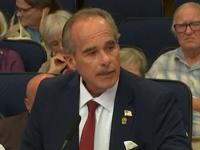
Burnt Store Corridor Coalition co-founder John Fleming addresses county commissioners during a public hearing on utility rates and connection fees Jan. 13 in Charlotte County.
Charlotte County government
“Back in 2012, Resolution 19 was passed, and it was to set up a new fee schedule,” Fleming said, adding that the increases were never implemented on an annual basis as intended. “As a result, you had a revenue shortfall.”
Financial Services Director Rick Arthur presented data prepared by Murray Hamilton of the national consulting firm Raftelis, showing how the new fees would be structured. Under the revised schedule, water connection fees for new construction will increase from $6,792 to $9,118, while wastewater connection fees will rise from $11,201 to $17,596. Combined, builders will pay $26,714 in connection fees.
The last time Charlotte County raised its connection fees was in 2018.
Deutsch asked Arthur how much revenue the county might have generated had connection fees been increased five years earlier. Arthur estimated the total would have been about $73 million.
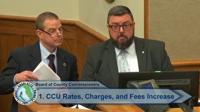
Murray Hamilton of Raftelis, left, and Charlotte County Financial Services Director Rick Arthur present proposed water and wastewater connection fee increases to county commissioners during the Jan. 13 meeting.
Charlotte County government
Deutsch said that when he and Constance first took office, the county was still emerging from the recession, and commissioners were hesitant to raise fees while residents and builders were struggling financially.
Arthur told commissioners that when impact or connection fees do not fully cover the cost of expansion, the burden shifts to utility ratepayers.
“If you don’t increase these fees, the pressure then is,” he said, “upward on the ratepayers.”
Constance said the county inherited longstanding financial challenges when Charlotte County Utilities decades ago took over the utility system from General Development Corp. for $60 million, only to discover it needed to invest another $60 million shortly thereafter. He said the utility has been “behind the 8-ball for decades.”
Fleming countered that coalition members, representing about a dozen communities along the Burnt Store Road corridor, had repeatedly warned commissioners about approving large-scale development without adequate infrastructure planning.
“You had 6,500 constituents who were willing to sit and talk with you,” Fleming said, accusing commissioners of being “tone deaf” to residents’ concerns.
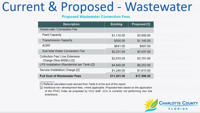
A county presentation outlines current and proposed wastewater connection fees, reflecting a significant increase for new construction under the approved rate structure.
Charlotte County government
Fleming also pointed out that while Charlotte County has some of the highest user utility rates in Florida, it also has some of the lowest tap fees for new connections.
Arthur said delaying the rate increase would only worsen the problem. Without action now, he said, residential ratepayers could face a 10% increase in the future.
Deutsch voted against the measure, saying he wanted to separate user rate increases from fees imposed on new construction. The remaining commissioners voted in favor, approving both increases to take effect April 1.