
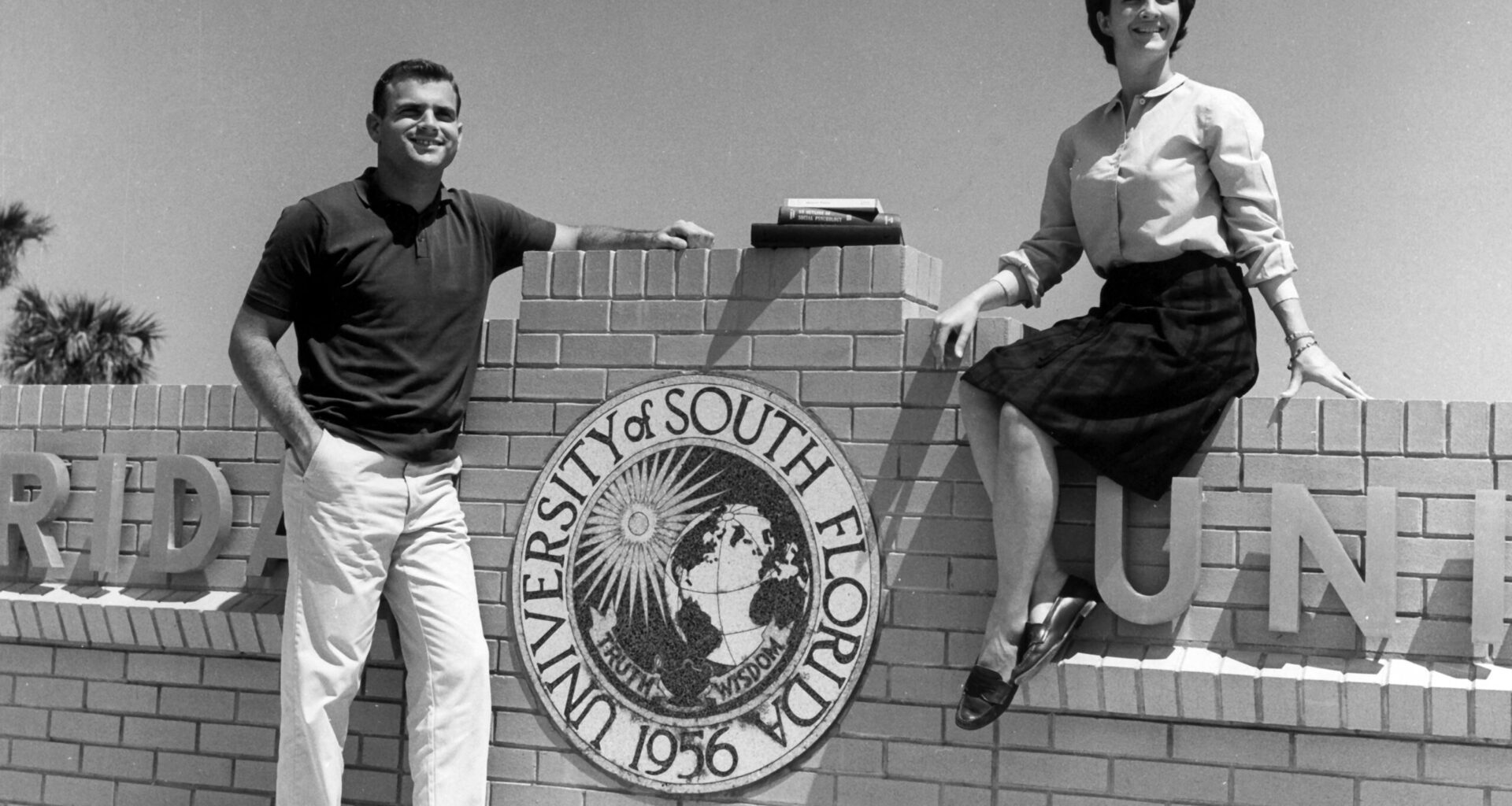
 USF students, faculty and alumni are celebrating 70 years of the university through nostalgia and optimism. ORACLE PHOTO/USF LIBRARY PHOTOGRAPH ARCHIVES
When USF was founded in 1956, the Tampa campus consisted of a handful of buildings surrounded by sand.
There were no sidewalks — only a few trees, three core buildings and minimal development beyond the university’s borders.
Now, USF has three campuses and over 280 buildings across Tampa, St. Pete and Sarasota-Manatee.
As this year marks 70 years since its founding, USF is celebrating national recognition, research milestones and marks of growth through full dorms.
USF recently scored a membership with the Association of American Universities, record-setting research funding, a top-ranked medical school and the creation of the first college in Florida dedicated to artificial intelligence, cybersecurity and computing.
While these achievements mark major institutional achievements, the anniversary has also prompted faculty, alumni and students to reflect on how the university changed over time.
Related: Board of Governors approves USF’s ninth president
Robert Potter, a professor in the department of chemistry, has been at USF since 1984 and said the campus he first encountered looked different compared to today.
“The campus was bleak,” Potter said. “[It had] very few trees, and there were broad open spaces between each of the colleges.”
Potter said many of the campus features that now define student life had not yet been built when he arrived — including the residence hall system and major academic and research facilities.
Despite the limited physical development at the time, Potter said the academic environment made an immediate impression on him.
“The faculty was friendly and entrepreneurial,” Potter said. “The faculty took both research and teaching seriously.”
As the university expanded its student population, Potter said some of the most meaningful changes were seen in how USF supported its faculty and students.
While teaching methods have changed dramatically over time, Potter said the university’s core has remained consistent.
“My favorite thing about working here today is still the people,” Potter said. “We have more talented faculty, staff and students than before, and the drive to improve is still strong.”
Related: USF professors alarmed by DOGE’s review of academic research
Judith Bryant, a psychology professor who has been at USF since 1981, said she has also witnessed decades of change.
Bryant said that when she came to USF, the campus felt physically isolated from the surrounding city.
“USF was built kind of out of nowhere,” Bryant said. “There weren’t all the apartments and condos and so on to the north of campus.”
But over time, Bryant said USF’s growth reshaped both student life and faculty experience.
By shifting from a largely commuter campus to a more residential one, Bryant said USF allowed for more student and faculty interactions on campus.
This year, all residence halls on USF’s Tampa campus reached full capacity for the first time in five years, with all 44 halls filled and 3,257 new students living on the Tampa campus.
“Lots of dorms on campus means that there’s more going on, and I think it’s kind of more exciting for the students, and also then that’s more exciting for faculty,” Bryant said.
But the university’s expansion came at a cost, she said, as the campus grew larger and less personal.
“It used to be the case that I felt like I kind of knew everybody,” Bryant said. “Now we have more faculty, more diversity, more interesting things being taught. But at the same time, it’s not kind of the same family feel that it might have been.”
USF’s first graduating class had 325 students, compared to more than 7,700 graduates in spring 2025.
Related: USF Tampa Library upgrades near final steps
For alumni, USF’s evolution is most noticeable in the physical and visual changes to campus.
Allin Shaw, a Tampa-based software engineer who graduated from USF in 2006, said the university once lacked the strong visual identity it has today.
Shaw said the campus felt quieter and less developed when he was a student.
“This was before the Research Park and the development of the new dorms and improved infrastructure,” Shaw said.
USF’s Research Park was established in 2005 to support partnerships between the university, private industry and government agencies.
Major residential expansions — including the opening of Juniper-Poplar Hall in 2009 and The Village in 2017 — followed in an effort to expand on-campus housing and student life.
Shaw said USF’s academic standing and AAU status represent years of effort and growth.
“This designation is the culmination of so many contributions over time and makes me very happy for both the current student body and the educators,” Shaw said.
Shaw said the on-campus stadium, expected to open in 2027, marks another step forward for USF.
“Having an on-campus stadium really helps integrate more of the student body into the lead up to gameday,” Shaw said. “It is another sign of how far the university has come.”
Although long-term faculty and alumni feel nostalgic and hopeful about the university’s past and future, students said USF’s ongoing growth is especially visible today.
Michael Zhang, a sophomore mechanical engineering student, said the pace of development is noticeable from one semester to the next.
“It feels like the university is still building,” Zhang said. “Every semester, I hear about something new the school is building.”
Recent projects include updates to the campus water tower and plans for the Fletcher District, a mixed-use development set to finish in fall 2027.
Zhang said that constant expansion increases access to campus facilities and resources, shaping how students experience campus life and academic opportunities.
“I feel like there has been a lot more school spirit lately,” Zhang said. “There’s more happening on campus, and it makes it easier to feel connected to the university.”