
The conveyor belt of volunteers stands in ankle-deep water, passing mesh bags full of emptied oyster shells. The regulars wear long sleeves to protect their arms from the shells’ rough edges. The newbies wear short-sleeved athletic attire and clunky sneakers that nearly glue their feet to the sediment.
Sometimes the shells tear through the casing, and a warning sounds. Volunteers on the bucket-brigade line for Tampa Bay Watch, an environmental nonprofit, try to keep them from spilling into the bay.
“Hole on top!” they shout.
Thump.
“Hole!”
Thump.
“Hole!”
Over several hours, they haul the 30-pound bags — stuffed with shells collected from the waste bins of local seafood restaurants — from a small fishing boat to the shoreline of MacDill Air Force Base.
This work, which brought more than 90 people together on a weekend in early November, is part of an effort to rebuild oyster reefs and stabilize shorelines around the region by giving discarded shells a new life in Tampa Bay.
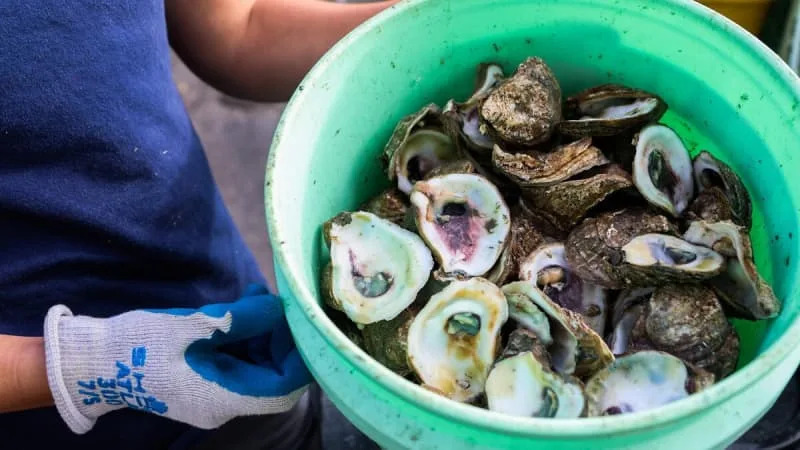
Eastern oysters are a pillar in marine ecosystems. As a keystone species, they provide habitat for fish, birds, crabs and other life, which fuels the local tourism industry. As oysters eat, they filter water, cleaning millions of gallons per day and aiding in the growth of seagrass. They stabilize vulnerable shorelines by slowing wave action and preventing erosion.
Tampa Bay’s connection to oysters stretches back thousands of years. Archaeological evidence in the form of shell mounds, or “middens,” shows indigenous people harvested oysters to eat and may have even used marine cultivation methods to enhance their growth.
But by the 1930s, construction companies began over-dredging oyster reefs for road-building materials, stripping away vital habitats. According to a1976 study, oyster dredging and channel deepening contributed to a 44% reduction of the original wetlands bordering Tampa Bay. Dredging was finally scaled back in the 1970s due to environmental concerns, but the damage remains.
Globally, oyster populations have plummeted by 85% over the past century due to overharvesting, habitat loss and poor water quality. Tampa Bay, the largest estuary in Florida, has experienced an equally devastating decline. In the 1940s, oyster reefs spanned over 2,000 acres of the bay. Today, 217 acres remain.
Tampa Bay Watch has been rebuilding the bay’s oyster population since the early 2000s. They’ve long installed oyster reef balls — concrete domes that give new oysters a hard surface to settle on. They’ve also provided vertical oyster gardens to homeowners with docks. In 2022, the organization debuted its “Shells for Shorelines” program, working with local restaurants to collect oyster shells that would otherwise end up in landfills.
Oysters, much like coral and anemones, are broadcast spawners, meaning they release eggs into the water for fertilization. They also have the ability to “taste” nearby oysters, including recycled shells, said program manager Rick Radigan.
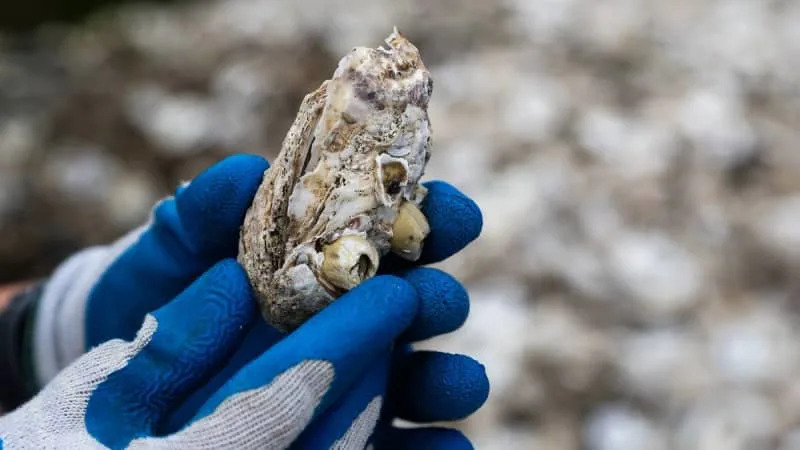
When oyster larvae are about 2 weeks old, they search for a hard surface to settle on. The recycled shells chemically signal to the larvae to attach, and the larvae bind for life.
The newly settled oysters, called “spat,” are no bigger than thumbtacks. They grow for 18 months, reaching their adult stage at roughly the size of the palm of a hand. As the reef grows, it influences more oysters to settle in the same place.
“When you take an oyster out of the water to consume it, you’re actually taking the home for future oyster populations,” said Radigan. “So that’s why we want to get as much of that shell back in the water.”
Over three years, around 311,000 pounds of shells have been collected and recycled — about the weight of 30 elephants — from restaurants around Tampa Bay. Those shells have been used to restore some 1.7 miles of coastline at MacDill Air Force Base, as well as local shorelines like those of Fantasy Island in Hillsborough Bay, Lassing Park along Tampa Bay and Abercrombie Park off of Boca Ciega Bay.
One of the biggest donors is The Tides Market in Safety Harbor. Kiera Andrews, a spokesperson for the restaurant, said The Tides contributed more than 28,000 pounds of oyster shells — around 200,000 individual oyster shells — last year. Andrews said the restaurant shares a countdown toward the end of each year to motivate staff and guests to increase the number.
The process is simple. After guests snack on oysters during happy hours, servers take away the platters and deposit the shells into a pale green utility bucket marked “Tampa Bay Watch,” instead of tossing them into the trash.
Volunteers pick up the buckets once or twice a week.
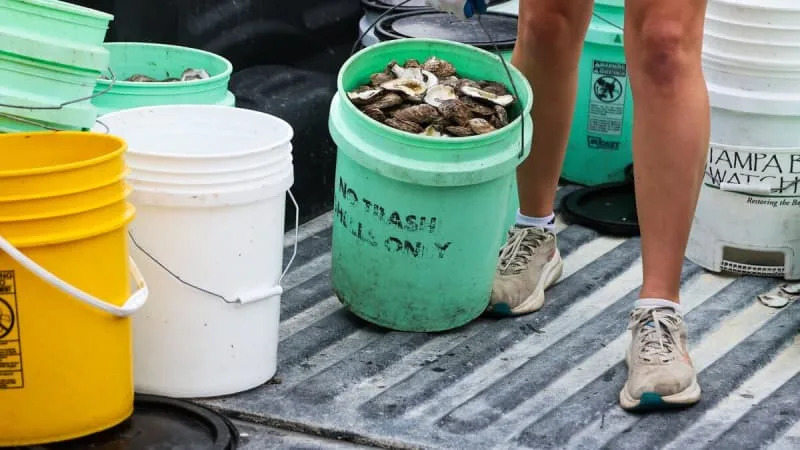
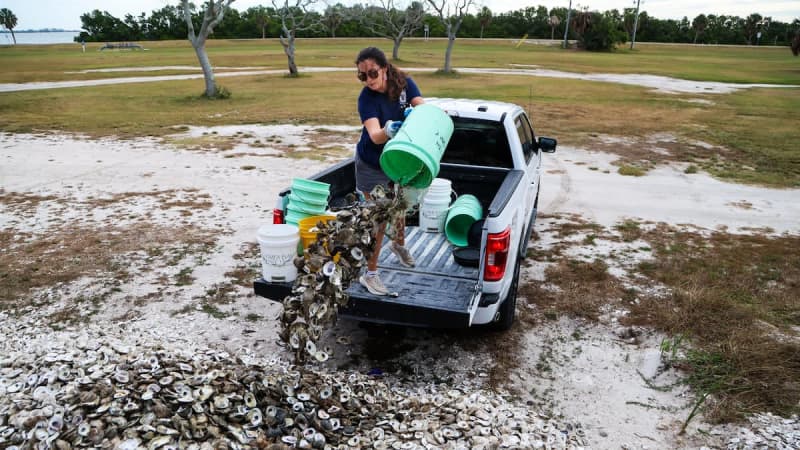
Karen Mastenbrook, 55, has been doing shell pickups since the spring of 2022. Every week, she scoops up 15 to 20 buckets of shells from the Island Grille in Tierra Verde, dumps them at Fort De Soto, and drops empty buckets back at the restaurant.
“I live right down the road from Island Grille, so there’s no excuse not to do it,” Mastenbrook said. “I love being able to help out.”
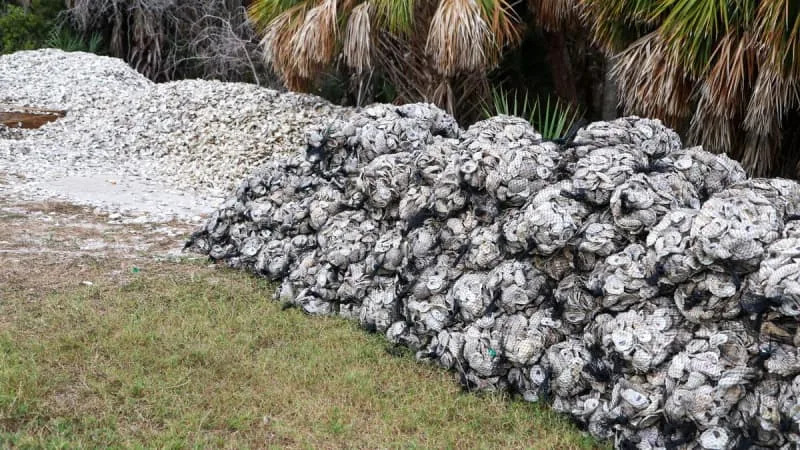
At Fort De Soto, the shells are stacked into white mountains, far from passersby, where they are prepped for reef reconstruction.
Because the majority of shells that come into the program are harvested outside of Tampa Bay, Radigan said it’s critical they go through a disinfecting process to avoid introducing exotic organisms or diseases.
After 90 days, the remnants of oyster flesh and sour smell are wiped clean by the elements. The shells hold onto their chemical sensors to attract juvenile oysters, but they have undergone a makeover: They are sunbleached, smooth and odorless by the time they are packed into mesh bags for reef-building.
Volunteers help transport the shells to their new home under Radigan’s guidance.
“We are incredibly lucky,” Radigan said during the haul in early November. “It’s really inspirational to see these groups of people coming from all walks of life. Corporate, blue collar, retirees, students, all working together.”
In the water, Mike McNulty was lugging shell bags through the bay. He began volunteering with Tampa Bay Watch in 1999. After moving to Tampa from Ohio, he was looking for a way to help the environment.
“It’s a really rewarding thing to do,” said McNulty. “I get back in my car after an event, and I just feel accomplished.”
He said the camaraderie keeps people coming back — high school students and retirees alike.
“We’re all stewards of the environment,” McNulty said.
At the end of the installation, volunteers stand atop the freshly placed layers of shell, still bright white and chalky. In three months, the shell bar will be coated in algae, and new oyster larvae will begin attaching. Those larvae will reach full maturity within two to three years, joining the rest of the reef in filtering water, spawning new oysters and supporting a plethora of other life in Tampa Bay.
Oyster reef installations account for just a fraction of the work Tampa Bay Watch does each year. To get involved and learn more about future installation dates, visit https://www.tampabaywatch.org/get-involved.