
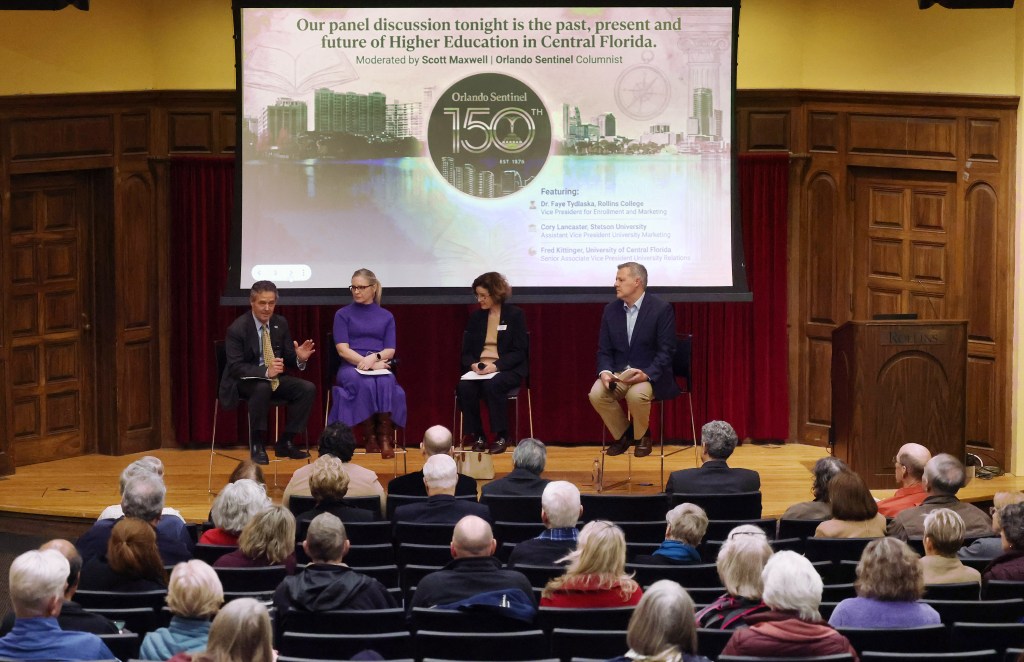
Central Florida’s higher education leaders spoke about tackling future challenges and preparing their students for a rapidly changing world at a Rollins College panel Thursday, part of the Orlando Sentinel’s 150th anniversary commemorations.
Senior faculty from Rollins, the University of Central Florida, and Stetson University noted that many are questioning the value of higher education in a rapidly changing labor marketplace.
But they reaffirmed their commitment to teaching students skills that they can use across a number of fields, no matter the changes in their industries caused by new technologies and trends.
One of those major transformations is artificial intelligence, including how to use AI at school and in the workforce.
“How do we embrace this, because this is something that our students are going to need to know and be comfortable with and understand how to use in their world of work,” said Dr. Faye Tydlaska, a vice president at Rollins. “…We just know that’s the world that they’re entering into.”
Cory Lancaster, an assistant vice president at Stetson, said the university had just issued Thursday new guidelines on generative AI. She said its important students know the risks and rewards of AI and be able to identify instances when it was appropriate to use AI in their research and when it would be academic dishonesty.
But there are larger concerns about the supply of future students and how to attract them, including what Lancaster called the “demographic cliff” — the decline of college-aged students among the population. She believes the key to combating it is to ensure higher education remains accessible and affordable for all, something especially important given the nation’s growing cost of living.
“Stetson is trying to meet this challenge by ensuring that our private form of education is affordable and accessible to all students,” Lancaster said. “Not just students in Florida or even in America, but students across the world. We have students this year from 56 countries.”
To that end, she said, Stetson’s president has set a goal to raise $350 million by the end of his second term in 2030, 75% of which will go to student scholarships.
But an even deeper problem is students’ readiness for college and how to recruit students.
“My husband’s a school teacher and there’s clearly been an erosion after COVID in the skill level of high school students,” Lancaster said. “I think colleges just have to meet students where they’re at and be ready to provide additional support.”
Tydlaska agreed and said its important to bridge the gap to meeting prospective students where they are as opposed to expecting them to come up to where they want them to be.