
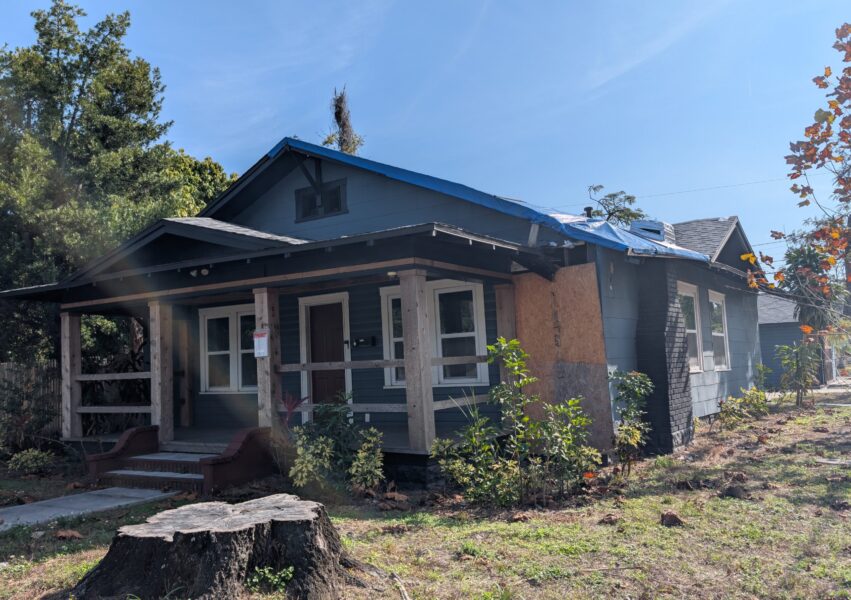
Hurricane victims throughout Pinellas County began receiving disaster relief checks before Christmas. St. Petersburg’s $160 million program has encountered yet another federal hurdle.
A historically long government shutdown delayed plans to open Sunrise St. Pete applications in November. While that has since occurred, residents still reeling from the 2024 hurricane season face an extended wait to receive financial assistance.
Amy Foster, housing and neighborhood services administrator, told a city council committee Thursday that St. Petersburg is likely two to three months away from providing any funding from the U.S. Department of Housing and Urban Development (HUD). That could also be a best-case scenario.
“We received word, multiple times, that our grant agreement was imminent,” Foster said. “And then last week, our HUD rep let us know that they are changing our grant agreement. We don’t know what that means.
“The best word we got from them was that they were changing some things to make it more readable, but also to incorporate more executive orders into it.”
St. Petersburg has done its part. City council members approved the initial, meticulously created $61 million residential recovery program in early October, a year after Hurricanes Helene and Milton decimated the area.
Foster said Oct. 2 that the shutdown wouldn’t impede officials from opening Sunrise St. Pete applications the following month. She was less certain the following week.
The 43-day federal impasse “absolutely” impeded the city from opening applications, Foster told the Catalyst at a Nov. 20 event. “People have been waiting a long time for recovery – the sooner we can get these dollars into people’s hands, the better,” she said.
“They’ve (HUD) had our grant agreement since October.”
City officials thought federal funding was on the way three months ago. Mayor Ken Welch’s administration hired program-specific staff, opened a call center and established two intake facilities. “Even though we’re not being reimbursed for that,” Foster said at the event.
“I made the decision that it made sense to get resources to our community sooner rather than later, knowing we had funding coming,” she explained Thursday. “We kept working diligently and opened the program, even without a grant agreement.”
Applications opened Dec. 15 and underscore the ongoing need for disaster assistance in St. Petersburg. Over 1,450 people applied by Jan. 7.
The city received 426 applications for up to $375,000 in reconstruction and elevation funding. Officials expected to help 98 households rebuild storm-damaged homes.
They also planned to provide up to $50,000 for 288 households that had previously completed storm repairs, and $15,000 in relief reimbursements for 784. Residents submitted 167 and 859 of those applications, respectively, in three weeks.
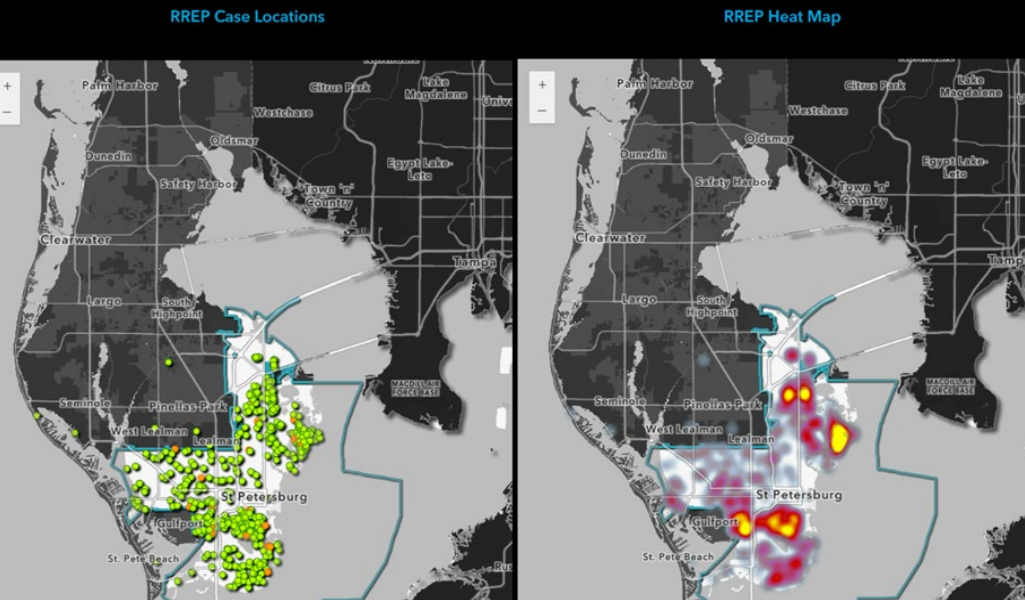
A heat map that highlights where residents have applied for home rebuilding assistance. Image: City documents.
Foster said administrators and city lobbyists “have been diligently sharing our numbers, weekly, with our elected officials to let them know how many people really need recovery assistance.”
She does not expect HUD to amend the county’s agreement. Councilmember Brandi Gabbard called that “interesting,” and asked if there were “any discernible differences” in what the two governments provided. “Not that I’m aware of,” Foster replied.
County Commissioner Brian Scott, then chairperson, hand-delivered the first People First Hurricane Recovery Program check to a Seminole family Dec. 22. Over 3,700 Pinellas residents who live outside St. Petersburg applied to the $813 million initiative between then and Oct. 20.
Fort Lauderdale is the only other Florida city selected by HUD to receive disaster relief community block grants. “I think anyone who didn’t have an executed agreement is getting the amendments,” Foster said.
“I don’t know who else is in that situation,” she added. “But post shutdown, they’ve decided to make some changes.”
Foster encouraged council members to advocate for a quick release of relief funding. She said administrators were shocked at the number of people who have yet to repair or rebuild storm-damaged homes, which is a “powerful case for support.”
“I just really wanted to underscore how many people we have that are hurting,” Foster said. “This assistance coming urgently is important.”
Councilmember Richie Floyd noted that many applicants likely assume they will soon receive a response on awards. Aubrey Phillips, strategic initiatives and grants director, said an estimated timeline for checks is the “main question that we don’t have an answer to for folks.”
Phillips said case managers are providing regular updates. “But we don’t have an answer. We would love one, too.”
Floyd asked if Foster was hopeful that residents would receive funding relatively quickly following an executed grant agreement. “Absolutely,” she replied. “That was our goal when we opened applications in December.”
Foster also praised city staff for their efforts. Particularly, street teams, who are going into homes and helping residents secure wraparound services, including legal aid and mental health care.
“I really want you to know that your vulnerable residents have this one-on-one support from the case managers that I never anticipated would be as good as it is,” she said.