
A state agency under control of Gov. Ron DeSantis has issued 11th-hour instructions to local officials that could hamper efforts to get a referendum to legalize recreational marijuana on the 2026 Florida ballot.
Last week, the Secretary of State’s Office — which is run by a DeSantis appointee — issued a directive to the state’s 67 county supervisors of elections that complicates the process for verification of voter signatures needed to qualify a referendum. It gives instructions that several supervisors of elections said aren’t backed up by state statute or case law established by previous court decisions.
The directive included a final sentence that grabbed the attention of its recipients: “Please note that the Attorney General’s Office is copied on this email.”
The instructions to the supervisors, who are elected by voters in each county to run elections, came from Maria Matthews, director of the state Division of Elections, which is a unit of the Secretary of State’s Office. The email containing the instructions was obtained through public records requests to two supervisors’ offices.
The latest change in policy comes at a critical time, just weeks before the deadline for sponsors of the proposed marijuana amendment to have the sufficient 880,062 verified signatures to get on the ballot in November.
DeSantis does not want recreational marijuana legalized in Florida. He was the most prominent opponent of a similar 2024 referendum, which failed.
The fate of the referendum effort is unclear, despite Smart & Safe Florida saying last week more than 1 million voters had signed petitions. Instructions from the Division of Elections can make a difference: 42,000 petitions signed by inactive voters and nearly 29,000 petitions collected by out-of-staters already are being removed, per its earlier efforts.
If it does get on the ballot and is approved by 60% of voters, the amendment would legalize recreational marijuana for people 21 and older.
A similar referendum in 2024 got majority support — 55.9% yes; 44.1% no — but failed because it didn’t reach the 60% threshold required for passage. The most prominent Florida voter, President Donald Trump, said at the time he would vote yes.
Same day
The Republican-controlled Legislature and DeSantis last year made a number of changes to put additional restrictions on the ballot-initiative process.
As of Oct. 1, state law now requires supervisors of elections to send a letter to each person whose signature on a referendum petition is verified. The mailing must also include a pre-addressed postage-paid form that a voter can use to alert the DeSantis-controlled Office of Election Crimes and Security in Tallahassee if they believe their signature was obtained fraudulently.
In her Jan. 8 email, Matthews cited the state law and cited the part of the new law that requires them to send the notices that specifies “the supervisor shall, as soon as practicable, notify the voter.” Matthews added something that isn’t in the law: that the phrase as soon as practicable “means on the same day you verified the signature as valid.”
Some Central Florida voters who signed petitions said they are confused after receiving mailers back from their supervisor of elections offices.
Lake Mary resident Bert Culpepper, a registered Republican, said he and his wife received the mailer from the Seminole Supervisor of Elections Office after signing a petition on the use of recreational marijuana.
“I thought: ‘This is so odd,’” he said this week. “Neither of us have ever received such a notice concerning a petition we’ve signed. This seems to be an attempt to confuse the voters and affect the results of the petition drive.”
Seminole Supervisor of Elections Amy Pennock said the new legislation requires her office to send out the mailers to notify voters that their petition has been accepted and gives them the opportunity to notify the state’s Office of Election Crimes and Security, or OECS, if their signature was misrepresented or forged.
As of Thursday, her office had processed a total of 44,396 petitions since Jan. 1, 2025. Since Oct. 1, just 22 residents have returned the form to OECS.
“Every voter concern matters,” she said in an email to the Sentinel. “And this process ensures transparency and accountability.”
In Orange County, Blake Summerlin, a spokesman for the Supervisor of Elections Office, said they also have received questions from puzzled residents.
“This is state-mandated,” he said. “There has been a little bit of feedback from folks. It’s something new, and they don’t know what it’s about.”
Several supervisors of elections said they are striving to follow the law — but that there is nothing in the law that suggests “as soon as practicable” means what Matthews said it means.
Alan Hays, the Lake County supervisor of elections and a former Republican state senator and state representative, said he had changed the procedures in his office but that only goes so far.
But he replied to Matthews’ email by asking her to “please guide me to the source of the definition of the term ‘as soon as practicable’, meaning the same day we verified the validity of the signature?… I have NEVER known the term ‘as soon as practicable’ to mean or imply the same day as an action is completed.”
He continued: “I have been and shall continue to strive to comply with the law but the rules changing so frequently as is being done in this marijuana issue makes it difficult for me to know if I’m complying or not.”
Hays said his email was acknowledged but his questions weren’t answered.
A spokesperson for the Secretary of State’s office didn’t respond to questions about the directive about the timing of mailings to petition-signers, and what will happen if it cannot be followed.
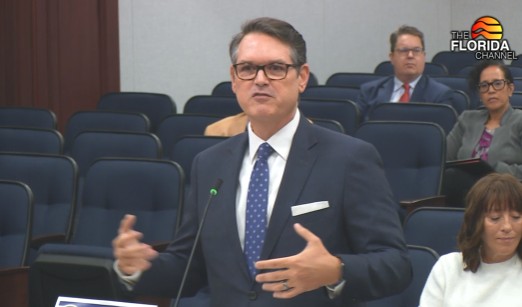 Florida Secretary of State Cord Byrd, appointed the state’s top election official by Gov. Ron DeSantis, has presided over a series of decisions that make it less likely a proposed state constitutional amendment legalizing recreational marijuana can get on the 2026 ballot. (Florida Channel/courtesy)
Attorney general
Among the unanswered questions was why supervisors were told the emailed instructions to them were being copied to the Attorney General James Uthmeier’s Office.
Attorney General James Uthmeier was appointed attorney general by DeSantis last year after serving as the governor’s chief of staff and campaign manager for DeSantis’ unsuccessful candidacy for the 2024 Republican presidential nomination.
While he was DeSantis’ top aide, he was a central player in the effort that ended up in defeat of the 2024 marijuana referendum.
In his current official role as attorney general, Uthmeier has urged the Florida Supreme Court to not allow the 2026 marijuana referendum on the ballot.
 “We, and I believe other supervisors, are doing everything we can to be in compliance with the statute. But sometimes ‘same day’ is not ‘practicable;’” said Wendy Sartory Link, Palm Beach County supervisor of elections and president of the state association of supervisors of elections. (Carline Jean/South Florida Sun Sentinel file)
A spokesperson for the Secretary of State’s office said the state is working to combat fraud through its Office of Election Crimes and Security. “In the last three months, ECS has received more than 1,700 complaints from voters reporting their signatures have been forged or misrepresented on the petitions,” it said.
This report includes information from the News Service of Florida.