
This month, Florida experts announced that they have unlocked the secrets behind one of the world’s most invasive pests.
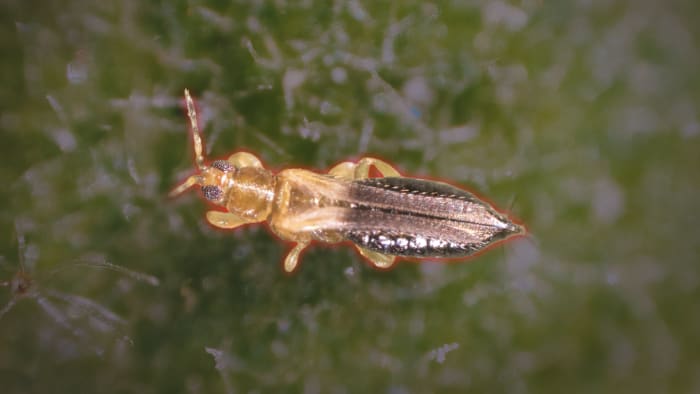
The tiny insect — identified as the short-spined thrip (a.k.a. “Thrips parvispinus”) — isn’t likely to be seen by many residents in the state, typically spanning about 1-4 mm long.
Researchers with the UF/IFAS say that these invasive thrips originate from southeast Asia and were first reported in the Sunshine State back in 2020, leading to a minuscule rampage across much of South Florida.
More specifically, these critters have damaged a variety of crops across Florida, including gardenias, hibiscus, mandevillas, peppers, beans and eggplants.
Adult female short-spined thrip feeding on a bean leaf (University of Florida Institute of Food and Agricultural Sciences)
According to experts, thrips can harm these sorts of crops by transmitting plant viruses, as well as piercing the plant tissue and sucking out the sap when they feed.
This reduces the crop’s growth and yield, which poses problems for growers and has cemented thrips as one of the world’s most damaging pests.
Bell peppers and eggplants are vegetables currently impacting grower production by the invasive thrip. (UF/IFAS Photo by Tyler Jones)
However, the UF/IFAS announced this month that researchers have made a huge breakthrough about why these thrips have become such a worldwide threat — along with an idea on how to keep them in check.
In a new study, experts said that South Florida’s climate is perfect for short-spined thrips thanks to the warm average temperatures, helping the bugs reproduce and develop more rapidly.
Tropical hibiscus (Hibiscus rosa-sinensis) is what’s commonly seen in garden centers and landscapes. Hibiscus range in size from low spreading shrubs to upright tree forms that can reach twenty feet in height.
The short-spined thrips has been a threat to the industry. (University of Florida Institute of Food and Agricultural Science)
But that’s actually good news for other areas of the country, as they can’t withstand long periods of cold weather.
“The results suggest that the short-spined thrips is susceptible to prolonged cold temperatures below (41 degrees Fahrenheit), which is good news for northern states because it appears that the pest will not be able to survive outdoors during the winter,” said Assistant Prof. Alexandra Revynthi of ornamental entomology and acarology. “However, under greenhouse conditions, we expect the thrips to be active year-round.”
Assistant Prof. Alexandra Revynthi (University of Florida Institute of Food and Agricultural Science)
A few other breakthroughs made during the study are as follows:
No need to mate
Females can produce male offspring without mating, meaning these thrips can establish new populations with only a few bugs.
However, this also means that if a female thrip already resists pesticides, she can pass that resistance to her offspring, creating even more challenges.
Short-spined thrip (University of Florida Institute of Food and Agricultural Science)
Soil-bound pupas
Researchers discovered that the pest pupates in soil, typically burying about 1 inch into the ground.
This opens up some potential avenues for control, including soil-based treatments like nematodes, predatory mites and rove beetles.
Thrip larvae (University of Florida Institute of Food and Agricultural Science)
These pests apparently can’t survive long without live plants. When given only alternatives like pollen or honey water during the study, the thrip lasted less than a day.
This spells good news for greenhouses, as it means that simple steps like removing unsold plants and clearing plant debris can help to control these insects.
Close-up image of a damaged pepper leaf (University of Florida Institute of Food and Agricultural Science)
That said, researchers are now tasked with implementing this new information by figuring out what sorts of controls can best reduce these pests, and how these treatments can be combined with chemical control strategies.
For more information on the UF/IFAS’ latest research, click here.
Breaking News Alerts
Get breaking news alerts delivered to your inbox.
Copyright 2026 by WKMG ClickOrlando – All rights reserved.