
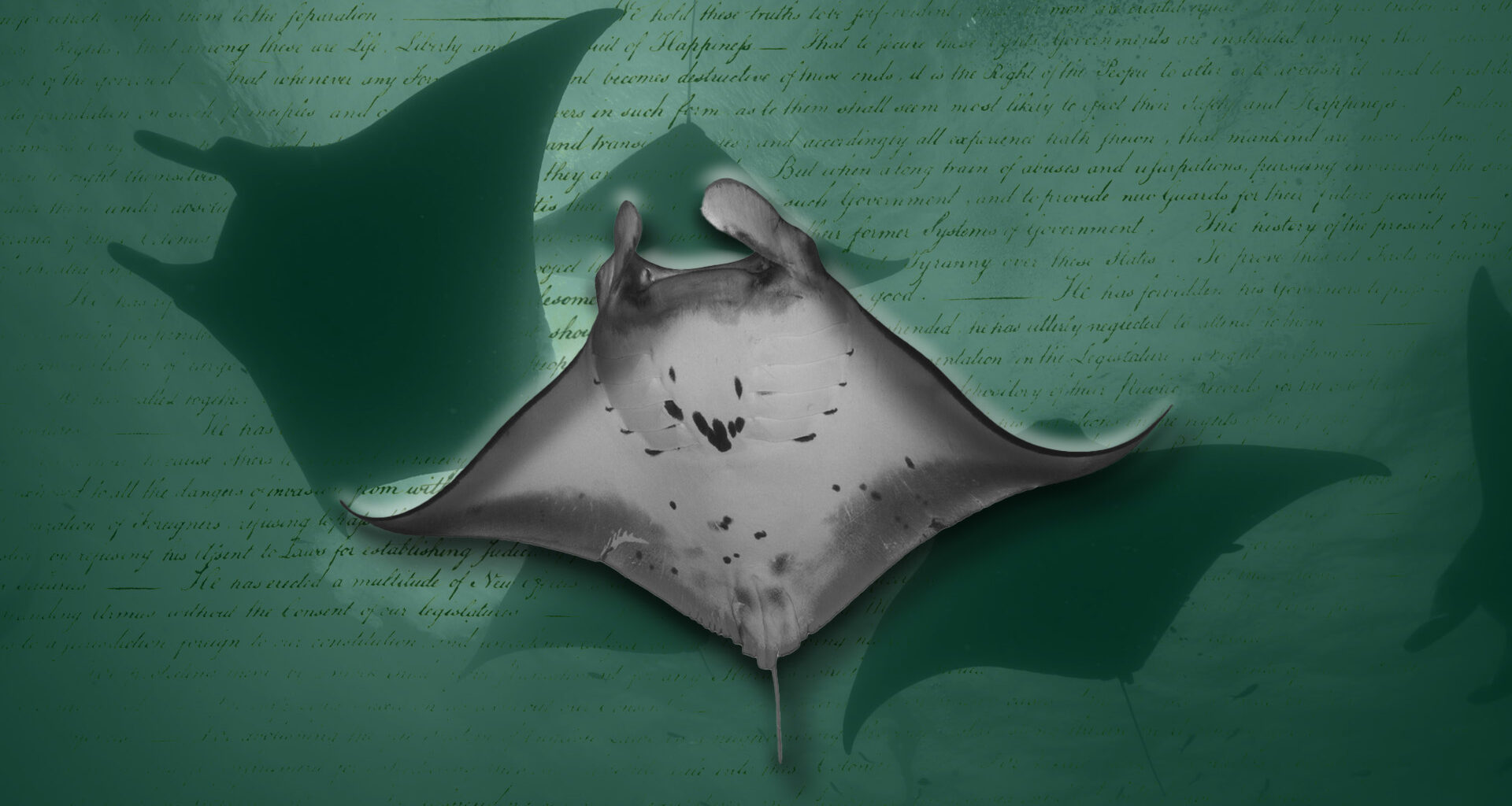
 Two Florida legislators sponsored the Manta Protection Act, a composition of House and Senate bills that aim to block legal loopholes from capturing and selling endangered marine life for public display. ORACLE GRAPHIC/THOMAS MARRS
A summertime video of the capture of a giant manta ray has prompted USF students and faculty to question whether Florida is doing enough to protect its vulnerable marine life.
Dynasty Marine Associates, an aquarium supply company, captured a giant manta ray off the coast of Panama City Beach in July — after the Florida Fish and Wildlife Commission granted the supplier a Special Activity License.
Special Activity Licenses are issued by the FWC for activities like research, exhibition and aquaculture, according to the FWC website.
After the capture, Dynasty Marine Associates sold the animal to SeaWorld Abu Dhabi for permanent display, according to the Tampa Bay Times.
A video of the capture gained traction online, and state lawmakers are now moving to close the loophole that allowed the giant manta ray to be captured and displayed.
The MANTA Protection Act is composed of Senator Ileana Garcia’s Senate Bill 988 and Representative Lindsay Cross’s House Bill 1171 and seeks to ban the capture and export of all federally endangered, threatened or vulnerable aquatic animal species in state waters.
The act would also bar the FWC from issuing or renewing licences that allow the capture of these protected species for public display.
However, some USF faculty and students are divided on whether the law is a scientific necessity or simply an emotional response to a circulating video.
Related: USF students criticize bill that could rename Alumni Drive after Charlie Kirk
Both Garcia and Cross have histories of sponsoring conservation-related bills.
Garcia filed SB 56 in 2024, followed by SB 302 in 2025, focusing on coastline restoration and regulating atmospheric geoengineering, according to the Florida Senate website.
Cross, a USF alumna, filed HB 1063 in 2025 in the hopes of establishing a Carbon Sequestration Task Force. This year, she filed HB 1319, which aims to protect coral, according to the Florida House of Representatives website.
Giant manta rays are listed as a threatened species under the National Oceanic and Atmospheric Administration’s Endangered Species Act, and are endangered under the International Union for Conservation of Nature.
South Florida is a manta ray nursery habitat, with over 47% of juvenile manta rays resighted in its waters, according to The Florida Manta Project.
Stephen Murawski, a professor of biological oceanography at USF St. Pete, said he views the bill as more of a cultural statement than a biological one.
“Considering how many permits have potentially been approved in the past, it’s likely not a major factor affecting the population of mantas off Florida or in the Gulf,” Murawski said.
Murawski said he believes captivity can motivate the public toward conservation.
“By viewing live animals that few, if any, would be able to see in the wild, [the display of live animals] may motivate the public to support marine conservation efforts in general,” he said.
Ultimately, Murawski said Florida’s legislative priorities should shift toward broader threats to marine life.
“Florida needs to better protect its fragile coastal ecosystems from ongoing threats from chemicals of emerging concern and other pollutants,” he said.
Hailey Holmes, a freshman biology major at USF St. Pete, said the current practice of marine life capture feels exploitative.
“As someone who lives so close to the water, I think it is very important and necessary that we protect marine life,” Holmes said. “We should push for more restrictions on the capturing and exploitation of other marine species as well.”
Holmes said she believes the bill is a vital starting point for broader wildlife protections.
“I also do believe that this bill will move forward and eventually pass since it would be beneficial to the species itself,” Holmes said.
Related: USF students say MOSI’s new dome is immersive
Julianna Pandolfi, a sophomore environmental science and policy major at USF Tampa, is a born-and-raised Floridian.
Pandolfi works at The Florida Aquarium, where she teaches guests about marine life.
Despite her occupation, Pandolfi said she believes capture isn’t necessary for conservation awareness.
“Conservation messages could be incorporated more into marine parks and maybe even into science curriculum for school-aged children,” Pandolfi said.
Pandolfi said she believes manta rays aren’t yet ready to be kept under human care because they need to recover their population numbers first.
“I do believe a bill like this is necessary… without it, nothing is going to stop the entertainment [or] aquarium industry from taking more manta rays from the wild until they ultimately face extinction,” she said.
While Pandolfi supports the protection act, she said she is skeptical of whether it will move forward.
“I’m honestly not too sure if this bill will pass, as a lot of times I’ve noticed that profit is prioritized over conservation,” she said.