
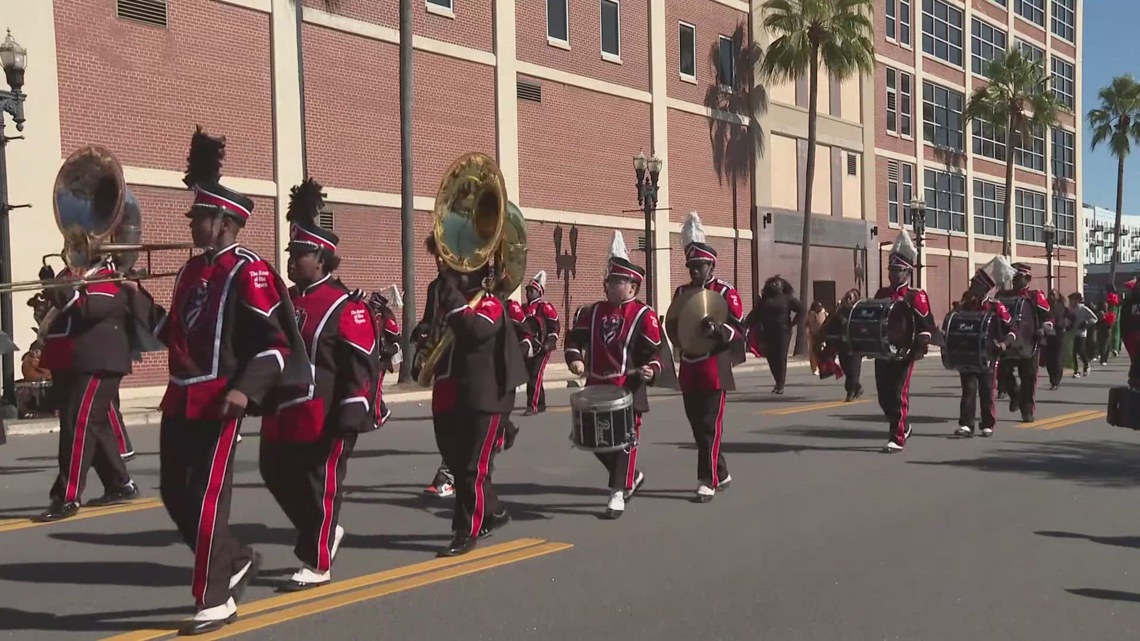
Hundreds honored Dr. Martin Luther King Jr. at the 45th annual parade in Downtown Jacksonville, celebrating his legacy and deep ties to the First Coast.
JACKSONVILLE, Fla. — Despite cold temperatures, hundreds of people filled Downtown Jacksonville on Monday to honor the life, legacy, and lasting impact of Dr. Martin Luther King Jr.
The 45th annual Martin Luther King Jr. Holiday Parade stepped off from the EverBank Stadium, traveling along Bay Street to Market Street. Marching bands, dance troupes, floats, and community groups lined the route, celebrating King’s message of unity and equality.
For many attendees, the parade is about more than tradition; it’s about service and togetherness.
“MLK Day is very special,” one parade-goer said. “This is a day that everybody should come out and celebrate.”
Another attendee said King’s leadership continues to inspire action decades after his death.
“Without him and his movements, we couldn’t be what we are today,” they said. “It’s about service and giving.”
Dr. King, one of the most prominent leaders of the mid-20th century civil rights movement, is best known for his commitment to nonviolent protest and his historic “I Have a Dream” speech delivered during the 1963 March on Washington. His leadership helped pave the way for the Civil Rights Act of 1964 and the Voting Rights Act of 1965.
While King’s influence is often associated with Washington, D.C., and the Deep South, his legacy is deeply rooted in Florida, and the First Coast in particular.
In 1964, King was arrested in St. Augustine during protests aimed at exposing segregation and racial violence in the nation’s oldest city. Concerns for his safety led authorities to move him to Jacksonville, where his case went before a federal grand jury. A judge ultimately ruled in King’s favor, stating that city officials could not interfere with his right to march.
Historians said that the ruling played a significant role in advancing the Civil Rights Act of 1964.
During his time in St. Augustine, King stayed at a home now known as the Canright House at Butler Beach that was moved to the Collier Blocker Puryear Park in West Augustine.
The home was shot at and firebombed by segregationists who believed King was staying there, but he was not inside at the time.
Despite the violence and resistance he faced, King continued pushing forward. When news broke that the U.S. Senate had passed the Civil Rights Act, King reportedly held up his fingers in a V for victory while still in St. Augustine.
For many lining the streets on Monday, the cold weather was a small sacrifice to honor a dream that continues to shape the First Coast and the nation.