
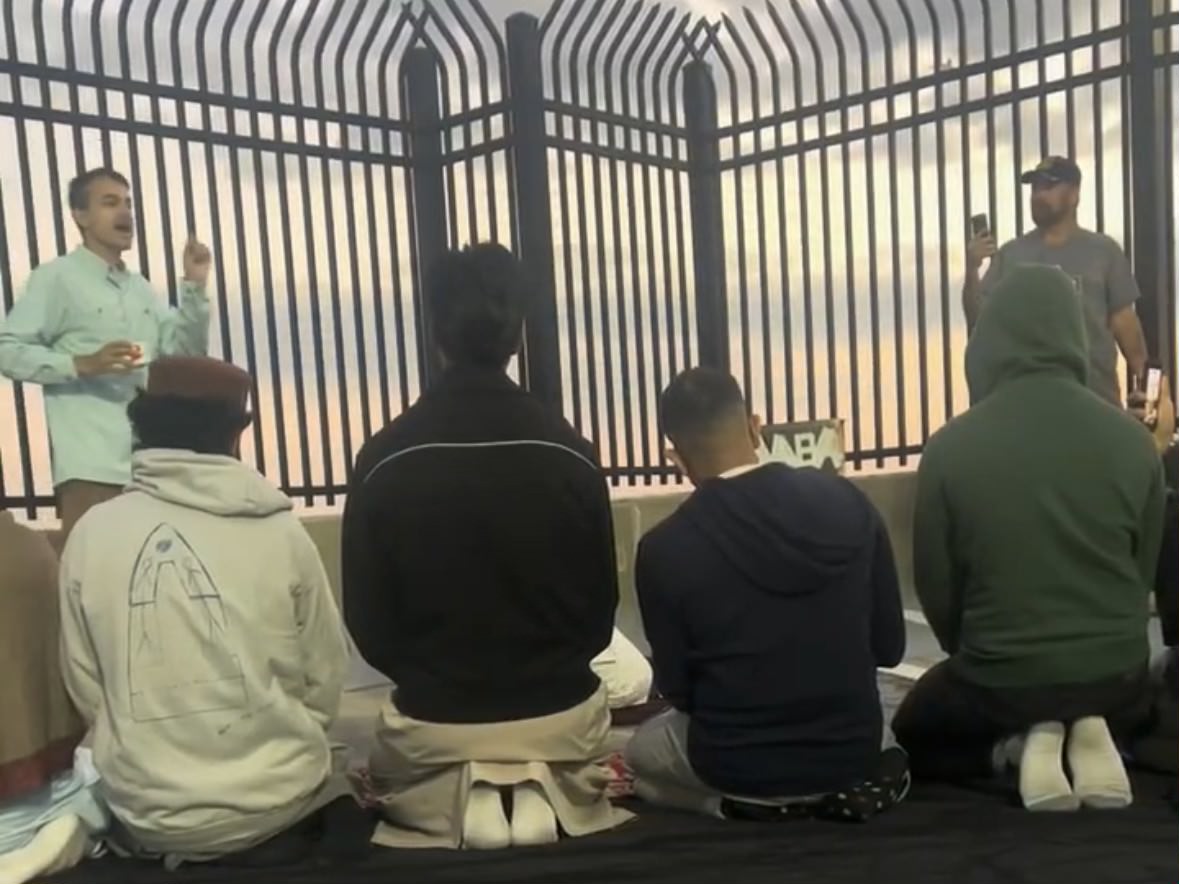
 The Hillsborough County State Attorney’s Office has officially charged three men, who are unaffiliated with USF, with misdemeanors. SPECIAL TO THE ORACLE/MUSLIM STUDENT ASSOCIATION
The three men who interrupted a USF student prayer session in November were formally charged with disturbing a religious assembly and disorderly conduct on Jan. 15.
During a Muslim Student Association Fajr and Breakfast event on Nov. 18, Richard Penkoski, Christopher Svochak and Ricardo Yepez approached 11 students at the top of the Collins Boulevard Parking Facility.
There, the three men disrupted the Muslim students’ prayers, yelled obscenities, told them they would be “going to hell” and dangled bacon in front of them.
On Nov. 21, University Police issued a statement saying it would recommend a hate crime charge against each of the individuals — which could later be elevated to a felony.
However, the Hillsborough County State Attorney’s Office issued a press release on Jan. 15 stating it did not move forward with hate crime charges against the men.
Instead, the Attorney’s Office charged the men with criminal misdemeanors for disturbing a religious assembly and disorderly conduct.
“While one’s words may be offensive, the criminal justice system punishes actions, not words alone,” a Hillsborough County State Attorney’s Office press release wrote. “Both the Florida Constitution and United States Constitution protect offensive viewpoints as much as our freedom to practice our religion.”
No arrests have been made, and the defendants are set to appear in court, according to the press release.
For a criminal misdemeanor in disorderly conduct, defendants can be sentenced to a maximum of 60 days of jail time, $500 in fines and a permanent criminal record, according to Mesic Law.
A criminal misdemeanor for disturbing a religious assembly has the same limits, but can be escalated to a hate crime if it is reclassified under Florida Statute 775.085 — which can occur if a defendant is found guilty of prejudice based on religion, according to the Florida Senate.
While the current charges differ from those originally filed by UP, the Council on American-Islamic Relations-Florida “welcomed” the decision.
Related: ‘Stand with us’: Muslim students call on USF for a stronger response after prayer harassment
One of the defendants, Penkoski, leads an online Christian ministry known as “Warriors for Christ” — which the Southern Poverty Law Center designated as a hate group in 2024.
In November, the defendants livestreamed the USF student prayer interruption on the “Warriors for Christ” YouTube channel.
A UP press release later informed that Penkoski, from Oklahoma, Svochak, from Texas, and Yepez, from Tampa, are unaffiliated with the university.
All three men were issued trespass orders to prevent them from returning to campus, according to UP.
Now that the men have been formally charged for the incident, CAIR-Florida has issued its own press release.
CAIR-Florida’s mission aims to empower American Muslims by educating others on Islam and protecting civil rights and justice, according to its website.
Hiba Rahim, the interim executive director of CAIR-Florida, said the charges hold the men accountable for their behavior and send a clear message — that harassment of students practicing their faith is unacceptable.
“While we believe the evidence of bias in this case is significant, we respect the strategic decision to pursue charges that offer the most direct path to a conviction,” Rahim said.
Rahim said CAIR-Florida’s “primary focus” is to ensure Muslim students’ safety on college campuses and to protect the constitutional right to worship without fear.
The U.S. and Florida Constitutions defend the right to practice religion under the First Amendment.
Wilfredo Ruiz, the communications director for CAIR-Florida, said in a statement that the prosecution of the three men is a “vital step” in protecting constitutional freedoms.
“We are hopeful that this case reinforces that Florida must remain a place where all people can pray in peace and dignity, free from targeted harassment,” Ruiz said.