
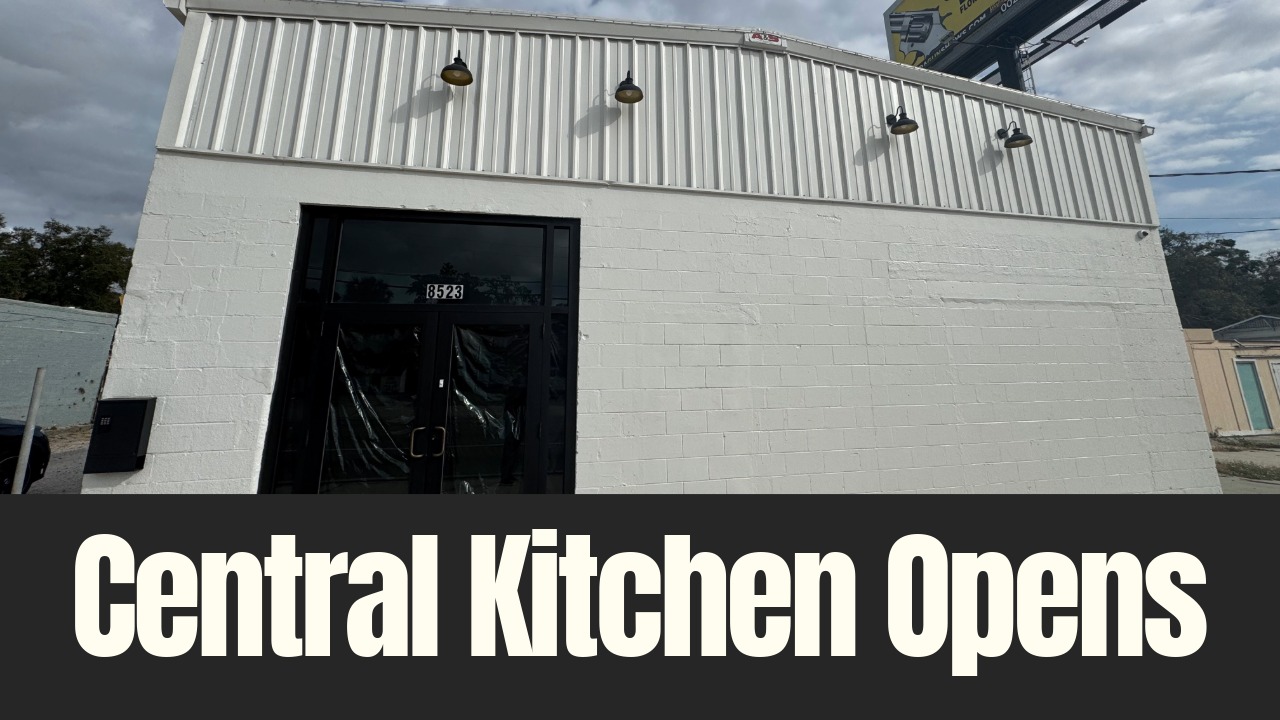
Bavaro’s has built out a central kitchen on North Nebraska Avenue following its 2024 acquisition of Gulf Coast Sourdough.
Owner Dan Bavaro said the facility consolidates catering and a growing share of food production outside the company’s restaurants, a shift designed to improve consistency across six locations.
The 3,500 sq ft building now produces sourdough bread, prepares fresh pasta and sauces and handles all catering for Bavaro’s Pizza Napoletana & Pastaria.
“It’s a central kitchen,” Bavaro said. “We utilize the building to do wholesale production. We do sourdough bread out of there.”
Acquisition drives production shift
Bavaro said the Nebraska Avenue project grew directly out of the Gulf Coast Sourdough acquisition, which brought wholesale bread production and the property under the company’s control.
The wholesale business had operated through local farmers’ markets.
Its owners were leaving Florida, opening the door for Bavaro’s to bring the operation in-house rather than outsource production.
READ: TAMPA BAY BUSINESS NEWS
“When I purchased that building last September, we purchased the wholesale part of the farmers market business because they were moving out of state,” Bavaro said.
He said the deal also preserved jobs tied to the business.
“We helped keep ten jobs that people can work in there for like a decade,” he said.
Restaurants still drive revenue
Despite the expanded production footprint, Bavaro said the company remains primarily restaurant-driven.
“It’s probably like 85% restaurant, 15% wholesale,” he said.
Bavaro’s operates six locations across Tampa Bay including downtown Tampa, St. Petersburg, Sarasota, Clearwater, Tampa International Airport and Benchmark International Arena.
READ: ST. PETERSBURG BUSINESS NEWS
From the Nebraska Avenue facility, the company produces a few thousand loaves of sourdough bread each week and supplies pizza dough to other restaurant groups.
“We sell about three tons of pizza dough a week,” Bavaro said.
Labor strain and consistency drove the move
As the company added locations, producing labor-intensive items inside each restaurant became harder to manage.
“You’ve got six different locations making ravioli,” Bavaro said. “There are variations. That’s not fair to the consumer.”
Centralizing prep allows restaurant kitchens to focus on service and execution rather than production.
READ: TAMPA BAY REAL ESTATE NEWS
“It frees up stress inside our kitchens for our teams to focus solely on execution,” he said.
Bavaro said the shift also improves job quality and retention in a tight labor market.
“Employee retention will be higher,” he said. “It’s not just about high quality wholesale. It’s about improving the quality of the jobs in our kitchens.”
He described the investment as part of a broader philosophy that long-term growth depends on systems that protect food quality while reducing strain on restaurant teams.
Catering fully routed off-site
As of January 1, all Bavaro’s catering now runs through the Nebraska Avenue facility.
Before the change, catering was produced inside restaurant kitchens alongside regular service.
READ: TAMPA RETAIL & HOSPITALITY NEWS
“If we got a huge order in a restaurant, it also had to make way for the catering,” Bavaro said. “Now 100% of our catering comes out of that facility.”
Small storefront planned
About 3,000 sq ft of the building is dedicated to production. Roughly 500 sq ft will be used for a new concept called “Cafe Bavaro.”
The space will support an in-house concept focused on craft coffee, prepared goods and catering pickup rather than a full-service restaurant or new Bavaro’s location.
“It’s not the biggest walkable area,” Bavaro said. “But I do see a draw.”
A plan paused and revived
The central kitchen concept is not new for Bavaro’s.
Bavaro said the company tested a similar model in 2019 but paused the effort when Covid disrupted the restaurant industry.
The Nebraska Avenue facility reflects lessons learned since then and gives the company room to scale production without adding pressure inside its dining rooms.
“Our goal is to expand the brand,” Bavaro said. “But it’s also to expand wholesale and keep our food more consistent inside the stores.”
For Bavaro’s, the project represents a shift toward infrastructure-led growth, prioritizing operational stability over adding new dining rooms.
Stay Informed