
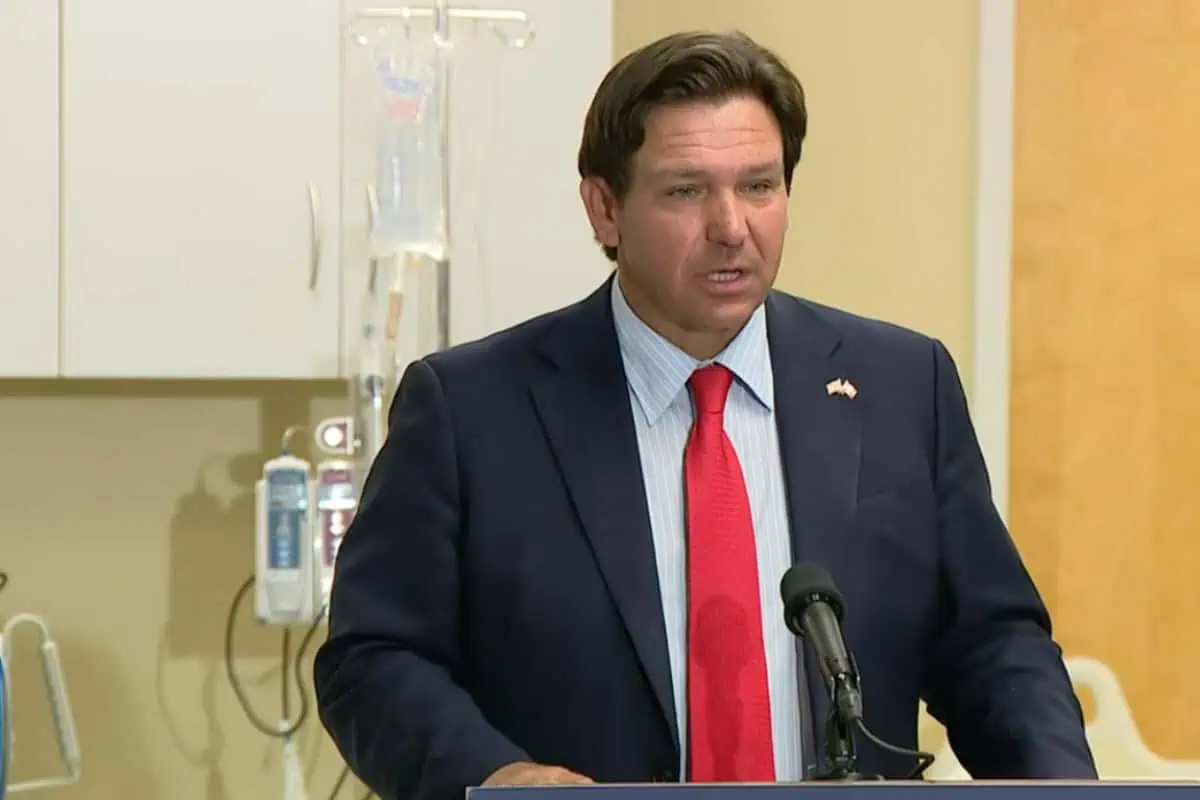
ST. PETERSBURG, Fla. — Gov. Ron DeSantis announced Tuesday an additional $20 million in state funding to bolster nursing education across Florida, part of a continuing effort to address the nationwide healthcare worker shortage.
Speaking at St. Petersburg College, DeSantis detailed the allocation of the new “LINE” (Linking Industry to Nursing Education) funding, with $14.5 million designated for state colleges and private postsecondary institutions, and $6 million set for state universities.
The announcement brings the total state investment in the LINE and PIPELINE (Prepping Institutions, Programs, Employers, and Learners through Incentives for Nursing Education) programs to nearly $500 million since their inception in 2022.
“We are now producing over 1,000 additional nurses every year between our state colleges and our state universities compared to before these programs began,” DeSantis said. “That is a meaningful, significant increase on a percentage basis, and it is vital to keep up with Florida’s population growth.”
BREAKING: @GovRonDeSantis announces Florida has invested nearly $500M in nursing education since 2022 and is awarding $20M more today
The effort is now producing 1,000+ additional nurses every year across state colleges and universities. pic.twitter.com/sOcPO9htOP
— Florida’s Voice (@FLVoiceNews) January 20, 2026
Performance-based results
The governor was joined by Commissioner of Education Anastasios Kamoutsas and State University System Chancellor Ray Rodriguez, who highlighted the high standards maintained by Florida’s nursing students.
DeSantis pointed to St. Petersburg College as a model of success, noting its 94.1% passage rate on the National Council Licensure Examination, or NCLEX, significantly higher than the state average of 83%.
“At St. Petersburg College, they are getting the job done,” DeSantis said. “Our workforce education spans a lot. You can get skills that are very hands-on, but they are advanced skills that have real-world application.”
The funding programs operate on two tracks:
LINE: A dollar-for-dollar matching grant that encourages partnerships between educational institutions and healthcare providers to fund scholarships, recruit faculty, and purchase simulation equipment.
PIPELINE: A performance-based incentive program that rewards institutions based on the number of graduates and high NCLEX passage rates.
Impact on students
Kelsey Krebs, a nursing student and president of the Nursing Association at St. Petersburg College, spoke about the practical impact of the financial assistance.
“Financial assistance has had a significant impact on nursing students like me,” Krebs said. “Funds go beyond tuition; they help cover essential needs like childcare, transportation, and utilities. Without this support, many students are forced to take on loans or extra hours at work, which increases stress and burnout.”
Krebs, who is set to graduate in May, plans to work in an Intensive Care Unit or Emergency Room before pursuing further education to become a nurse practitioner.
DeSantis concluded by emphasizing the human element of the profession. “You’re always going to need someone to be a nurse,” he said. “There is a human connection, an empathy, and a bedside manner that really matters to people in critical situations.”