
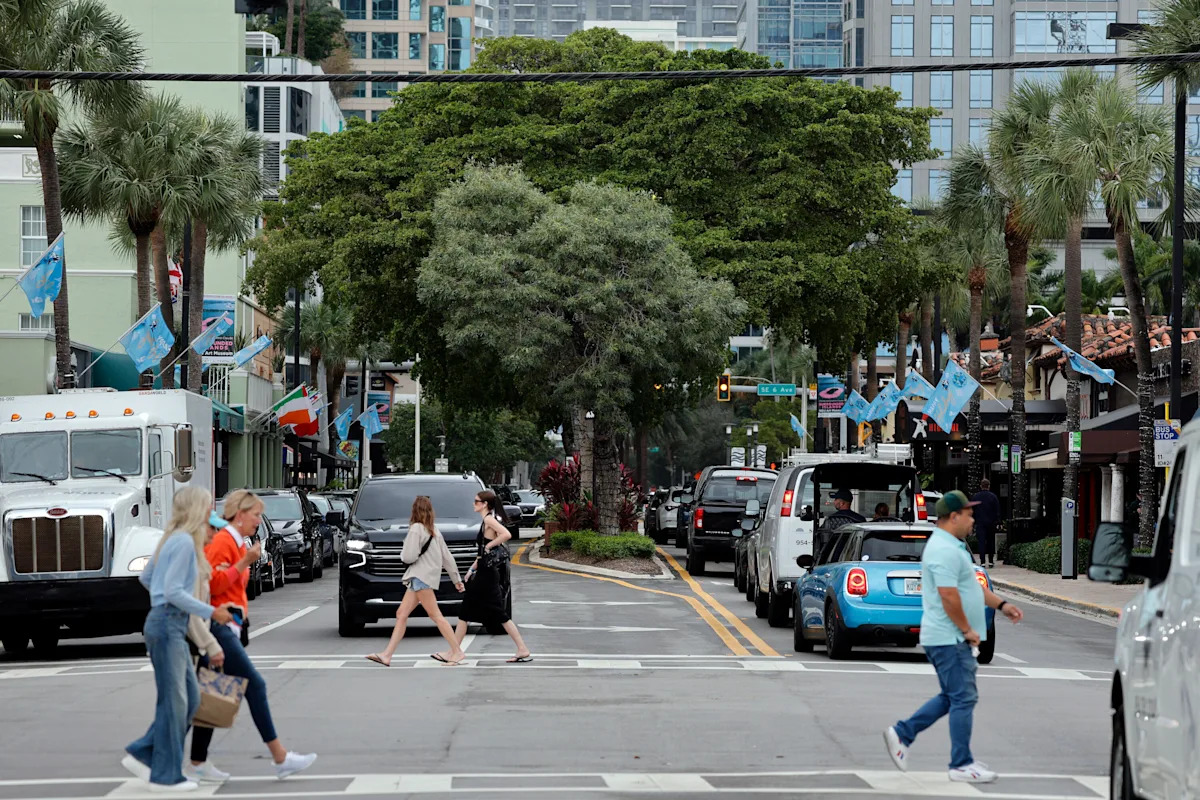
Say goodbye to those pretty black olive trees on Las Olas.
The fate of Fort Lauderdale’s famous tree-lined median on its equally famous boulevard was sealed Tuesday night when the commission decided the median must go to make way for wider sidewalks and outdoor cafes.
Today, four blocks of olive trees line the shops section of Las Olas.
Construction will not begin on the long-planned redesign of those blocks for another two to three years. But eventually, the trees will be removed along with the median in a project that will cost at least $7.5 million.
In the past, Mayor Dean Trantalis has argued the trees should stay.
But there was no such talk Tuesday night. Not on the dais anyway.
Commissioner Ben Sorensen argued the median no longer makes sense.
“We need wider sidewalks on Las Olas,” he said. “We need on-street parking for ease of access to businesses. It also has a slowing effect on traffic. If we want both of the elements, we can’t have the median.”
Commissioner Steve Glassman quickly agreed.
“We are really planning for the future,” Glassman said. “And I really think that if we are planning for the future, we really do need to eliminate the median. If we are going to create an iconic boulevard for the future, we really must look at the no-median option. This is our defining economic corridor. This is the corridor that is really what everyone thinks of when they think of Fort Lauderdale.”
There’s nothing quite like Las Olas Boulevard in all of South Florida partly because of its impressive tree canopy, Vice Mayor John Herbst said.
“I think maintaining a tree canopy on Las Olas is critical for the look, the feel of what makes it unique,” Herbst said. “But whether that’s in a median or on a sidewalk I don’t think is the driving force. If we’ve got an extensive tree canopy that’s on the sidewalk, I think that can work just as well.”
Commissioner Pamela Beasley-Pittman said she too is now ready to say farewell to the median.
“I’m excited about the opportunity for the increase in the number of trees that are being proposed in these options,” she said. “Las Olas means so much to everyone. This is the time to elevate and make some changes.”
Several residents and one former commissioner did speak up for the trees, however.
Bill Ott, speaking for the Downtown Fort Lauderdale Civic Association, argued the median and its majestic trees should stay.
“We believe that’s an iconic design element of the city,” Ott told the commission. “It’s what makes us stand out around the world.”
Like others, Diane Gagne said she was worried Las Olas would lose its charm without the canopy provided by the black olive trees planted decades ago.
“I thought keeping the olive trees was an option,” she said. “It sounds predetermined that it’s not an option. I’d rather have a median with different trees than not have a median at all.”
Warren Sturman, who lost his District 4 commission seat to Sorensen in November 2024, was unable to attend the meeting, but sent a written note to Herbst asking that his request that the median stay be read into the record.
“The beauty and uniqueness of the tree-lined median has always defined and set Las Olas apart,” Sturman’s note said. “Even when the current trees die, keeping the median keeps a placeholder for future landscaping. If the median is removed, this option will be lost forever.”
Charlie Ladd, a board member of Fort Lauderdale’s Downtown Development Authority who owns property along Las Olas, made a strong case for getting rid of the median.
“As far as I know, the median at 6 feet in width is not allowed to be replanted with canopy trees,” Ladd told the commission. “The best you can have is palm trees or a smaller tree [under the current city code].”
Instead of planting trees in the median, the redesign calls for planting dozens of trees along the sidewalks on either side of Las Olas.
“Fifteen trees in the median would be gone and replaced by up to 90 or 94 canopy trees,” Ladd said.
But not just any tree will do, according to Ladd. If it were up to him, he said he’d plant oaks.
“If we could line that street with 90 oak trees, you would have one of the prettiest streets in the world,” he told the commission.
“There’s 100,000 people a week who come to Las Olas,” he said. “That defines our city. That with the Riverwalk and the beach is what we are. And we can’t screw it up. We have a chance to really make it special.”
The commission plans to make their decision official with a vote at their next public meeting on Feb. 3.
Under the latest plan, several trees along the boulevard would be replaced with large canopy trees at 75% maturity, said Catherine Prince from the city’s design consultant WSP USA Inc.
“They are not going to be baby trees,” Prince told the commission. “And we hope they will reach their full canopy in five to eight years.”
A consulting arborist told the commission the black olive trees are nearing the end of their lifespan.
“The average life span of a tree in an urban environment is around 30 years,” Brian Voelker with Chen More and Associates said. “These trees have been in the ground a lot longer than that. I would say they’re heading toward the end of their lifespan.”
Susannah Bryan can be reached at sbryan@sunsentinel.com. Follow me on X @Susannah_Bryan