

For Florida Grand Opera, a new era is underway, as artistic director Maria Todaro vows to keep her promise that she’s not presenting “your grandmother’s opera” with the upcoming reimagining of “Die Fledermaus.”
It’s what she said about her staging of FGO’s “Carmen” last season, which she conceived to be accessible to everyone. She brought in a new crowd who were drawn to a familiar name — “The Real Housewives of Miami” star Julia Lemigova (who is married to tennis star Martina Navratilova), for which Todaro wrote in a part.
“We want to keep opera relevant and exciting, to draw young and more diverse audiences,” said Todaro, the daughter of Italian opera singer Jose Todaro and Brazilian mezzo-soprano Maria-Helena de Oliveira who was named interim FGO director in 2023 and general director/CEO the following year.
Her European pedigree and her professional life in opera as a mezzo-soprano are part of what drive her desire to have FGO — recognized as one of the oldest opera companies in the United States, continuously operating since 1941 — become what she calls a “true opera company, an international House.”
A resident orchestra is among the factors Todaro believes gives the company its stature. In May, Todaro announced Pablo Mielgo as its music director. He has been artistic and musical director of the Orquesta Sinfónica Islas Baleares in Spain since 2014.
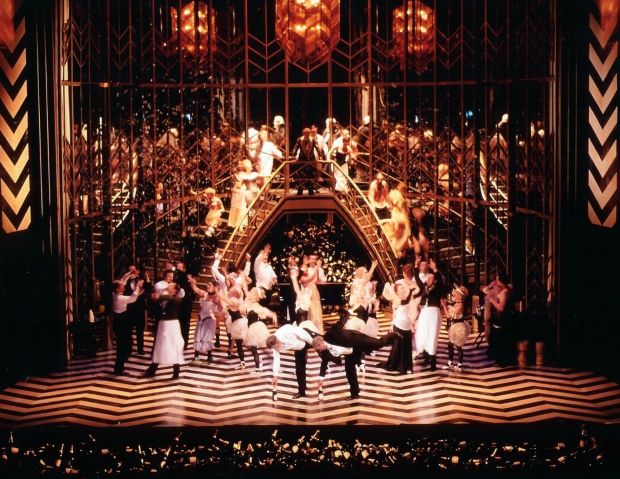 The Art Deco-inspired set for “Die Fledermaus” was created by Belgian set designer Benoît Dugardyn for the Glyndebourne Festival Opera in England. (Florida Grand Opera/Courtesy)
Mielgo said the players in the pit for previous FGO shows were contracted.
“It was an external orchestra and when I became director, we decided, with the board, to have our own orchestra,” he said. “When the musicians are hired by the company, they are involved in the life of the opera company. They feel the growing, they feel the compromise, and they get close to the artistic side. Being involved in the life of the opera company, everyone knows that success depends on everyone’s work.”
Todaro agreed with Mielgo’s assessment of the orchestra’s buy-in and how the sense of ownership will add to fueling a great ambition: to make Florida Grand Opera a true international company.
Building the in-house orchestra is integral to FGO’s production of “Die Fledermaus,” which has three performances coming up at Miami’s Arsht Center for the Performing Arts this weekend and Tuesday, Jan. 27.
The in-house orchestra made its debut with the company’s most recent production, “Silent Night,” but “Die Fledermaus” marks the first time Mielgo and his musicians will be together.
Mielgo, who was born in Madrid, said his connection to Miami is one “from many, many years ago. I have someone there who is a second mother to me,” he added, referring to Tanya Capriles Brillembourg, founder of the SaludArte Foundation. (Mielgo has been the foundation’s musical and artistic director since 2005.)
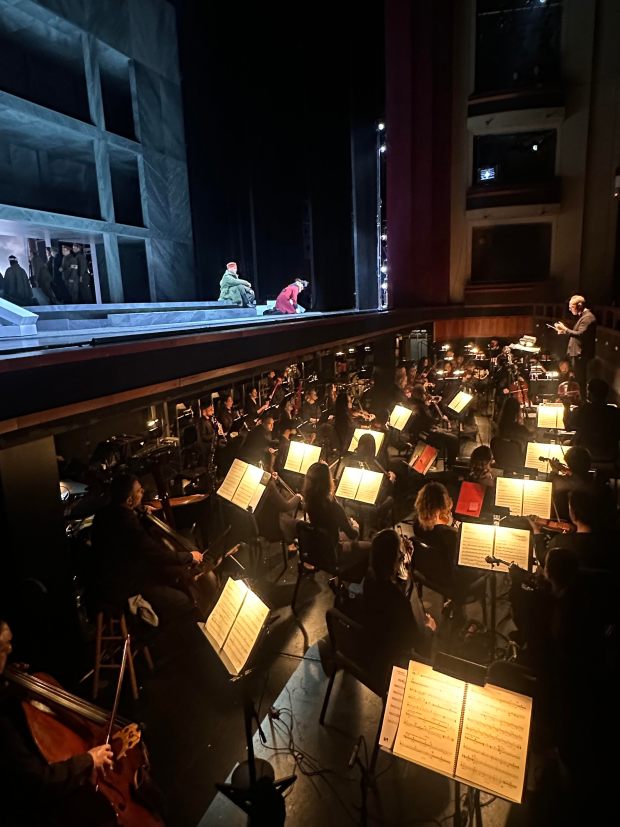 The Florida Grand Opera in-house orchestra made its debut with the most recent production, “Silent Night,” but “Die Fledermaus” marks the first time they play with music director Pablo Mielgo. (Florida Grand Opera/Courtesy)
In 2011, Mielgo made his Florida Grand Opera conducting debut during a co-production of the zarzuela “Luisa Fernanda” with the SaludArte Foundation. The production featured legendary tenor Plácido Domingo, who sang the lead role for a special gala performance, with Mielgo conducting.
“The home base of SaludArte Foundation is Miami, so I was traveling quite often to Miami to do music projects,” Mielgo said. “I’d say it’s been about 22 years, so I know the city quite well, and I think Miami is a city that is changing all the time.”
He agrees that FGO should be the world-class opera company of a destination that, he said, is attracting so many international residents — many from Europe — who bring with them opera and classical music traditions that shape expectations for what is offered here.
Those expectations are exactly what the company is embracing in “Die Fledermaus,” approaching the classic operetta with a fresh sense of creativity that reflects both its European roots and Miami’s contemporary, international character.
Johann Strauss’ comedy of errors about love and hidden identities has been given a distinctly local twist, Todaro revealed.
“There’s a lot of tradition in Viennese operetta, but we are changing that,” Todaro said. “In the place of the role of the Italian tenor, it is a Latino tenor. Everything that has foreign illusion is going to be Hispanic or Latino. That is a big wink to our population here.”
The operetta’s success rests equally on its witty dialogue and its brilliant music.
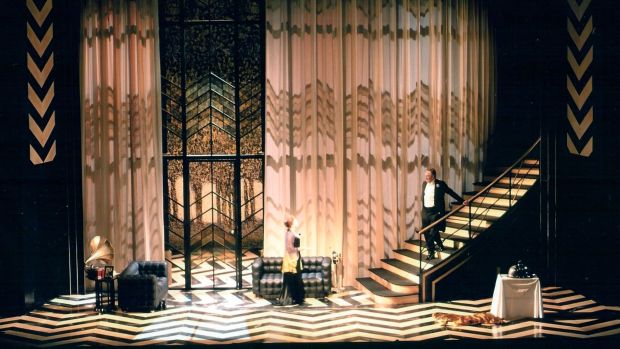 Florida Grand Opera acquired the set for “Die Fledermaus” from the Washington National Opera. (Florida Grand Opera/Courtesy)
“We have completely rewritten the text,” said Todaro, of the dialogue work she and stage director Conor Hanratty partnered on. “So it’s completely owned by us.”
The dialogue is in English while the singing parts of the opera will remain in German with English and Spanish supertitles.
“We wanted to be authentic and respect the German language. With the English dialogue, audiences can laugh at the jokes, so we have a little bit of both worlds,” explained Todaro.
Another tip to Miami is the Art Deco set that the company recently acquired and now owns. “The set has a beautiful pedigree behind it,” she said.
Belgian set designer Benoît Dugardyn created the Art Deco-inspired set for “Die Fledermaus” for the Glyndebourne Festival Opera in England. Todaro said it has “traveled all over the world,” making its debut in 2003.
FGO acquired it from the Washington National Opera, whose production that same year featured celebrity cameos including then-Supreme Court Justices Stephen Breyer, Ruth Bader Ginsburg and Anthony Kennedy.
Costumes, inspired by Austrian painter Gustav Klimt and designed by German costume designer Ingeborg Bernerth, were acquired from Washington National Opera’s artistic director, Francesca Zambello.
“She was very generous with us. We are being faithful to the styles, but we are kind of readapting them,” said Todaro, describing the costumes for her “Die Fledermaus” as cool, bubbly and accessible.
“This is part of, as you know, our desire to not be your grandmother’s opera, to keep our promises and to keep us relevant.”
IF YOU GO
WHAT: Florida Grand Opera’s “Die Fledermaus”
WHEN: 6:30 p.m. Saturday-Sunday, Jan. 24-25, and 8 p.m., Tuesday, Jan. 27
WHERE: Arsht Center for the Performing Arts, 1300 Biscayne Blvd., Miami
COST: $22-$300
INFORMATION: 800-741-1010; fgo.org
ArtburstMiami.com is a nonprofit media source for the arts featuring fresh and original stories by writers dedicated to theater, dance, visual arts, film, music and more.