
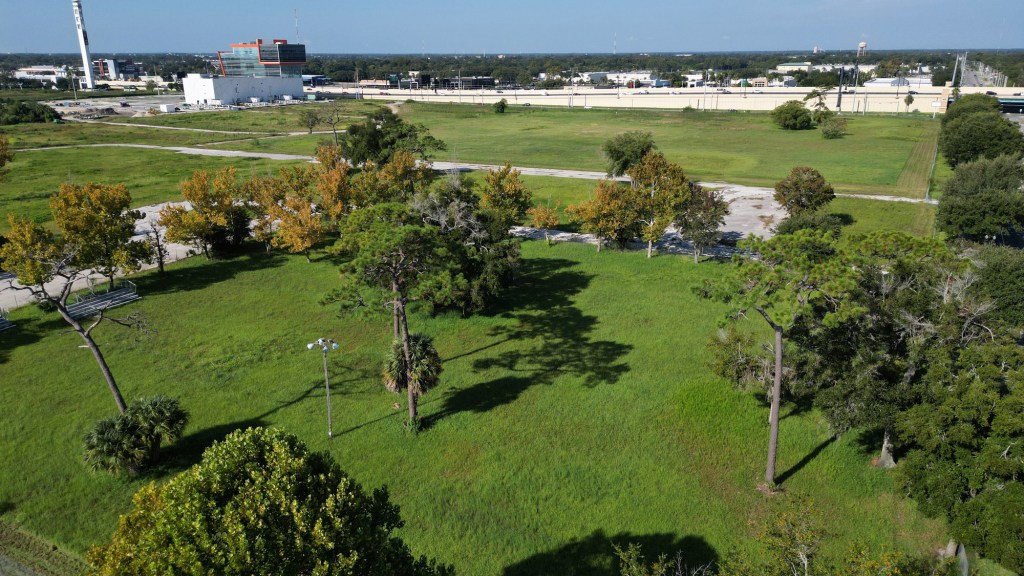
Dr. Phillips Charities offered an olive branch to Eatonville on Tuesday, meeting with leaders and residents to mollify community concerns over plans for the town’s historic Hungerford school property.
The charity bought the property last week from the Orange County School Board in a deal supported by Eatonville mayor Angie Gardner but opposed by other town council members, who felt they had been kept in the dark about the deal and were concerned about the town being left out of the decision-making process once the property was sold.
Ken Robinson, the charity’s president and CEO, and Terry Prather, the charity’s chairman, outlined their vision for the property and assured the council they wanted to collaborate closely to shape the project’s future.
“We understand the concerns, and the fears, and the desire to make certain that the property, that this town, gets treated with the respect it deserves,” Robinson said. “Let us earn your trust.”
Key to that collaboration is the creation of an advisory committee made up of town residents and subject matter experts that will ensure they have input on the property’s development. The charity’s goal is to set up the committee of seven to nine members by the end of February.
Robinson and Prather said their goal is to protect the town’s history and legacy as the oldest incorporated African American municipality in the nation while ensuring lasting economic opportunity and vitality. They said they will vet potential partners for development who share those ideals.
“At the end of the day, we’ve got to find partners that are willing to invest, invest for impact and not for financial return,” Prather said. “And that’s our commitment. … Dr. Phillips Charities will not make one penny and profit off of the work that we do here.”
Councilmembers were receptive, including Tarus Mack, who has voiced some of the harshest criticism of the property’s sale.
“I’m not happy with how everything had played out, but I’m willing to move forward with doing things that’s going to be for the betterment of my community,” Mack said.
But some town leaders, who pushed for the school board to donate the land directly to Eatonville, are worried Dr. Phillips plans does not include enough projects that would build the town’s tax base.
The charity wants to develop the land with housing, retail businesses including a grocery store, and a conference hotel center along with educational facilities, medical facilities and parks. It also plans to donate some of the property back to the town.
Dr. Phillips bought the land for $14 million. It paid $1 million upfront, and the remaining balance would be waived if the organization fulfills its development goals within ten years.
The charity aims to began work at the Hungerford site by October. It also plans to create a project master plan with help from the planned advisory committee, as well as commission a civil engineering and economic impact study.
The fate of the Hungerford property has long been controversial.
The school site sits along Interstate 4 and serves as a gateway to the town. Town and school leaders have long hoped new development on the now-vacant property would boost Eatonville’s limited tax base and jump-start a revitalization of the town, which has has struggled economically.
The property was once home to the Robert F. Hungerford Normal and Industrial School, a private boarding school for Black students when segregation-era white school districts would not educate them. The school board purchased the Hungerford land more than seven decades ago — for less than market value and under controversial circumstances, some Eatonville residents argue — and operated a public school there for years.
The school was closed in 2009 and the buildings were demolished in 2020. The school board, with the town’s approval, has tried to sell the property to private developers but those plans have fallen through.