
By Mike Lednovich
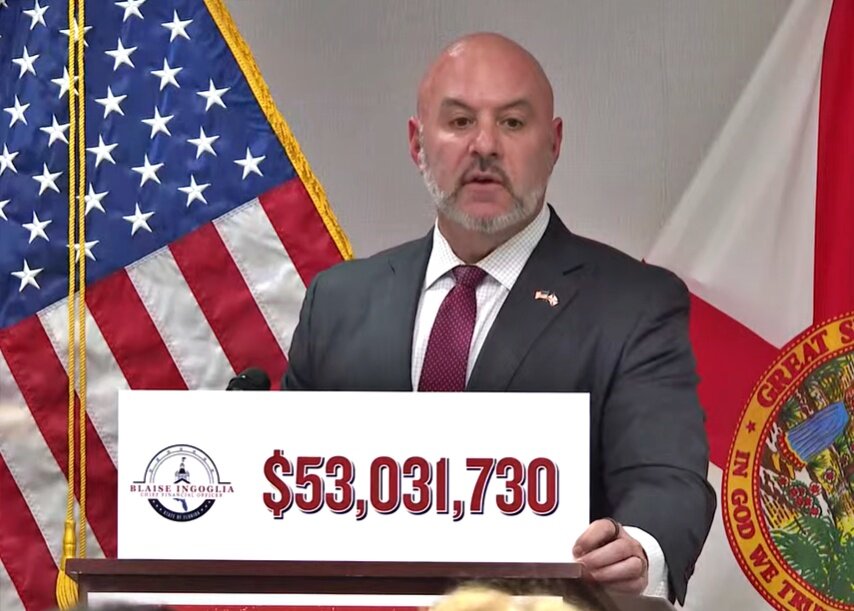
A state audit led by Florida Chief Financial Officer Blaise Ingoglia found Nassau County overspent by more than $53 million, according to findings presented Wednesday during the CFO’s statewide audit tour.
“This is not a political issue,” Ingoglia told county officials and residents during his presentation. “This is not Republican versus Democrat. This is a math problem.”
Ingoglia said his office reviewed Nassau County’s budgets over multiple fiscal years and found spending increases that significantly outpaced population growth and inflation.
“When government spending grows faster than the people’s ability to pay for it, the people eventually lose,” he said. “You can only pull from reserves for so long before you hit a wall.”
According to Ingoglia, Nassau County spent or committed approximately $53 million beyond what his office considers sustainable, including the use of reserves and what he described as aggressive budget expansions.
“You can’t spend money you don’t have forever,” Ingoglia said. “At some point, the bill comes due, and that bill is paid by the taxpayers.”
Ingoglia emphasized that the audit tour is intended to promote fiscal accountability rather than assign criminal blame.
“This is not an investigation. No one is going to jail,” he said. “But ignoring these numbers would be irresponsible.”
Ingoglia responded that growth alone does not explain the scale of spending increases.
“Every county in Florida is growing,” he said. “But not every county is spending like this.”
He also pushed back on arguments that reserve spending was justified.
“Reserves are not a revenue source,” Ingoglia said. “They are a safety net. Once you drain them, you don’t have a parachute anymore.”
Critics of the CFO’s audit tour methodology have argued that the analyses rely on high-level comparisons that may oversimplify local government finances and fail to account for legally restricted spending, voter-approved projects, and one-time capital expenditures.
One recurring criticism is that the audits compare spending growth primarily to population growth and inflation, a framework opponents state does not fully reflect the costs faced by fast-growing counties. Local governments experiencing rapid development often incur upfront infrastructure expenses — such as roads, utilities, public safety facilities, and stormwater systems — that may not align neatly with year-to-year population increases.
Ingoglia warned that continued spending at current levels could force future boards to raise taxes or fees, even if current officials avoid doing so.
“You may not raise taxes today,” he said. “But if you lock in spending, you are guaranteeing someone else will have to raise them tomorrow.”
The CFO urged county leaders to adopt what he called a “reset mindset,” including slowing spending growth and reevaluating long-term obligations.
“This is about protecting the people who live here,” Ingoglia said. “They expect their government to live within its means, just like they have to.”
Ingoglia said his office will continue to review Nassau County financial data and issue recommendations aimed at improving transparency and sustainability. No enforcement actions have been announced.
The audit tour stop comes as Nassau County officials continue debating impact fees, mobility fees, and major capital projects, with pressure mounting over how to fund growth without increasing the burden on residents.