
The city of Hialeah has launched an unprecedented investigation into nearly 300 local businesses that may be involved in commercial activities with the Cuban regime, in what its authorities describe as a measure aimed at cutting any potential economic complicity with the dictatorship.
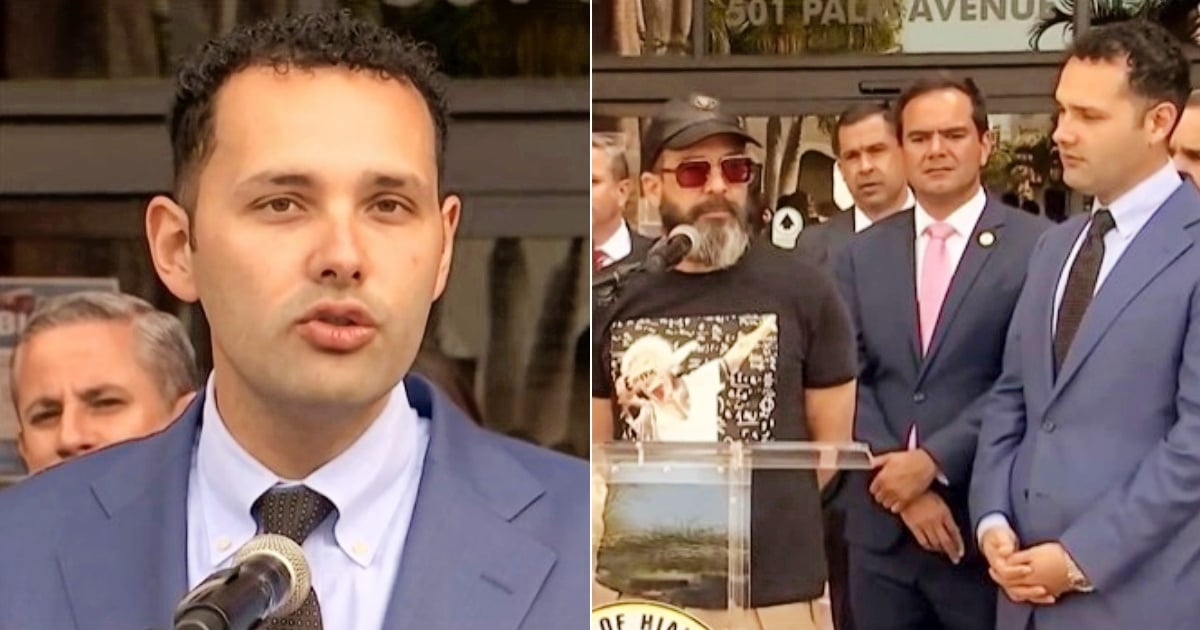
The announcement was made by Mayor Bryan Calvo at a press conference that signifies a decisive change in the municipal government’s stance on trade relations with Cuba.
The decision to initiate this investigation arises from the establishment of the Business Advisory Group with Cuba (CUBAT), created by executive order from Calvo on the day of his swearing-in.
The group’s main objective is to audit the contracts and business licenses of companies operating in Hialeah that may be directly or indirectly benefiting the Cuban regime.
“We have identified more than 290 businesses that are potentially doing business with the Castro regime in Cuba”, Calvo announced at a recent press conference.
The mayor detailed that each of those establishments will be required to present documentation demonstrating the legality of their operations and the necessary federal permits to trade with Cuba.
Although the names of these companies have not been made public, it is unofficially known that many would be engaged in shipping packages to the island.
Documents, licenses, and a thorough auditing process
The research will consist of several phases. First, the authorities will formally notify the 290 businesses about the commencement of the process.
Then, they must present detailed evidence of their operations, including export licenses, logistical agreements, and transaction records with the island.
“It would involve the export and import of products, but it is not limited to this,” explained Calvo, who emphasized that any form of economic cooperation with sanctioned entities—such as the Cuban military conglomerate GAESA—will be subject to special scrutiny.
The submitted documents will be analyzed by the economic crimes unit of the Hialeah Police Department to determine whether any of these companies are violating state or federal legislation.
Alex Otaola, leading the investigations
One of the surprises of the announcement was the designation of the Cuban influencer Alexander Otaola as a key figure in overseeing the process.
Known for his radical stance against Castroism, Otaola will take an active role in reviewing and exposing potential violations.
“The complicity is over,” he stated, promising that this investigation would not only focus on the present but also on the past.
“This investigation will delve into whether you are complying with the parameters established by the licenses, and if not, you will need to provide explanations. Not only for what you have been doing now, but also for what you have done retroactively,” he added
Regional support and extension to other cities
The initiative from Hialeah extends beyond its geographical limits.
Representatives from other municipalities joined the announcement, including the mayors of Doral and Coral Gables, as well as the Miami city commissioner, Rafael Rosado. The latter has already proposed bringing the issue to the Miami Commission.
The tax collector of Miami-Dade County, Dariel Fernández, was also present at the event, reinforcing the institutional nature of this initiative.
What will happen to the businesses under suspicion?
Although the process is still in its initial stage, a course of action has already been outlined.
In the coming days, businesses will be formally notified.
Then, in a second phase, they will need to submit detailed documentation about their activities.
In a third stage, the authorities will review each case and decide whether or not the revocation of their licenses is warranted.
According to official statements, the entire process could extend over six months, and it is expected that some public hearings before the City Council will determine the future of certain businesses.
A measure aligned with the platform of the new mayor
The investigations reflect the spirit that characterized Bryan Calvo’s campaign, who, at just 27 years old, became the youngest mayor in Hialeah’s history.
In his victory speech, he was emphatic: “Hialeah will not be a safe haven for the interests of Castroism or for those who have benefited from the repressive Cuban system.”
A Harvard graduate in Political Science and a lawyer from FIU, Calvo has built his career with an image of an unwavering prosecutor.
As a municipal commissioner, he denounced budgetary abuses, political privileges, and fee increases. His election to the mayor’s office with over 53% of the votes was seen as a clear mandate for change.
“The transparency is non-negotiable. We will investigate every contract, every investment, and every company with questionable connections.
Hialeah belongs to its honest citizens, not to those who launder money from communism,” Calvo declared, emphasizing that his administration will focus on eradicating corruption and foreign influence.
This measure carries considerable political and symbolic weight.
In a city where the Cuban exile has historically been an influential force, the idea that certain businesses might be collaborating – even indirectly – with the Castro regime generates outrage.
For many in Hialeah, this offensive represents an attempt at moral and economic cleansing. For others, it is a possible overcorrection that will require solid evidence to prevent injustices or arbitrary actions.
Conclusion: a clear message from Hialeah
The truth is that the city has issued an unambiguous warning: there is no room for ties to Castroism in its territory.
Calvo and his team have initiated a legal, administrative, and political mechanism that could redefine the relationship between local companies and their actual or perceived ties to the Cuban system.
The Hialeah case could set a precedent for other cities in South Florida. And if the message resonates, not only will the businesses under investigation have to account for themselves, but many others will begin to scrutinize their operations and partnerships closely.
The warning has been made, and the mayor summarizes it this way: “We will restore integrity to the City Council and protect our city from any corrupt influence, no matter where it comes from.”