
Under the state constitution, the Florida Legislature has only one specific job: Every year, it must write a balanced budget. It’s never easy, especially if lawmakers are sincerely trying to be fair. There’s rarely enough money to meet the endless needs competing for a share of state resources — and that’s before politics enter the picture.
This year, there’s a strong case to be made for a conservative budget outlook. The most recent revenue estimates predict a $3.8 million surplus in the 2026-27 budget year if lawmakers stick to the levels of spending they established in the current fiscal year. But the state’s long-term projections are grim: In 2027-28, Florida – if it maintains current spending levels — can expect a $1.5 billion shortfall that grows to $6.6 billion in the following year. If they want to avoid driving the state over a fiscal cliff, lawmakers must start this year to plan prudently for the coming years.
That doesn’t mean the state won’t have enough money to meet its priorities — most importantly, its duty to its children to provide high-quality public education (a duty that’s also hard-coded into the constitution, even if that clause doesn’t specifically mention the Legislature) as well as support for families struggling in a rapidly evolving economy.
But it won’t have enough money to indulge political whims. This takes many forms, but the biggest challenge lies in setting the tone for the budget negotiations to come. Tomorrow, we’ll address a singular issue that threatens to capsize the state’s public school system. Today, we’re focused on accountability.
Rein in DeSantis
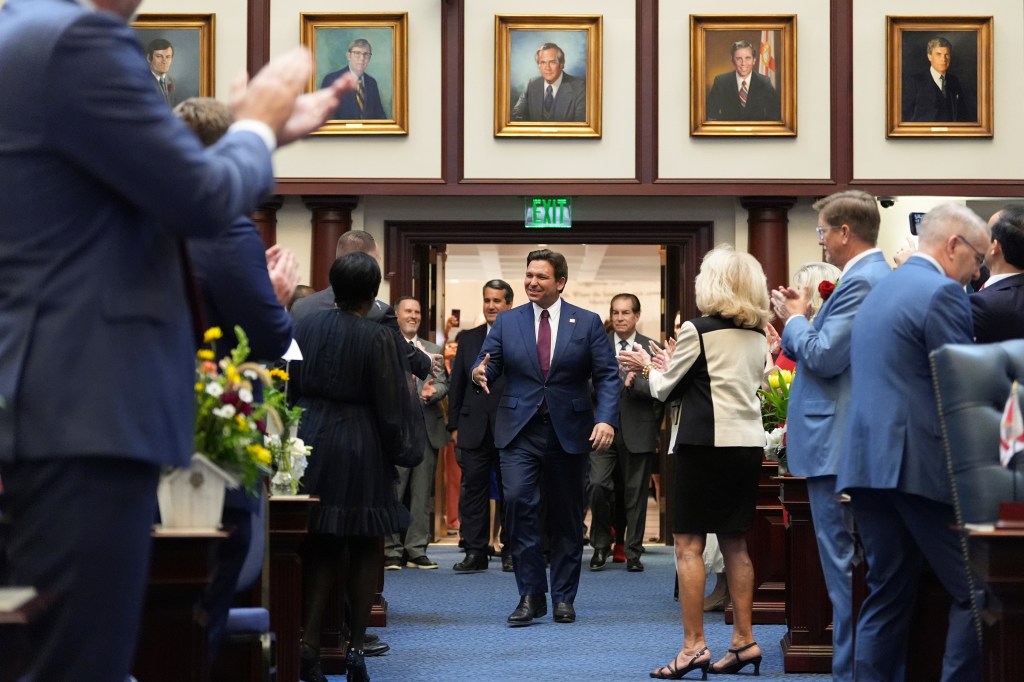
That starts with a challenge the Legislature has flunked for the past seven years: Find a way to restrict Gov. Ron DeSantis’ lavish spending — and consider stricter guidelines for future chief executives that treat appropriations bills as mere suggestions, and carefully allocated state funds as their personal political piggybanks.
Here’s just one example: Nobody authorized DeSantis to filch millions of dollars from a state Medicaid settlement to fund a campaign against a proposed constitutional amendment to legalize recreational marijuana. The governor just did it.
Laudably, Perez launched an investigation, but we have yet to see any substantive legislation that would protect the state against whatever wild whims might cross a governor’s mind. They should be inspired by their witness of a governor who woke one day, decided it would be a good idea to dump hundreds of millions of dollars into an immigrant-detention camp in the Everglades and then demanded the project take shape in the course of weeks. The resultant mess may be partially compensated by an allocation of federal funding that was cleared after the fact, but that funding was itself granted by the apparent whim of President Donald Trump.
The need to clip the governor’s wings is clearly urgent: DeSantis is less than a year away from the end of his governorship, and may be calculating his next moves based on his future ambitions. Meanwhile, the state is seeing the fallout from the Legislature’s prior indulgence of the governor’s political whims. Earlier this week, the Sentinel’s Jeffrey Schweers catalogued the crumbling of the state-funded militia that DeSantis demanded lawmakers authorize back in 2022. Who knows how many other scandals are already brewing?
And what impact should that have on the state’s overall spending plan?
Needs vs. ambition
That may be the toughest question lawmakers face this session — and they are probably still smarting from the debacle of the 2025 budget-writing standoff, which saw DeSantis vetoing the entire spending plan, then keeping them on call for months while negotiations dragged on. The resulting budget fell far short of meeting some of the state’s biggest priorities, including laying the groundwork for responsible and expected increases in the state’s Medicaid budget.
Editorial: Will lawmakers really stand up to DeSantis? For Floridians’ sake, we hope so.
This year, with elections loomingl lawmakers might be tempted to make up any shortfalls from politically motivated mistakes by short-changing some of the programs that benefit Florida’s most vulnerable — and voiceless – residents, something we’ll also address later this week.
In addition, the Legislature could decide to balance the books by spending down the billions of dollars in reserves that the state has set aside for a rainy day, or easing off on the trend of paying down debt. Many of those cruel cuts and fiscally shortsighted moves might go unnoticed by Florida’s powerful elite — the people who write the big campaign checks lawmakers will be soliciting as soon as the session wraps up.
Meanwhile, lawmakers will be acutely aware that DeSantis could, with repeated budget vetoes, keep them in Tallahassee until summer again. And by law, state lawmakers can’t accept campaign contributions while they are in session.
The most politically profitable stance would be capitulation. But lawmakers have a better choice before them, one that should be guided by the courage that House and Senate leaders have already shown in standing up to the governor. They can promise their constituents that they will allocate spending wisely, fairly and compassionately. And they can write a budget that puts Florida’s fiscal future and the well-being of its residents — in particular, its children — above their own ambitions.
This is a test that will play out across dozens of committee hearings and backroom negotiations over the next seven weeks. But it’s a challenge that we think lawmakers can meet if their leaders set the tone from the outset.
The Orlando Sentinel Editorial Board consists of Opinion Editor Krys Fluker, Executive Editor Roger Simmons and Viewpoints Editor Jay Reddick. Use insight@orlandosentinel.com to contact us.