
By Craig Pittman, Florida Phoenix
In Summary:
A new opinion column questions Florida’s relentless push for growth as drought conditions worsen and water supplies face mounting pressure. The piece highlights the state’s heavy reliance on the Floridan Aquifer, the expanding watering restrictions across multiple water management districts, and the lack of statewide planning to match development with long-term water availability. It also points to costly, uncertain alternatives — including desalination, deeper wells, and wastewater injection — as signs that Florida is entering an era in which “cheap water” no longer exists.
*****
Have you heard of Dry January? It’s a pledge not to drink alcohol for at least a month, a sign of your resolve to change your ways. But what if we made it about water — and changed it into Dry 2026?
I ask this because of several relentlessly upbeat stories I’ve seen lately about all the new developments planned for this year.
Related: District expands hiring efforts to fill high-skilled roles shaping Florida’s water future.
The Fort Myers News-Press, for instance, reported last week that “new county-level data released in December foresees massive growth to continue in Southwest Florida based in part on the latest research from the state that looks all the way out to 2050.”
Every time I read one of these stories offering sunny projections about bringing in lots more residents who need new homes and apartments, one question runs through my head: What are they going to drink?
Look, I know the Florida economy operates like the world’s largest Ponzi scheme — in fact, it’s been suggested we call ourselves the Ponzi State. The whole system depends on a never-ending supply of new people buying homes.
We continue packing in new people like we’re stuffing more clowns in a clown car, but I feel compelled to point out that nobody’s making new water to slake their thirst. There’s no wild-haired Dr. Einstein in a lab repeatedly combining one part of hydrogen with two parts of oxygen. It doesn’t work that way.
Instead, we’re facing watering restrictions, shortages, and widespread drought. Yet we act as though there’s still plenty of water for all the new people.
Florida Taxwatch, not exactly a bunch of radical tree huggers, was warning two years ago that Florida is using so much water that parts of the state would start running out if the Legislature failed to act.
Has the Legislature acted? Nope! Our duly elected dimwits have been more concerned about banning Pride flags and restricting drag shows than making sure everyone has water to drink, bathe in, and flush their toilets.
We’re now seeing desperate local attempts to boost the dwindling water supply with experiments that may not work. One to revive the flow of the Suwannee and Santa Fe Rivers has yet to find a source of funding, yet Florida water managers are already counting on it to make up for draining the river basin.
“We’re not just putting all our eggs in one basket,” Ryan Smart of the Florida Springs Council told me. “We’re throwing all our eggs in the air and hoping a basket appears.”
A lot of people in Florida never think about where their water comes from.
If you asked, they’d probably say it comes from the faucet. Or maybe the bottled water section of the grocery store.
The fact is, some 90% of the water we use for drinking, bathing, and watering our lawns comes from under our feet. Utilities suck the stuff up out of the Floridan Aquifer, a vast pool of freshwater coveringabout 100,000 square miles.
The aquifer is huge, but it’s not infinite. Refilling it takes plenty of rain. And right now, we’re not getting enough.
Nearly 90% of the state is stuck in a major drought. It’s so dry that 14 counties have imposed burn bans, fearing a wildfire could sweep across the dry acreage.
“Don’t count on any significant rain helping improve Florida’s drought anytime soon,” the Tallahassee Democrat warned recently.
Florida’s water planning and policy is under the control of five water management districts run by a bunch of gubernatorial appointees. Those appointees tend to be either developers or agriculture folks who donated to the governor’s campaign, not experts in water supply.
That’s why they rarely say no to any water-use permits, no matter how outrageously large. They’re like Jim Carrey in “Yes Man,” always giving a green light, never a red.

Ryan Smart via Linkedin
We’re seeing the result of that overly positive policy now. Too much pumping from the aquifer — to irrigate golf courses, boost crops, and provide lush suburban lawns — has lowered the pressure in a number of our taxpayer-owned springs, lessening their once-forceful flow.
“The aquifer is enormous, so we have the luxury of sinking more wells and sinking them deeper,” Smart told me. “Unfortunately, the spring vents all stay the same depth.”
While our water managers rush to accommodate the developers, he said, nature is the one that suffers.
Instead of the Ponzi State, we call ourselves the Sunshine State, but that’s a lie we tell the tourists.
Many of our cities get more annual rainfall than famously soggy Seattle. Four are in the top 10 cities for rainfall in America. The state is hit by about 58 inches of rain every year.
Except right now, our precipitation has dried up as if by prestidigitation.
If you look at the Florida drought map, you’ll see 91% of the state is in the iron grip of a drought. Much of the state shows up as yellow (“abnormally dry”), tan (“moderate drought”), or orange (“severe drought”) from the lack of rain.
The worst spot is around Tallahassee, where conditions are as red as a stop sign, which means “exceptional drought.” No, that doesn’t mean Florida’s legislators drank up all the water. They prefer stronger beverages.

Dave Zierden via FSU
Florida’s official climatologist, David Zierden, said he foresaw this coming last year when we dodged all the hurricanes.
“That was our first indication that this was coming,” he told me.
The Southwest Florida Water Management District has imposed watering restrictions on Citrus, DeSoto, Hardee, Hernando, Hillsborough, Manatee, Pasco, Pinellas, Polk, Sarasota, and Sumter counties, as well as portions of Charlotte, Highlands, and Lake counties. Those restrictions are scheduled to continue until July.
“The district received lower than normal rainfall during its summer rainy season and now has a 13-inch regional rainfall deficit,” agency officials noted.
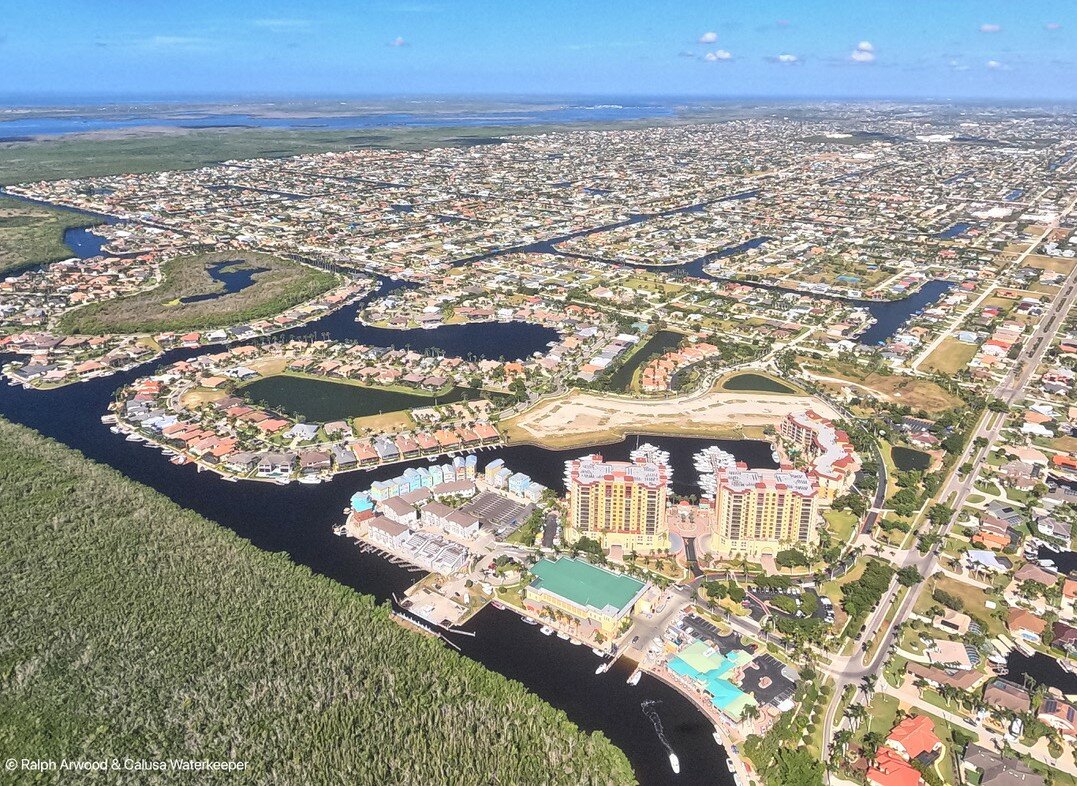
The South Florida Water Management District has also imposed year-round landscape watering restrictions across its 16 counties. One of the areas facing serious limits: Cape Coral, billed in the 1950s as Florida’s “Waterfront Wonderland” because it has 400 miles of canals, more than anywhere else on earth. But that’s all saltwater, not fresh.
The St. Johns River Water Management District is restricting water use, too. That’s three water management districts limiting water use by existing homeowners. Yet not one has limited new development.
We used to plan in advance for the utilities, roads, and other needs of our growth, but that went out the window in 2011. Still, the state has prepared a 2025 water plan, and it predicts that lots more water consumption is coming.
“Between 2020 and 2040, the population in Florida is expected to increase by 24%, from 21.6 million to 26.7 million,” the Florida Department of Environmental Protection plan says. “During this same period, it is estimated that Floridians will require 14% more water, or approximately 0.9 billion gallons of water per day.”
That’s why the plan calls for everyone to start thinking about alternatives.
But those are much more expensive.
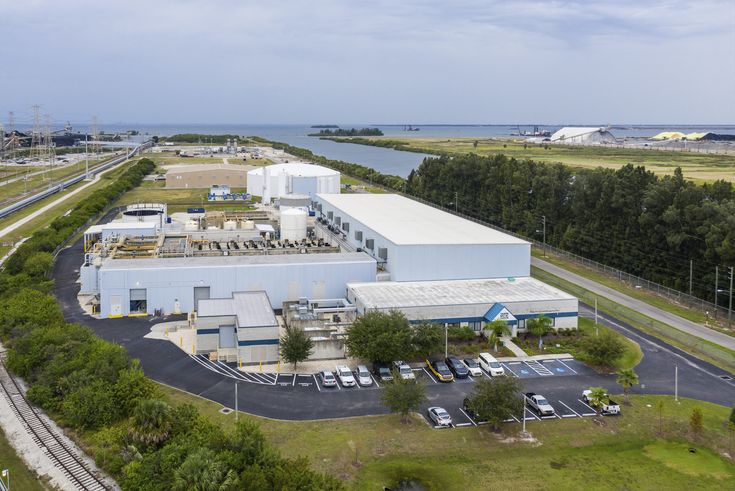
The C.W. Bill Young Reservoir via Tampa Bay Water
I used to cover the state’s largest wholesale water utility, Tampa Bay Water. Over and over, I would hear experts say, “The era of cheap water is over in Florida.”
What they meant was that you could no longer just stick another well down in the aquifer or pump a lot more water out. We saw the consequences of that during the Tampa Bay Water Wars. It led to serious damage, to the point that lakes and wetlands dried up.
Bringing those places back to life required finding alternate water sources. Tampa Bay Water built the state’s largest desalination plant using reverse osmosis to convert salty water into fresh.
Then the utility built a system for skimming freshwater from the Hillsborough River and a reservoir that could hold more than 15 billion gallons of water, making it the largest in the state. That allowed the utility to stop pumping so much water out of the ground.
Thanks to the decreased pumping, the lakes and wetlands that had been sucked dry slowly recovered. But it wasn’t enough.
Now, to meet the needs of all the new people who have moved into the area, Tampa Bay Water got permission from the water district last year to take even more water out of the Alafia River. It’s increasing the amount from 60 million gallons a day to 75 million gallons a day.
As a result, Tampa Bay Water is now in a fight with people in Polk County who want the same water. Welcome to Water Wars II: Electric Boogaloo!
But Polk County is also trying something even wilder.
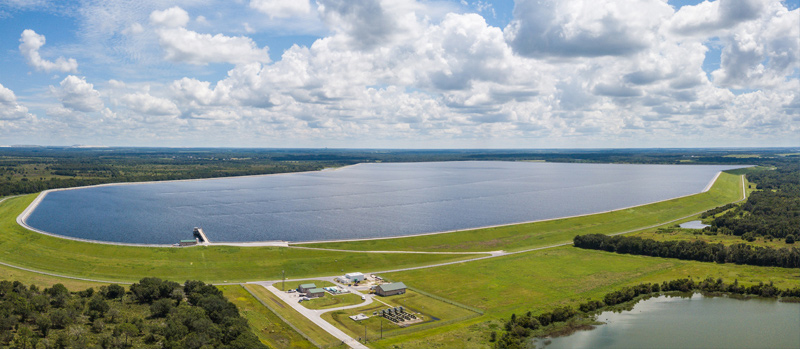
The C.W. Bill Young Reservoir via Tampa Bay Water
A couple of years ago, “Imperial” Polk County was recognized as the fastest growing county in America. WTVT-TV reported that “subdivisions are springing up left and right to keep up with the growing population.”
To keep up with that booming growth, Polk has handed out so many water permits that now it’s become desperate. It’s trying a $600 million experiment: Drill into the brackish lower level of the Floridan Aquifer.
But the product from that level will be saltier than George Carlin’s most famous comedy routine. That means it will require so much treatment that it will be much more expensive — by some accounts, 12 times more costly than fresh water.
One of the odder alternatives is coming from Jacksonville. The place known as the River City is trying to make up for pumping so much water out of the ground in North Florida that it’s harming the springs along the Santa Fe and Suwannee rivers, Smart said. The proposed solution: pumping treated wastewater out of the city and injecting it into the ground.
It’s a controversial idea — Suwannee Riverkeeper opposes it, for one, suggesting, “How about Jacksonville get a grip on its water usage?”
At this point, nobody knows who’s going to pay for this billion-dollar plan or even if it will work. But Smart said state water officials are already considering it the ideal way to make up for the water withdrawals and proceeding accordingly.
Otherwise, they might have to admit that we’ve reached the point where we can’t provide enough water for all the people who are jamming into our state now. Welcome to Dry 2026!
As usual when I have a growth and planning question, I called Wayne Daltry. He was in charge of “smart growth” in Lee County waaaaay back when Lee County cared about smart growth.

Wayne Daltry, via subject
He pointed out to me the other problem with so much of the development that’s occurring right now is where it’s being built.
“Our water recharge areas are being developed, and that’s an issue,” Daltry told me.
Those are the places in the landscape where rainfall can soak down into the ground, refilling the aquifer. If the water can’t soak in, it can’t replace what’s being sucked out. Too often, that water winds up being flushed out into the nearest stream or river and carried away, rather than being retained for consumption, he said.
Slap a slab of cement over a swamp, and the rain that does fall can’t penetrate the earth to refill our drinking water supply. Fill in wetlands, and they can no longer screen out the impurities flowing toward our bays, streams, and rivers.
Then, when we realize that our water supply has shrunk to the point where we can’t use it, it’s too late.
Fortunately, the solution to all this is obvious. It comes from the brilliant movie “Idiocracy.”
Instead of water, we can just pipe a Florida-based sports drink to every new home in Florida. We don’t have to dig it out of the ground. We just pay the manufacturer and dump it right into the pipes, so people can get it through their faucets.
Will it be expensive? Sure, but at least nobody will go thirsty. Plus, it’s got electrolytes!
Key Points:
The column argues Florida’s pro-growth policies ignore a critical constraint: water supply is finite, and the state isn’t getting enough rainfall to replenish reserves.
About 90% of Florida’s drinking and household water comes from the Floridan Aquifer, which is vast but not unlimited.
Drought conditions cover most of the state, with burn bans and watering restrictions already in place across multiple regions.
The writer criticizes water management districts as being led by political appointees who rarely deny large water-use permits, even as springs and ecosystems suffer.
Expensive and controversial solutions — including desalination, brackish water drilling, and wastewater injection — may define Florida’s next chapter as “cheap water” disappears.
Keywords
Florida drought,
Florida water supply,
Dry 2026,
Floridan Aquifer,
watering restrictions Florida,
water management districts,
Florida development growth,
desalination Florida,
Tampa Bay Water,
Suwannee River Santa Fe River,
Florida Springs Council,
water permits Florida