
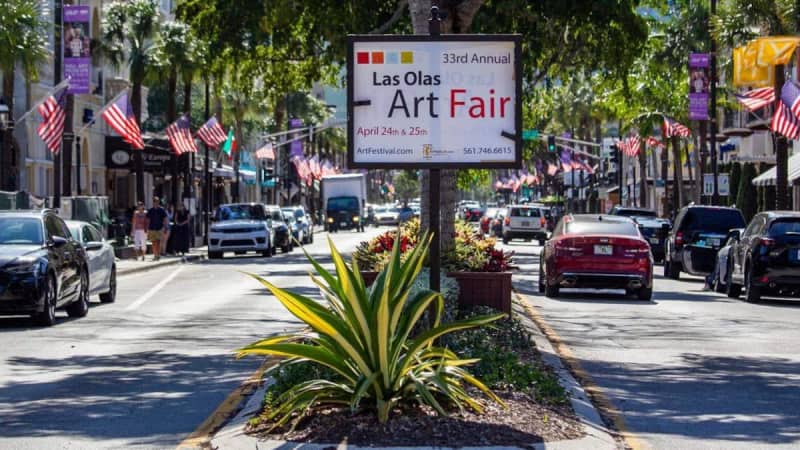
FORT LAUDERDALE — The fate of Las Olas Boulevard’s iconic black olive trees — and the medians they’re planted in — appears to be sealed. They’re done for.
As Fort Lauderdale plans to renovate Las Olas Boulevard with wider sidewalks and more tree canopy, city commissioners said Tuesday that they preferred to remove the iconic black olive trees that have lined the popular street for decades, despite backlash from some residents who argued that Las Olas would lose its charm without them.
By the end of the city commission conference meeting, the commissioners reached a consensus: the medians were out, the on-street parking would stay and the sidewalks must be widened. The commission will vote on the Las Olas redesign on Feb. 3.
“If we are going to create an iconic boulevard for the future, we really must look at the no median option,” said Commissioner Steven Glassman. “It offers the most beneficial balance of mobility, pedestrian safety, business access, long term functionality.”
The city commission has sought to revamp Las Olas Boulevard for years, finally approving a vision for the popular downtown area in 2021 that would remove the four blocks of black olive trees, which were planted into the medians decades ago, the Sun Sentinel reported.
But the trees’ impending doom outraged many residents, who have railed against the idea ever since. The city contracted consultant firm WSP USA for the Las Olas redesign in May 2024.
“We have mature trees. We don’t have to wait for growth,” said Denise Grant, a social worker and Fort Lauderdale resident of 40 years. “Las Olas is a beautiful scenic environment for people to walk and shop. It’s ridiculous to waste money to rip this out just to plant new trees.”
WSP gave the commission two options, one that removed the medians and another that retained them. Either way, the existing black olive trees would be removed because the roots would be damaged during the overall renovation process, said Brian Voelker of Chen Moore and Associates, the consulting arborist for the Las Olas project. Ironically, city codes forbid the city from replanting that same tree species.
“The average lifespan of a tree in an urban environment […] typically we’ll say is around 30 years,” Voelker said. “These trees have been in the ground well, well past that.”
The tree debacle is just one part of a larger makeover for the Las Olas western corridor, which WSP divided into three sections: “downtown” near Huizenga Park, the “shops” where the olive trees are and the Colee Hammock neighborhood. Catherine Prince, the WSP project manager, presented the commissioners with a slideshow detailing each section at the conference meeting.
For the hotly contested “shops” section, where the black olive trees currently stand, the consultants offered two options, each estimated to cost about $7.5 million. The first option removes the existing median to increase sidewalk width. The second option retains the existing median, modifies on-street parking and expands sidewalk width on both sides. Both options include planting new trees along the sidewalks to create shade.
The topic of trees dominated the discussion on the dais well before any residents commented on the proposal. Commissioners showed more interest in the option that removes the existing medians, though they had several questions and concerns about the trees, particularly whether there’d be enough shade. Mayor Dean Trantalis pointed out that the renderings WSP provided made it look like much of the sidewalk would be exposed to harsh sunlight despite the new tree canopy.
“I do want to emphasize that this is only a rendering,” Prince said. “We can absolutely go back and make sure the rendering is updated to reflect this priority.”
Vice Mayor John Herbst said his preference to get rid of the median was partly because it would make it easier for fire trucks and emergency vehicles to access the area. Fire Chief Stephen Gollan said at the meeting that the existing median complicates traffic flow and access during emergencies on Las Olas.
“Maintaining a tree canopy on Las Olas is critical for the look and the feel of what makes it unique in South Florida, but whether that’s in a median or whether that’s on the sidewalk, I don’t think is the driving force,” Herbst said.
During public comment, residents were mixed on whether to keep or ditch the median. Diana Gagne said she felt a bit blindsided because she was under the impression that there was a chance for the black olive trees to stay. The ordeal reminded her of Joni Mitchell lyrics: “You don’t know what you’ve got ‘til it’s gone.”
“I’d rather have a median with different trees if we don’t keep the black olive trees, I guess what I’m trying to say, than not have a median at all,” Gagne said. “Because I do think it makes Fort Lauderdale very unique. […] I’m one of those people that moved here because of the charm of Las Olas Boulevard.”
Resident Steve Hudson said it was time to say goodbye to the median.
“Las Olas is a destination, not a commuter corridor,” Hudson said. “The median consumes scarce right of way, limits flexibility, complicates access and delivers limited pedestrian investment. With the median left in place, this project becomes compromised from the start.”
The matter of on-street parking proved to be just as controversial as the black olive trees. Several residents said they preferred to get rid of the current on-street parking on Las Olas, calling the parking spots in front of Las Olas storefronts unnecessary. The mayor, though, disagreed, arguing that the parking is beneficial to businesses and drivers are accustomed to parking there.
Besides the tree debate, the city commission also discussed proposed renovations to the two other sections of the Las Olas corridor, which were far less controversial.
The proposal for the downtown section, which is the stretch from Andrews Avenue to US-1, would extend an existing median, increase the tree canopy and install a raised intersection at SE 1st Avenue. At Huizenga Plaza, the proposed plan would also widen the sidewalk by a foot and install a raised crosswalk. The project for this section costs about $5 million.
For the Colee Hammock section, from SE 12th Avenue to 17th Avenue, consultants proposed to turn the sidewalk into a “shared-use path” for pedestrians and bicyclists and plant 72 shade trees and 54 flower trees. That would cost about $6.8 million.