
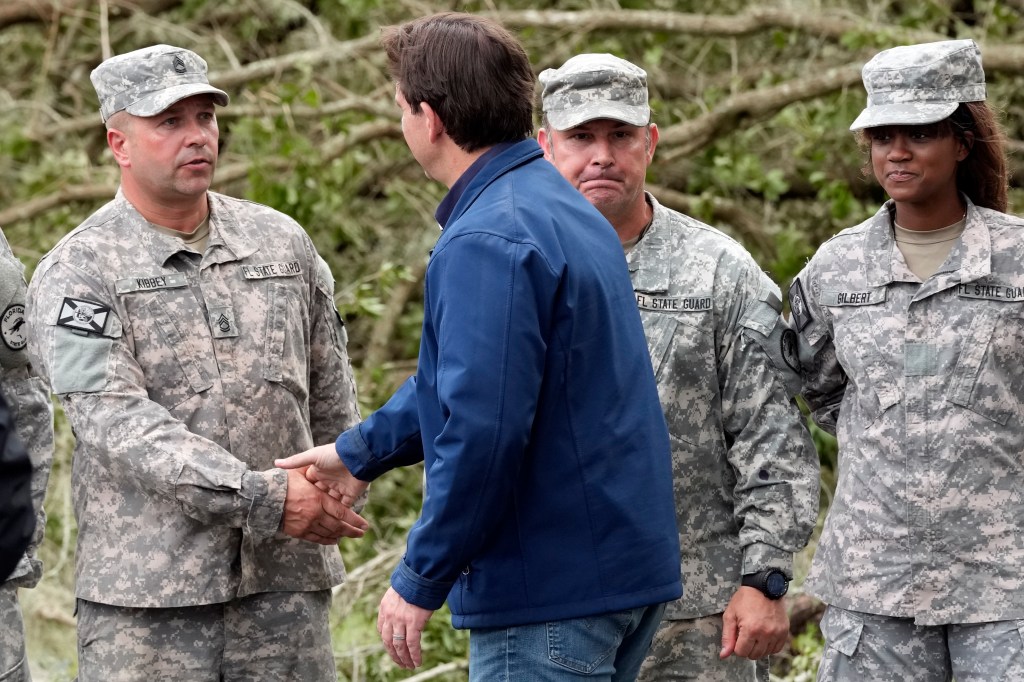
Give the governor his own private militia, they said. There’s no way this could go wrong, they said.
In the face of recent revelations about the inner workings of the Florida State Guard under Gov. Ron DeSantis, this blithe attitude seems unforgivably naive. As the Sentinel’s Jeffrey Schweers reported last week, the state-based guard (which is not the same as the Florida National Guard) seems to have devolved into a chaotic kleptocracy, as well as a mocking insult to the patriotic veterans who at one point were eager to volunteer their services to help the state in emergencies. Allegations are still emerging, but people at all levels of the guard are apparently quitting, and high-ranking former members say they’ve seen public resources commandeered for personal use, money spent on unneeded parts and supplies and retaliation against some who dared to object.
To be fair, when the Legislature first authorized the revival of the Florida State Guard in 2022, nobody realized what the governor would try to accomplish with it — perhaps not even DeSantis himself. The plan, as originally described, was to re-create a civil defense force set up during World War II to replace national guardsmen deployed overseas. With German U-boats sinking ships just off Florida’s coast, that protection made sense in 1942.
Missing: A mission
But DeSantis was vague about the missions the new state guard would assume. The sales pitch was of a small volunteer force — about 200 brave veterans who would volunteer to give Florida “the flexibility and the ability needed to respond to events in our state in the most effective way possible,” the governor said, with the suggestion that the military force would mostly mobilize to assist in the aftermath of big storms. At the time, many people suspected that the governor’s real intention was to capitalize on his own military background by giving him a ready-made backdrop of men and women in camouflage for his press conferences. And sure enough, a Miami Herald photographer captured a shot of him doing just that in August 2023, in the aftermath of Hurricane Idalia.
“Most effective way” apparently meant most effective for the governor’s runaway ambitions, as he jostled for the 2024 presidential nomination and then apparently transitioned into auditioning for a key defense job under President Donald Trump.
Using public dollars and the service of veteran volunteers to burnish his image would have been bad enough.
Editorial: Is Florida Guard really DeSantis’ private militia?
But it quickly became apparent that the governor had plans for the new unit that went far beyond photo ops — by “events in our state” he meant stunts, such as sending members of the Florida Guard to assist, somehow, at the Mexico-Texas border. That effort drew headlines, but not always flattering ones, especially after estimated costs of that mission topped $3 million. During a port workers’ strike, DeSantis also sent state guard members to ports in an apparent attempt to intimidate union members into going back to work. Meanwhile, the state hired a contractor to oversee recruitment and training of guard members — not in civilian disaster response, but in combat tactics laden with “warrior culture.” Among the company’s instructors: a former U.S. Navy SEAL accused of war crimes.
Unfolding problems
From the start, the new unit was plagued by missteps. Some early recruits had to be dismissed, and far more were quitting within a few months or a year of joining. By the time its first training class wrapped up, the guard was on its third (and current) commander, Marine Corps veteran Mark Thieme. Under his leadership, the guard’s activity rapidly multiplied, along with its budget, which in the current fiscal year is $36.8 million — with DeSantis requesting more than $62 million for the coming budget year.
By many accounts, the money is not being well-spent. Comments by two high-ranking guard officials suggest corruption, starting with a straight-up allegation that Thieme commandeered a state plane and racked up $100,000 in flight time to obtain his private pilot’s license. Michael Pintacura, a former member of Army Special Forces who helped lead the Florida Guard’s Special Missions Unit, quit last week, saying in his resignation letter that he’d lost confidence in Thieme’s judgement, and that he felt guard members are being put in harms’ way.
“Remaining in the role would signal acceptance of a culture where implied pressure and informal direction supplant disciplined planning, clear task organization, and accountable leadership,” Pintacura wrote, adding that he’d witnessed a “sustained pattern of compromised integrity, lack of accountability in maintaining budget controls and equipment tracking,” that included the forced resignation of one officer who refused to relay what he considered to be an unlawful command. Other officers said Thieme demanded the guard order millions of dollars’ worth of aircraft parts the unit didn’t need and couldn’t use, to avoid leaving unspent funds at the end of the budget year.
Florida deserves answers
Of course, Thieme may have rational responses to each of these charges, including proof that he didn’t use state aircraft for personal gain. But we can’t tell you that right now — because he wouldn’t talk to Schweers and we were unable to obtain public records that would show the truth.
Meanwhile, the Legislature is in session. Soon, it will start work on its annual budget-writing process. Lawmakers need to know if there are serious questions about the guard’s leadership and its management of state funds. And they need to demand answers.Normally, we’d include the state’s chief financial officer in that call to demand accountability. Unfortunately, the current occupant of the CFO’s office, Blaise Ingoglia, has shown little interest even in the face of blatant warning signs that state funds are being misspent and unaccounted for. He’s too busy scampering around the state, accusing county and city officials of wasteful spending with almost no evidence to back his claims.
Maybe news of this scandal will finally prompt Ingoglia to do his actual job . But right now, Floridians’ best hope for accountability lies with lawmakers. We hope they demand the answers their constituents are entitled to.
The Orlando Sentinel Editorial Board consists of Opinion Editor Krys Fluker, Executive Editor Roger Simmons and Viewpoints Editor Jay Reddick. Use insight@orlandosentinel.com to contact us.