
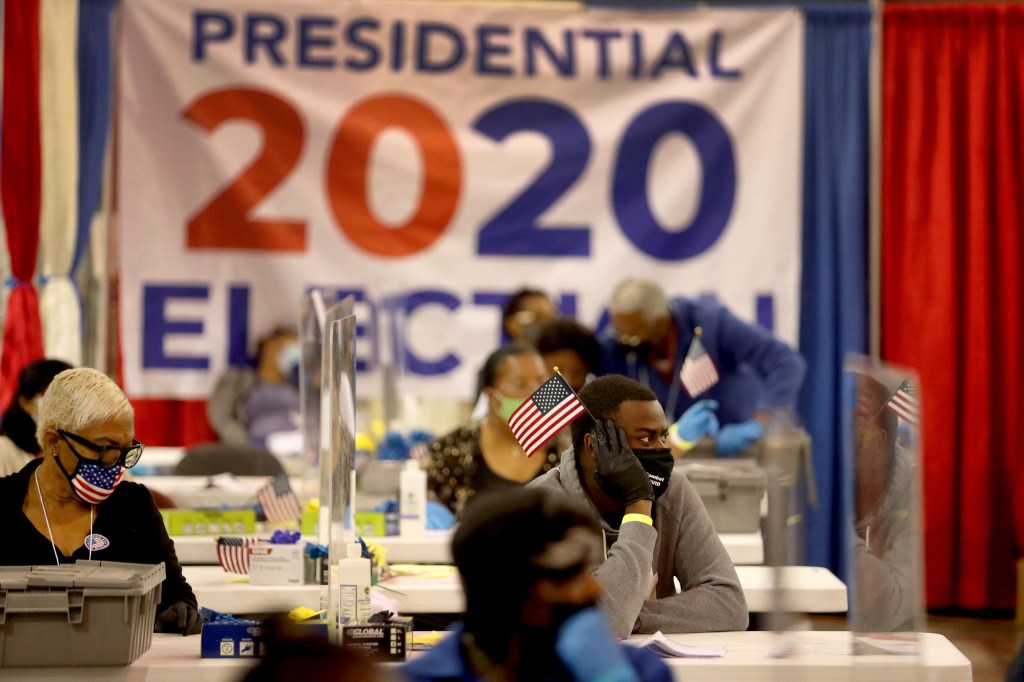
Florida’s closed primaries bar political independents, nearly a quarter of voters, from participating in primary elections even though primaries decide most general elections.
Representing myself, I challenged this system of closed primaries in federal court. Although the appellate court ruled against me, the concurring opinion acknowledged the changed electoral landscape warranted reexamining the Supreme Court’s two-word affirmance in 1976 of closed primaries.
Florida’s closed primaries originated in the Jim Crow South. In 1907 the Sunshine State enacted its closed-primary statute. Five years earlier, Florida had banned Blacks from voting in Democratic primaries. Those primaries determined general elections because the Civil War had turned the post-Reconstruction South into one-party states,
The Supreme Court held a state like Florida could not prevent Blacks from voting in primaries under the Equal Protection Clause. But the Supreme Court subsequently allowed the Democratic Party to ban Blacks from their primaries.
In 1944 the Supreme Court reversed course. The existence of white primaries was deemed state action under the 15th and 14th amendments. The Court found that primaries had become an essential part of a unified state system leading to the general election of public officials,
Florida’s present closed primaries and past white primaries disenfranchise independent voters in a comparable way. In 1946 the Florida Attorney General determined that “316 negroes” were ineligible to vote in a primary election because they had no political affiliation. Before 1944 these same Black individuals would have been barred because of race. The constitutional freedoms of political belief under the First Amendment or of racial equality under the 14th are both fundamental. Florida can no more suppress a vote because of political conviction than it can because of race.
Almost 90% of Florida’s state legislative districts are non-competitive because either the Democratic Party or the Republican Party so thoroughly controls a district that its primary is the true election. For Florida’s independents to vote in the general election is almost as futile a gesture as it would have been for Blacks to vote for Republicans in general elections under Jim Crow.
 My own experience in Sarasota County illustrates the problem. By registering as politically unaffiliated I cannot vote in primary elections for the Sarasota County Commission. Yet the Commission collects from me and other registered independents real estate taxes to pay for primary elections in which we cannot vote.
General elections in Sarasota County are generally decided in the Republican primary. The last non-Republican elected to the Sarasota County Commission was in 1966. Since 1968 Republican primaries have foreordained the results in general elections. No Democratic presidential candidate has prevailed in Sarasota County since Franklin D. Roosevelt.
Political independents are forced to subsidize the political views of partisan and often polarized voters whose politics they do not share. This is unlike subsidizing a park we will never use because all citizens have a First Amendment right not to join or endorse a political party. Independent voters have become second-class citizens whose votes have less efficacy than partisan votes.
The right to vote arises from citizenship and not from membership in a political party. What happens in Sarasota County also happens in other counties, except that in those dominated by Democrats the meaningless vote would be for the Republican candidate in the general election. Florida’s closed primaries operate for the benefit of the Democratic and Republican parties. The state currently has 15 minority parties, but no minority party has ever met the membership threshold to qualify for a state-funded primary.
Gov. Ron DeSantis has described Florida as an “oasis of freedom.” The oasis runs dry when Florida offers a Hobson’s choice: either betray your political convictions and join a party so you can have an equally effective vote like others or stand true to your politically independent convictions and accept political irrelevance.
Florida makes it a third-class felony to give false information on your voter registration form. Misstating one’s political beliefs is not the only falsity. The inflated membership rolls of the political duopoly reflect no genuine allegiance but rather coerced affiliation. A system of closed primaries suppressing voters with open minds makes a mockery of political freedom.
Michael J. Polelle is a professor emeritus at the University of Illinois Chicago School of Law. He lives in Sarasota.