
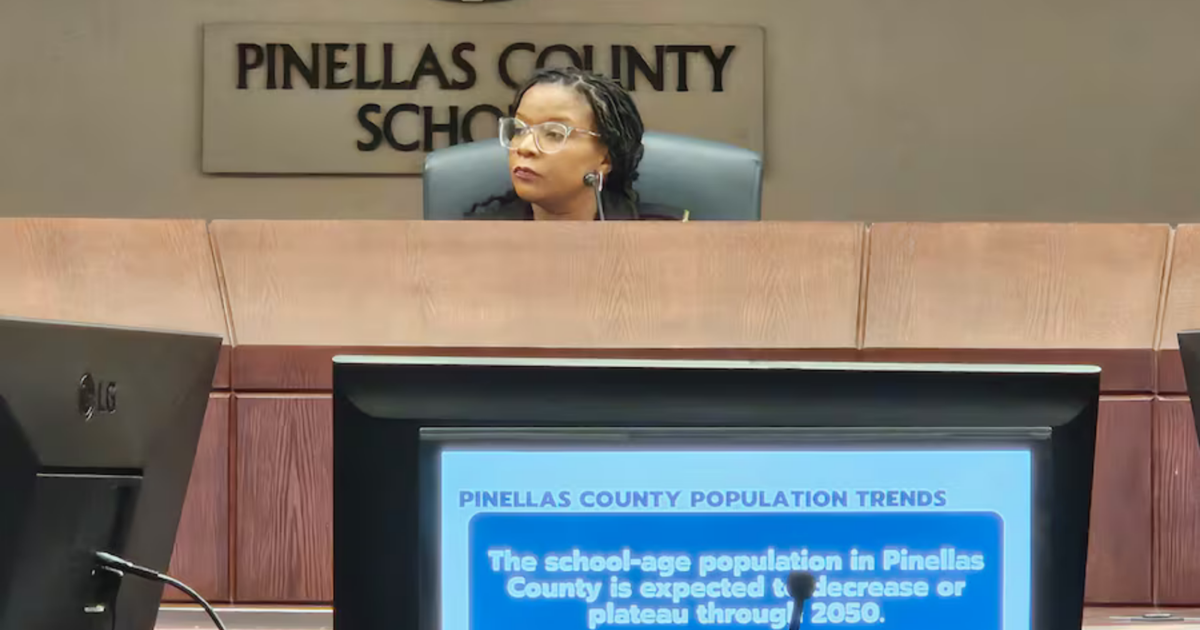
Six Pinellas County schools are slated for major change as the district works to better use its space in light of steadily declining enrollment.
This year, the district has 35,000 more seats than students. About a third of its campuses sit at less than 60% capacity. District data suggest the decrease owes more to smaller families with fewer school-age children than to a heavier use of vouchers and charter schools.
Superintendent Kevin Hendrick said his recommendations, unveiled at a school board workshop Jan. 20 after being delivered to potentially affected schools and families, are the first step toward right-sizing the district for more efficient operations.
“This is not the last step in the process,” Hendrick said.
The first round of proposed moves includes:
• Combining Bay Point Elementary and Bay Point Middle into a K-8 school on the middle school campus on 62nd Avenue South in St. Petersburg. The change would take effect in fall 2027. Bay Point Middle sits at about 35% capacity, and Bay Point Elementary just under 50%.
• Expanding Oldsmar Elementary into a K-8 school beginning in 2026-27. The school sits at just over 50% capacity.
• Expanding the district’s employee child care program into two classroom buildings at McMullen-Booth Elementary in the 2026-27 school year. The school is at about 54% capacity.
• Closing Cross Bayou Elementary in Pinellas Park, which sits at about 45% capacity, at the end of this school year, and rezoning its students to nearby Bardmoor and Pinellas Central elementary schools. This move also would include shifting the elementary Deaf/Hard of Hearing program to Walsingham Oaks K-8.
• Closing Disston Academy at the end of this school year and relocating its programs and students to other educational alternative sites. The Disston school sits at about 17% capacity.
Overall, the proposals would eliminate 1,781 student seats, while also reducing about $7.7 million in recurring personnel costs and about $7 million in planned capital expenses.
Pinellas is one of several Florida school districts working to downsize its physical footprint as its numbers decrease, a result of several factors such as a rise in student vouchers for private and home schooling and a decline in birth rate. A recent state law allowing certain charter schools, known as Schools of Hope, to claim unused space in under-capacity district campuses without paying for rent or services has compounded the concerns.
Hendrick told his board it would be wrong to ignore all possible options as the district works to best educate Pinellas children and protect the investment of local taxpayers.
His team spent months since the fall analyzing data, reviewing school use and exploring options for each campus. The district held several public forums to collect feedback, incorporating ideas such as support for K-8 schooling and early childhood services into its proposals.
Board chairperson Caprice Edmond said getting input from parents, students and staff is a critical component to a successful rollout of whatever the district decides to do.
“No one is being blindsided by what potentially could happen,” Edmond said, stressing that no final decisions have yet been made.
The district plans to hold community meetings on each of the proposals at the individual schools before holding another workshop on Feb. 17. The board is scheduled to vote on the recommendations at its Feb. 24 meeting.
Board member Laura Hine acknowledged the difficulty inherent in making such significant alterations to the school system.
“While this is tough and change is hard, what I am 100% confident in is the quality of our schools,” Hine said.
She and others noted that the district has tried to have smooth transitions in past closures and consolidations leading to this point. Those include the merger of Walsingham and Southern Oak elementary schools into a K-8 school and the transformation of Pinellas Secondary into a child care center for employees.
This round of recommendations mirrors those type of smaller shifts, which generated little pushback. The next round is expected to be more far-reaching, but Hendrick repeated a key goal will remain “to give families as good a choice or better” than what they currently have.
Plans also call for looking at selling the Disston and Cross Bayou sites, in addition to at least four other properties the district owns and has no long-term intention to use. Those discussions are not as immediate.
Hine cautioned her colleagues to think hard before giving up some of the last pieces of undeveloped land in the county, calling the sites “significant assets” that will likely become only more valuable.