
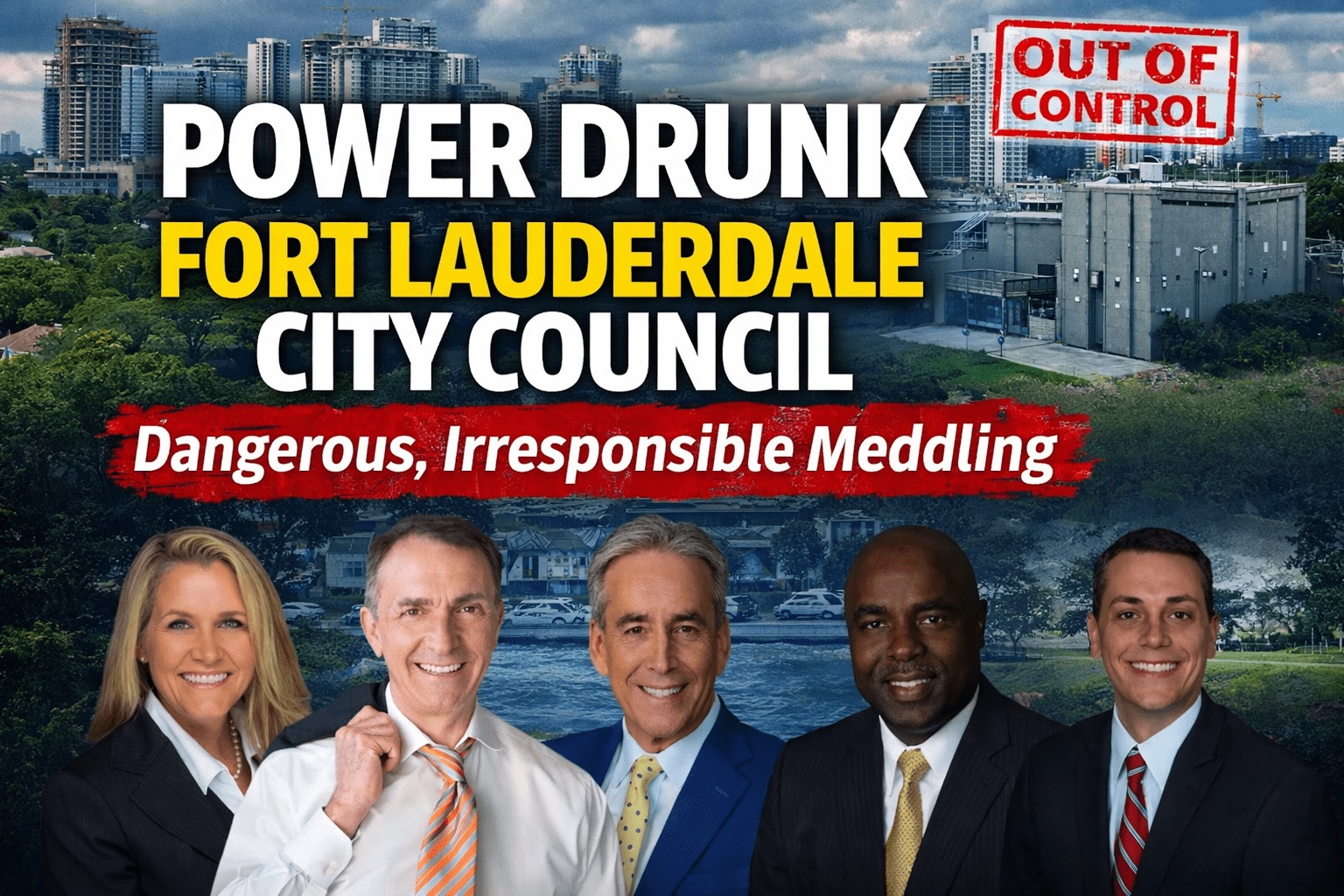
A City Under Siege: How Fort Lauderdale City Council Is Undermining Its Own Identity
Fort Lauderdale is not being reshaped by market forces or inevitable change. It is being actively dismantled by its own City Council. What residents are witnessing is no longer isolated misjudgment or one controversial vote. It is a pattern of power-drunk meddling that touches nearly every part of the city that works, nightlife, tourism, parks, streetscapes, and long-standing neighborhoods, while ignoring the structural failures that actually demand leadership. This is not progress. It is mismanagement layered on top of denial.
The Alcohol Crackdown: A Direct Hit on the City’s Brand
The council’s decision to eliminate open containers and outdoor alcohol consumption in entertainment districts is being sold as a public safety response. In reality, it strikes at the heart of Fort Lauderdale’s identity and economic engine. Fort Lauderdale is not Miami. It is not a bottle service city built on isolated venues and velvet ropes. It is a walkable, bar-hopping beach town, informal, social, and open. That culture fuels tourism, supports thousands of hospitality jobs, and sustains independent businesses that invested here precisely because of those rules.
Bars are regulated. Bartenders are trained. IDs are checked. Cameras are running. Security is present. Parking lot drinking, which officials claim is the issue, has none of those controls. Yet instead of targeting illegal street drinking with enforcement, the council chose to rewrite long-standing laws and punish licensed businesses. Business owners have warned this will lead to closures, especially when paired with proposals to roll last call back from 4 a.m. to 3 a.m.
The message is unmistakable: the city no longer has your back, even if you followed the rules.
Las Olas Trees: Meddling With the City’s Soul
Las Olas Boulevard is not just a road. It is the image of Fort Lauderdale, the postcard, the vibe, the emotional center of the city. Yet this council continues to entertain plans that would remove or fundamentally alter the iconic tree canopy that defines Las Olas, even as high-rise development accelerates around it. Instead of protecting the one element that humanizes the corridor amid vertical growth, officials appear eager to “modernize” it into something sterile and interchangeable. Cities across the world fight desperately to preserve what Fort Lauderdale already has. This council treats it as an obstacle.
The “Poop Park Five”: How Public Parks Became Infrastructure Dumping Grounds
Perhaps the clearest symbol of institutional failure is the decision to place large sewage lift and transfer stations inside public parks. These facilities are not being located in parks because it makes sense. They are being placed there because the city failed to plan years ago, failed to secure appropriate industrial locations, and now cannot cancel or relocate projects without admitting that failure. So parks, spaces meant for children, families, and community life, become collateral damage.
Residents have started calling them what they are: poop parks.
When this happens repeatedly, across multiple neighborhoods, it stops being an accident and becomes a governing philosophy: hide mistakes in places people care about least politically, even if those places matter most socially.
High-Rise Overload With No Infrastructure to Support It
At the same time, the city is approving high-rise towers at a pace that far exceeds its infrastructure capacity. Traffic, sewage, stormwater, parking, emergency response, and green space are consistently treated as afterthoughts. Approving density without synchronized infrastructure planning is not growth. It is short-term revenue chasing at long-term public expense. Residents pay the price in congestion, strain, and declining quality of life, while developers move on and the council declares success.
Public Input Treated as an Inconvenience
Residents across Fort Lauderdale describe the same experience: public meetings that feel performative, feedback that vanishes, and decisions that appear predetermined regardless of opposition. Public input has become a procedural checkbox rather than a governing principle. When residents raise legitimate concerns, they are dismissed as emotional, uninformed, or resistant to “progress.” That is not leadership. That is arrogance. A city does not belong to its council members. It belongs to the people who live, work, invest, and raise families there.
Failed Projects, No Accountability: The Amphitheater and Beyond
The city’s recent history is littered with long-term projects launched without secured funding, clear timelines, or accountability, none more emblematic than the failed public park and amphitheater initiative. Marketed as a cultural asset, it moved forward without real funding behind the scenes. Predictably, it stalled and collapsed, leaving residents with disruption instead of results.
This pattern repeats: big announcements, glossy renderings, political credit upfront, followed by silence, delays, or quiet abandonment when execution fails.
A Familiar Pattern: Neglect, Then Over Correction
Fort Lauderdale already destroyed its original Riverfront entertainment district, tearing it down and leaving the area under construction for more than a decade. Southwest Second Street, once vibrant and classy, was left to wither during that period. Businesses closed. Foot traffic disappeared. Disorder followed. Now, as the area struggles back, the council’s response is not revitalization or accountability, it is restriction. The same governing body that neglected the district now punishes it for the consequences of that neglect.
This Is Not Democracy, It’s Governance by the Simple Minded Few
These are short-term, elected officials making permanent changes to a city brand that took more than a century to build. Democracy does not end on election day. It requires restraint, listening, and respect for institutional memory. What Fort Lauderdale residents are seeing instead is power-drunk governance, officials drawn to iconic elements precisely because they are visible, symbolic, and easy to meddle with. Fort Lauderdale did not need to be reinvented. It needed to be protected.
Instead, residents are watching their city turned into a policy experiment, one ordinance, one tree, one park, one district at a time. And the longer this continues, the harder it will be to undo the mess. At this point residents will vote for anyone who promises to undo everything this council has done.
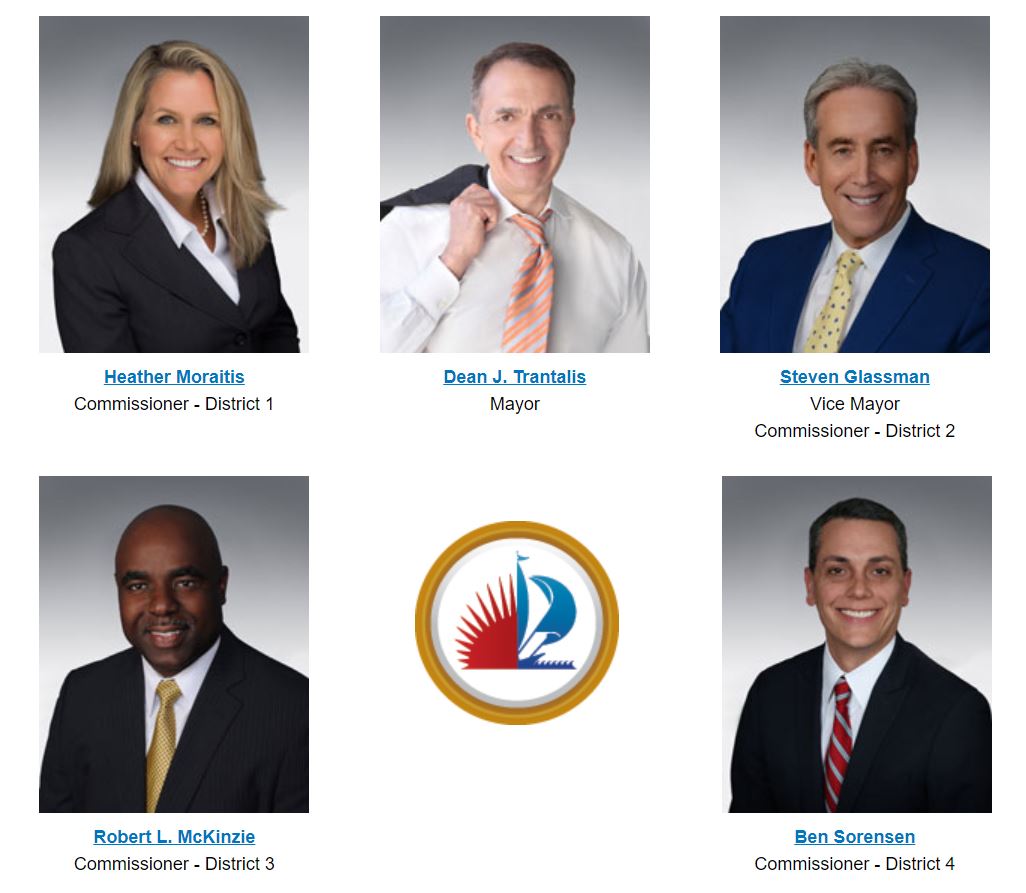
Fort Lauderdale City Commission
Mayor (At-Large)
Dean Trantalis
City Hall, 1 E. Broward Blvd., Fort Lauderdale, FL 33301
Phone: 954-828-5314
Email: [email protected]
Commissioner – District 1
John C. Herbst
Phone: 954-828-5008
Email: [email protected]
Commissioner – District 2
Steven Glassman
Phone: 954-828-5009
Email: [email protected]
Commissioner – District 3
Pamela Beasley-Pittman
Phone: 954-828-5007
Email: [email protected]
Commissioner – District 4
Ben Sorensen
Phone: 954-828-5006
Email: [email protected]
City Commission Office (Administrative)
Office of the Mayor & City Commission
City Hall, Suite 444
Phone: 954-828-5004