
The play is wrapped around the story of the MS St. Louis, a ship filled with Jewish refugees who fled Europe in 1939. They were denied entry into Cuba, the U.S., and Canada, and sailed back to Europe. Many assimilated into different countries, but about 300 ultimately wound up killed in concentration camps. It is a story that carries shame.
The story of the St. Louis is a cautionary tale about our responsibility to neighbors in need, and about acceptance in the face of nationalism. It’s relevant today.
The frame of Sotto Voce is as follows.
Bemadette Kahn (Sara Morsey) is an 80-year-old German author living in Manhattan. Saquiel (Gabriell Salgado) is a young researcher from Cuba who is obsessed with the story of the St. Louis. He interviews Bemadette after finding letters, private correspondences between Bemadette and her old lover, Ariel, who ultimately perished.
Like Titanic, the story unfolds through an older narrator traveling back in time, revisiting her relationship with Ariel before the voyage.
The play is a subtle lullaby of memory and loss.
It is a poetic meditation on love, belonging, and the weight of history.
Yet the play is also more disguised as a historical drama.
Scenes at times shift between the present and past, but this two-act, 120-minute play, with a 15-minute intermission, is not grounded in action or traditional historical drama. Much of the play consists of characters talking to one another, in the present, trying to connect. The researcher struggles to reach the reluctant author, while a third character, Lucila (Claudia Tomás) the author’s assistant, a young Colombian woman, triangulates the drama, offering comic relief, sparking moments of chemistry and desire for life.
The acting is steady. Sara Morsey delivers a deep impassioned performance. Claudia Tomás is a delight, bringing whimsy and real chemistry. And Gabriell Salgado is a stud, in range and presence. Salgado is one of South Florida’s most prolific actors, appearing in productions it seems like everywhere. We last loved him in Lincoln Road Hustle. His career appears destined for bigger things, in television, perhaps film.
The play itself is literary in its ambition but unusual in its use of point of view. It bounces between emails, phone calls, letters, diary-like passages from Bemadette’s book, and third-person scenes that occasionally slip into flashbacks. The point of view shifts a lot for a play.
The challenge is that this constant shifting doesn’t leave enough space to ground emotional depth or raise the dramatic stakes.
The story moves like the ocean, back and forth, breaking and receding, perhaps intentionally, perhaps like memory.
Memory, as years pass, becomes quiet, subtle, lingering in the psyche.
But we don’t forget.
Therefore, it is fitting this drama unfolds in a subtle manner, like a whisper or a soft voice (sotto voce translates to soft voice). There are no loud bangs. There is no traumatic, confrontational use of suspense, conflict, or resolution with dramatic stakes. The story, like the sea, like memory, vacillates. In its subtle vacillation lies its value and entertainment.
Sotto Voce
world premiered Off-Broadway in 2014, written and directed by Nilo Cruz. It was later performed in Atlanta, Washington, D.C., and Portland, Oregon, and now arrives in Miami, once again under Cruz’s direction. It is playing at GableStage until Feb 15th.
For more info and tickets, click here.
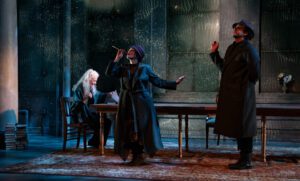 photo by Magnus Stark
 photo by Magnus Stark