
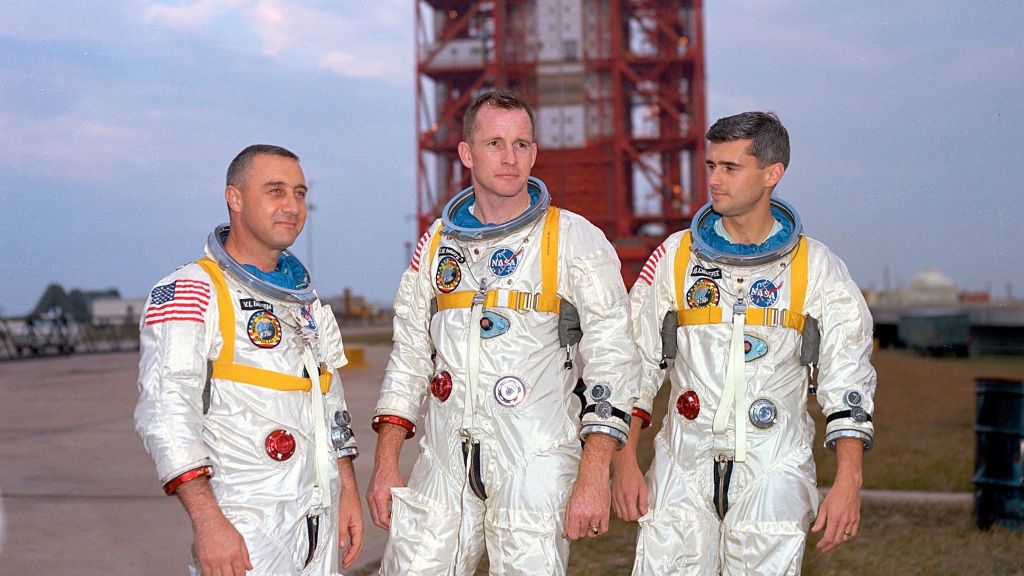
As part of our 150th birthday, the Orlando Sentinel will reprint articles from our archives as part of our Monday Memory feature. Here’s one from 59 years ago this week about the death of the Apollo 1 crew on the launch pad on Jan. 27, 1967. This story was written by Dick Young of the Sentinel staff, and the headline above it said, “3 Astronauts Killed. Flash fire hits craft on ground.”
CAPE KENNEDY – The prime crew for the first manned flight of Project Apollo died at 6:31 p.m. Friday in a flash fire inside the three-man spacecraft atop its Saturn booster at Complex 34.
Gus Grissom, Edward White and Roger Chaffee – scheduled to ride the nation’s 17th manned spacecraft into orbit on Feb. 21 – were inside the spacecraft’s command module during the countdown of a simulated flight test.
The accident occurred at the T-minus 10 minute mark of a planned simulated liftoff.
Some early reports indicated that the fire started in the service module and then spread to the command module. A NASA spokesman denied this, however.
The fire, the spokesman said, started in the interior of the conical command module and was confined within the cabin section. Speculation immediately arose as to the fire’s origin but NASA shut the door on details pending a formal inquiry. “There was a flash and that was it,” said a spokesman watching the screen in the blockhouse a few hundred yards away.
The screen went blank “and there were no communications from the crewmen at that time.”
The spacecraft was in a simulated flight position and the astronauts were breathing the pure oxygen used as a spacecraft environment.
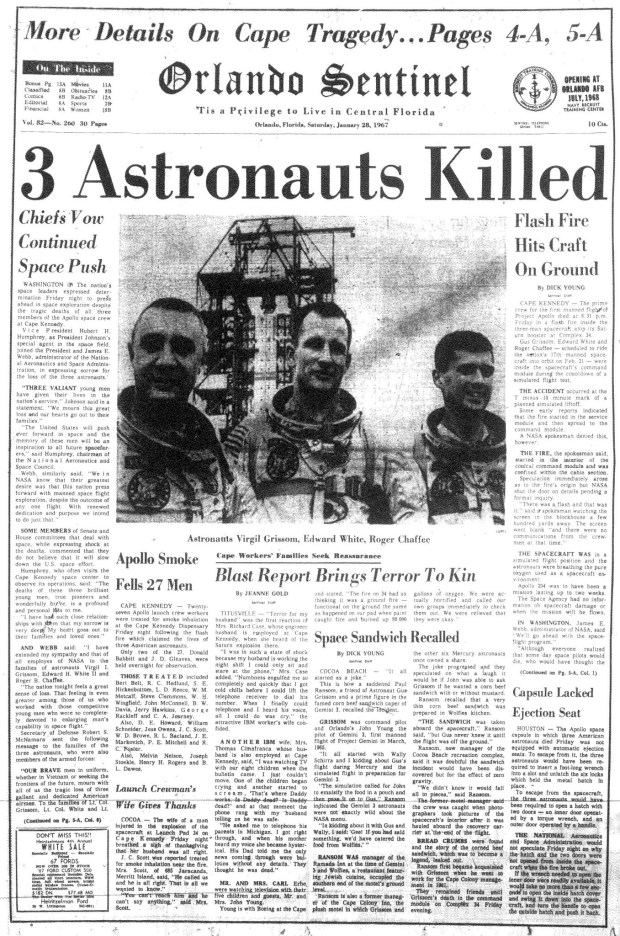
Orlando Sentinel
Orlando Sentinel front page grom Jan. 28, 1967 with Apollo 1 accident coverage.
Apollo 204 was to have been a mission lasting up to two weeks. The Space Agency had no information on spacecraft damage or when the mission will be flown.
In Washington James E. Webb, administrator of NASA, said “We’ll go ahead with the spaceflight program.”
“Although everyone realized that some day space pilots would die, who would have thought the first tragedy would be on the ground?” Webb asked.
The backup crew for the flight is composed of Walter Schirra, Walter Cunningham and Don Eisele.
This section of Florida lives and breathes space and the triple tragedy cast a noticeable pall over residents of spaceport communities. Grissom, one of the original seven astronauts, and White, intrepid Gemini 4 spacewalker, were especially well known.
Grissom’s portrait is one of seven hanging in the lobby of Cape Colony Inn, a motel the seven original astronauts once owned here.
Only last month, Grissom was asked what he would consider a successful flight aboard Apollo 1.
“As far as we’re concerned,” Grissom cracked, “It’s a success if all three of us get back.” Rescue workers attempting to enter the spacecraft located 215 feet above the launch pad were hampered by the heavy smoke which poured out when the spacecraft’s hatches were removed.
Twenty-five launch crew workers were treated for smoke inhalation at the Cape Kennedy dispensary in the aftermath of the futile rescue attempt. Word of the tragedy started to leak out of the Cape at about 7 p.m. but it was 8:30 before the space agency made a formal announcement of the three astronauts’ deaths.
 Orlando Sentinel 150th birthday logo for Monday Memory feature.
Attempts by newsmen to get word from the Complex 34 blockhouse proved fruitless as pad personnel declined to supply information or page public information officials.
The crew entered the spacecraft at 3 p.m. and the space agency noted that minor difficulties had been encountered with the spaceship’s environmental control and communications system during the simulated launch exercise. NASA has impounded all data surrounding the fire and its origin pending its investigation.
The triple death was the latest misfortune to stalk the first manned Apollo mission.
The flight had been scheduled for mid-November shortly after the Gemini program was completed but a series of spacecraft problems, notably with its environmental control system, pushed the flight into the third week of February.
Grissom was the nation’s the second man in space, making suborbital flight of Project Mercury. Grissom had a close call with death even then. His Mercury spacecraft sank and Grissom almost went down with it.
Grissom was the command pilot on Gemini 3, first manned flight of Project Gemini, and completed a three-orbit mission with John Young of Orlando.
Ed White achieved fame during Gemini 4, when he stepped out into space for a 20-minute stroll, the first American to perform this feat. This was to be Chaffee’s first flight..