
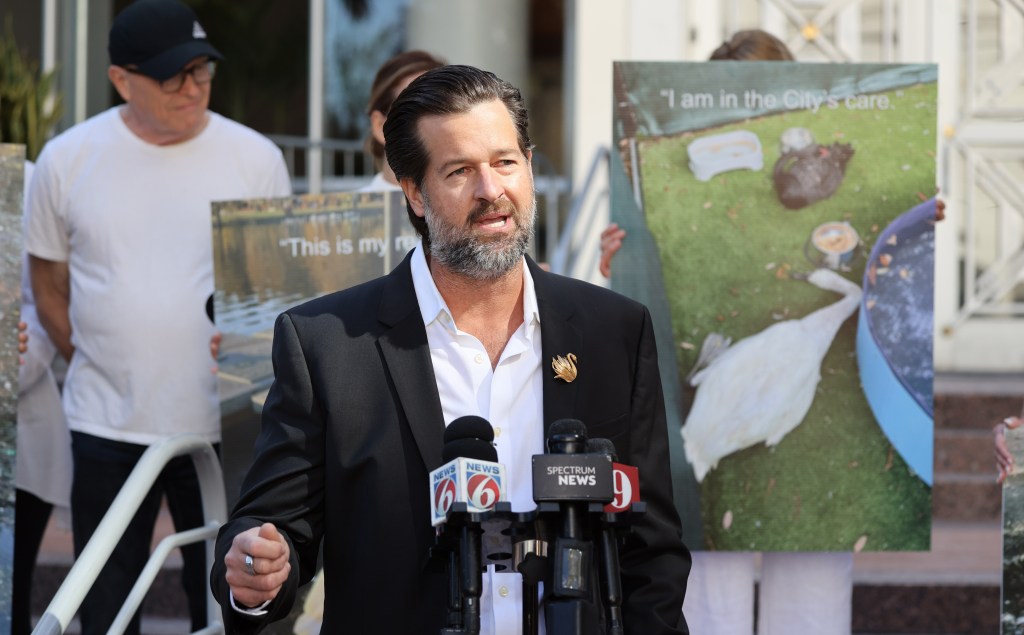
Faced with a flock of petitioners slamming “deplorable” conditions for Orlando’s prized Lake Eola swans, Mayor Buddy Dyer promised that city leaders will listen.
“We’re going to take a comprehensive look at everything that goes on,” Dyer said at Monday’s City Council meeting. “We want to do the right things by the swans and we need to evaluate exactly what that might be.”
Over the past month, as an avian flu outbreak at the city’s signature park has killed 37 birds – including 29 swans, 25 of which were city property – a petition gained steam highlighting what advocates consider shortfalls in their care beyond the virus.
Specifically, advocates have called for either a staff avian expert or more frequent consultation with an outside one, as well as the creation of an advisory board and more thorough trash pickup at the lake.
They also called for better cleaning of feeders and spreading them out around the park, along with more areas for baby birds to get out of the water, where a high seawall keeps cygnets from reaching the shore.
“Their food, safety, medical care and survival are entirely dependent on city decisions and human care,” said Andrew Marshall, a longtime volunteer caretaker of the flock. Marshall was one of a half a dozen advocates to address the City Council.
“If you, the city, chooses to keep these swans, you must also ensure better care and accountability,” he said.
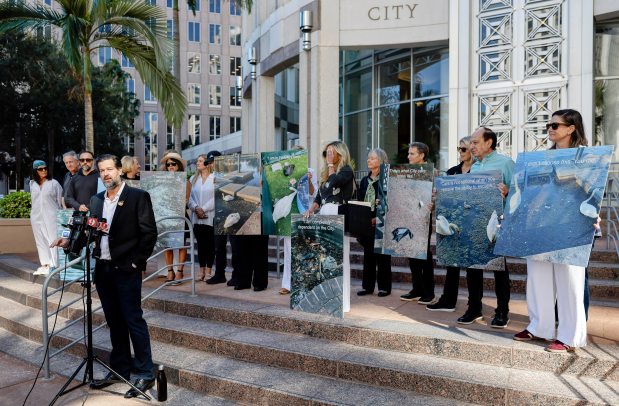 Andrew Marshall speaks during a press conference outside Orlando City Hall to call for changes to how the city cares for its iconic swans in Lake Eola Park, on Monday, January 26, 2026. (Ricardo Ramirez Buxeda/ Orlando Sentinel)
Most of the swans at the park are owned by the city, though a few wild birds have also moved in over the years.
Marshall said about 30 swans died at the lake last year from causes unrelated to the avian flu, and another 13 were unaccounted for at the annual swan round up – where the birds are vaccinated, have their wings clipped as required by Florida law and checked by veterinarians.
Rosina McVicker, who said she worked in animal rehabilitation for 20 years, said the conditions at the lake “were deplorable.”
“The mortality rates are also appalling,” she said. “Traditionally, captive wildlife live longer than those in the wild … to see the reverse happen here is distressing.”
City Commissioner Patty Sheehan, whose district includes the park, said the city intends to take input as it reviews the program.
“We at the City of Orlando parks department will take input and make necessary improvements to the program to benefit the swans at Lake Eola Park,” she said.